
The short answer
How did the 1893 Cheviot purchase mechanism differ from the later arrangements for subdividing and settling the estate?
Compare the documents
Authority, evidence and limits
These records describe different responsibilities; one should not silently substitute for another.
| Record | What it establishes | What it does not establish |
|---|---|---|
| 1893 Act, preamble | Records the tax-valuation dispute and April 1893 conveyance. | Does not make this a purchase under the later 1894 generalpower. |
| 1893 Act, disposition provisions | Separates classification, reserves and subdivision-related costs. | Acquisition alone does not establish a settler’s later terms. |
| 1894 tenure descriptions | Identifies different holdings and forms of occupation. | Selected records do not describe every settler or a uniform outcome. |
The preamble identifies a specific purchase mechanism
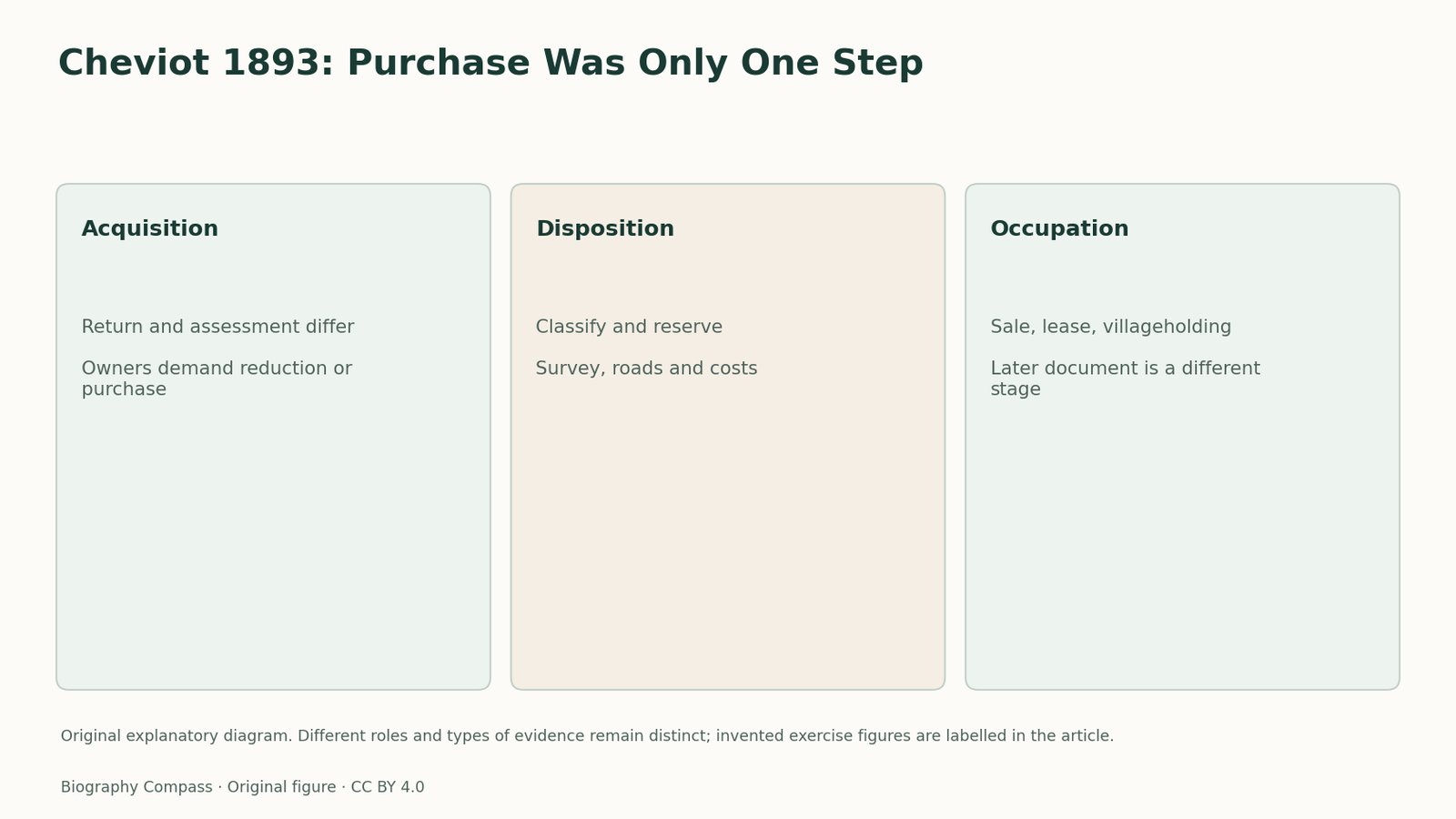
The Cheviot Estate Disposition Act’s preamble describes an estate returned at £260,220 and assessed at £304,826 under the earlier taxation framework. The owners demanded a reduced assessment or purchase; the preamble records the government’s decision and an April 1893 conveyance at the returned value. This is a specific sequence, not a licence to call every Liberal estate purchase an application of the later 1894 general compulsory-acquisition legislation. A date matters because it identifies the legal mechanism actually available. The purchase belonged to a valuation-and-purchase procedure already in existence, while the 1893 Act addressed what the government would do with the estate after acquiring it.
Sources for this section: [3]
Ownership did not automatically produce usable holdings
The Act provided for classifying and disposing of land, setting aside reserves and accounting for costs. Its cost provisions included more than the initial price: surveying, subdivision, roads and administration could affect the basis on which land was offered. As an interpretation of that structure, buying an estate is an acquisition decision; creating access, boundaries and tenures is a settlement programme. They can require different evidence and different dates. A purchase announcement alone does not show how much land became a road, which holdings were sold or leased, or whether a particular family could sustain the payments and work needed to farm it.
Sources for this section: [3]
Tenure records show different outcomes within one estate
Te Ara’s descriptions of 1894 Cheviot documents distinguish a large purchased holding, a 400-acre lease and a 10-acre village-settlement interest. The captions identify different forms and scales of occupation rather than one uniform treatment of all settlers. We inspected those written descriptions, not a newly measured map of every holding. They answer a narrower question than the Act: how particular arrangements were recorded after the legal framework existed. McKenzie’s larger land programme also operated within a colonial transfer of opportunity that disadvantaged Māori. The estate example should therefore be studied as a particular administrative process rather than used to declare that all land reform had the same beneficiaries or effects.
Document-order exercise and reference answer
Make four original cards: owner’s valuation return, purchase conveyance, subdivision-cost calculation and a named settler’s lease. Put them in a sequence that separates the basis for acquisition from the arrangements for occupation. Then ask whether an 1894 lease proves that the estate was acquired under the 1894 compulsory-purchase power. The answer is no. The Cheviot preamble records the 1893 acquisition under the earlier tax framework; a later tenure document concerns a later stage. To test a particular settler’s costs, the conveyance alone would also be insufficient: one would need the relevant offer, classification and tenure terms. The exercise uses invented cards rather than copied documents. It demonstrates how the actual Cheviot record connects several operations without collapsing them into a single legislative event.
Continue the chronology
Related history guides
Biography context
Explore New Zealand through connected lives
Connected biographies
People behind the collaboration
1839–1901
John McKenzie
Land minister and agricultural reformerJohn McKenzie helped shape New Zealand’s Liberal land programme, connecting estate purchases and leasehold settlement with a farming policy that also accelerated Māori land loss.Read biography1839–1893
John Ballance
Liberal premier and newspaper editorBallance moved from journalism into Liberal leadership, forming a government in 1891 and replacing property tax with a new land and income framework.Read biography1845–1906
Richard Seddon
PremierRichard Seddon consolidated Liberal government while combining social reform with an assertive imperial outlook.Read biography1857–1932
William Pember Reeves
Labour minister and diplomatReeves combined labour and education reform with diplomacy, helping create the 1894 arbitration system before representing New Zealand in London.Read biographyQuick answers
Common questions
- Was Cheviot bought under the 1894 Land for Settlements compulsory-purchase power?
- No. The 1893 Act’s preamble records its acquisition through the earlier tax-valuation mechanism. The later settlement records concern disposition and occupation.
Primary and institutional sources
How this history was checked
The bibliography distinguishes contemporary records, retrospective participant accounts and later institutional research. Access limits and uncertain attributions are identified in the article; the exercise is an original teaching example. This article was reviewed on 7 November 2026.