
The short answer
Which operations does a selected historical account describe, and where does a person still work within its apparently mechanical sequence?
The records answer different questions
Keep the measures separate
The question changes when the object, unit or reporting period changes.
| Record or measure | What it establishes | What it does not establish |
|---|---|---|
| Historical account | A mechanism and a walking raker | An eyewitness test of every later improvement. |
| Museum object | An exhibition model and contributor credit | A complete original construction record. |
| Our worksheet | A classification of the selected passage. | A universal priority verdict. |
Chronology
A timeline of the turning points
Early stage
Demonstration reported.
Object association
Exhibition model.
Retrospective account
Casson’s book published.
Read an account at its own date
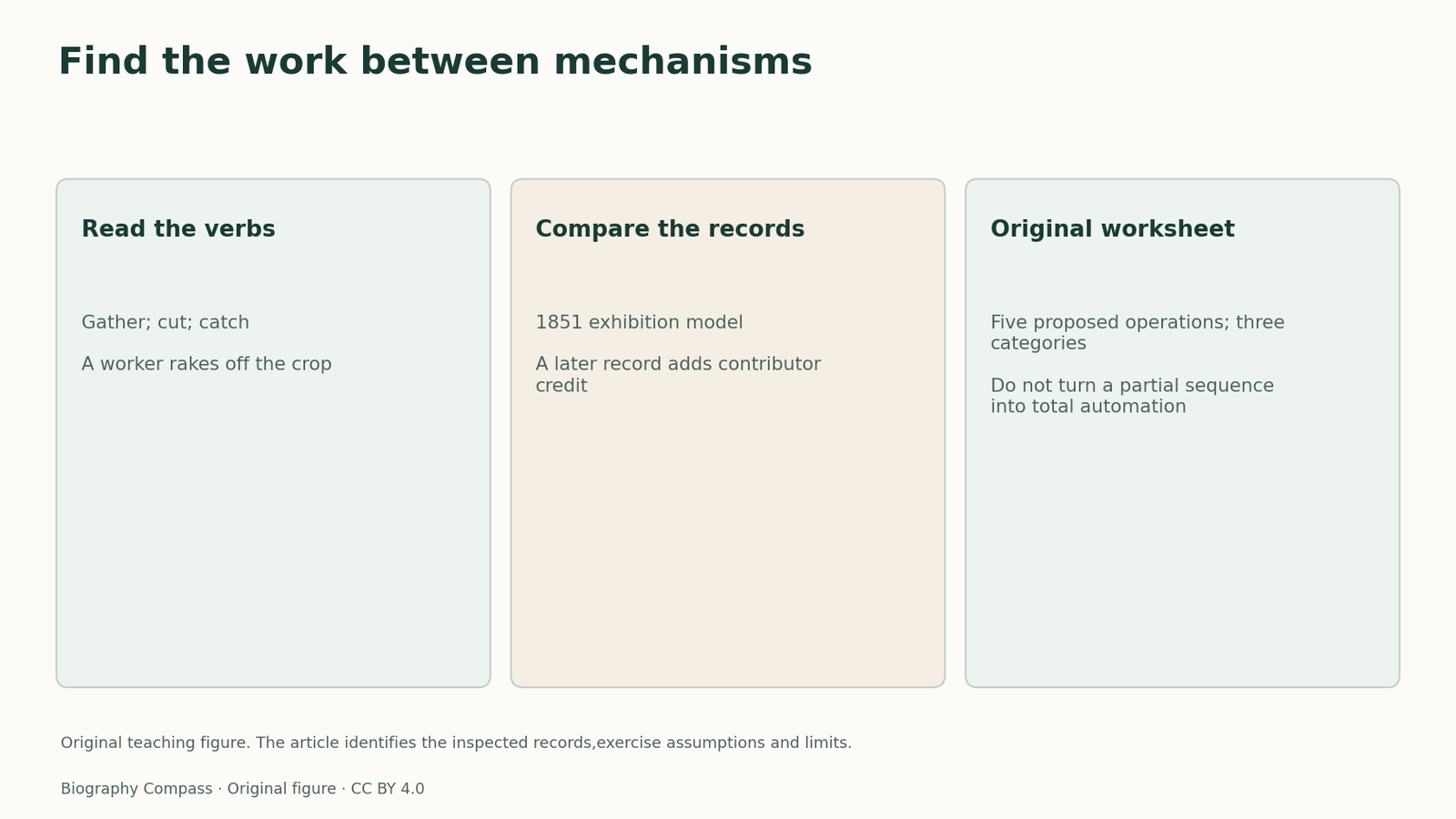
Casson’s 1909 biography describes the reel, moving blade, supporting fingers and a platform. A walking worker rakes the cut grain from the platform. His demonstration narrative names the raker as John Cash. This is a historical description, written long after the early machine, rather than a film of the original demonstration.
The useful move is to follow verbs rather than only nouns. A named mechanism may move or support the crop; a person may complete a transfer after it. Calling the whole thing a machine does not make every stage automatic. Nor does the presence of one worker mean that no task has been mechanised.
Sources for this section: [1]
Compare the later object record
The Smithsonian identifies its object as a model of the machine presented at the 1851 exhibition and credits assistance by Jo Anderson, enslaved by the family. This adds a contributor whom an inventor-centred reading can miss.
The museum’s broad description includes cutting, threshing and bundling; the selected older passage describes a narrower work sequence. Preserve that difference rather than silently turning the passage into evidence for a fully automatic combine. Casson also makes sweeping priority claims. His celebratory tone is part of the source, not a conclusion that this study independently proves.
Original task: annotate a work sequence
Write a five-row worksheet using these proposed operations: gathering, cutting, catching, moving the cut crop off the platform, and automatic grain separation. For each row, mark “described mechanism”, “described human work” or “not established by the selected passage”. Underline the verb or relation that makes the classification possible.
A second learner proposes this caption: “The record proves one inventor built an entirely automatic harvesting system.” Repair it in two sentences. One sentence should identify the work described; the other should preserve the contributor and evidence limits. Do not replace it with another unsupported first-ever claim.
Reference answer: automation has a boundary
The reel gathers, the blade cuts and the platform catches. A walking worker removes the cut grain. Automatic grain separation is not established by this selected passage. The last classification is a statement about evidence, not a claim that every later machine lacked that operation.
A defensible note says that this account combines mechanised cutting with manual transfer. It then states that the later object record credits an enslaved assistant and does not independently document every phase of the original construction. This preserves both the machine’s contribution and the unequal labour relationship.
As a final check, draw an arrow at the point where the crop changes from one task to another. If the arrow has no actor, return to the passage. This small exercise is useful for reading many industrial histories because it makes missing work visible without pretending that a diagram is a time-and-motion study.
Continue the chronology
Related history guides
Biography context
Explore United States through connected lives
Connected biographies
The connected careers
1809–1884
Cyrus Hall McCormick
Manufacturer and inventorMcCormick built a reaper-manufacturing enterprise.Read biographyQuick answers
Common questions
- Does a mechanised stage mean the whole workflow is automatic?
- No. The selected account still assigns crop transfer to a walking worker.
Primary and institutional sources
How this history was checked
Read these dated records together; the original task states its own assumptions and separates them from reported facts. This article was reviewed on 31 October 2026.