
The short answer
Mary Lavin’s story places a widow named Vera at a farm in County Meath. The opening moves from a house imagined as an island to the cost of managing grass. The distance between those subjects is part of the story’s method.
Evidence comparison
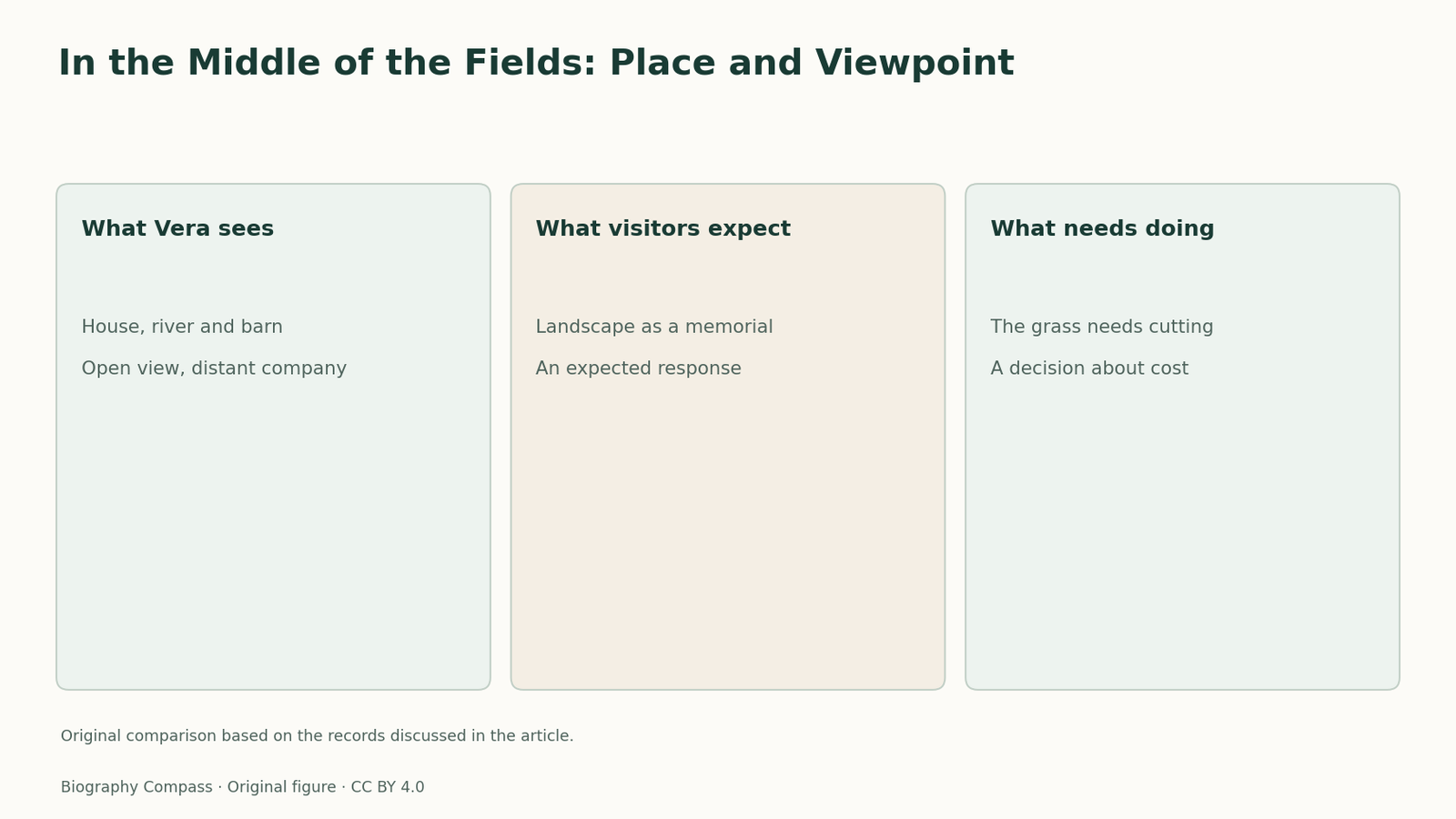
Three ways to see the same land
Compare physical detail, received memory and a decision about work.
| Detail | Function in the opening |
|---|---|
| House and surrounding grass | Turn an exposed place into an image of isolation. |
| Visitors looking across fields | Show the expectations others attach to the view. |
| Overgrown grass | Creates an immediate question about work and cost. |
Chronology
A timeline of the turning points
Magazine publication
The story appeared in the print issue dated 3 June.
Collection
A collection took the title In the Middle of the Fields.
A farm seen from a particular position
The opening image gives the house the isolation of an island, with grass and cattle described through the language of water. Vera can see another building across the river without seeing another home. The distinction matters because the view is physically open while human company feels distant. This is an example of setting doing the work of viewpoint. A map might record a house, field and river. It would not tell a reader why the visible barn fails to offer comfort. That judgement belongs to the way the story attends to Vera’s situation.
The visitors’ version of memory
Vera’s visitors speak as though they expect her to look for her husband in the landscape. The narration makes room for her resistance. She can momentarily be absorbed in what she sees, then be reminded of the obligation others assume she feels. Comparing these positions is a more useful reading than asking whether she remembers him enough. One group has a social script for condolence, and one person must continue living in the place the script describes. The friction becomes legible because the story moves close enough to her thought to register a reply she need not make aloud.
Sources for this section: [2]
An estimate interrupts a metaphor
The image of a sea returns when coarse grass makes the field look agitated. Vera then asks what it will cost to have it cut. The shift gives the opening a second line of action. This is land that must be managed, and decisions about a worker’s time or pay have consequences. There is no need to choose between a symbolic field and an actual field. The same sentence sequence can hold a visual likeness, a financial problem and an emotional rhythm. A reader who follows only the metaphor misses part of the widow’s authority over her own surroundings.
Reading an issue date against a book date
The magazine archive identifies its print issue and the biography identifies a later collection with the story’s title. A reading note should say which text it is using and what part of it has been examined. Here the opening establishes the practical question, so it is enough to explain how a story can change the emphasis of a remembered place in the span of a few paragraphs. The short story and the later book remain distinct objects. A date attached to the collection should not be used to describe when the story first met its magazine readers.
Follow the shifts of attention
A helpful annotation uses a different mark for objects Vera can point to, judgments she forms, and the sayings she attributes to visitors. The opening can shift among all three without a change of physical location. That is why a reading organised only by events can miss its movement. The setting is stable enough to compare while the significance of what she sees keeps changing.
Biography context
Explore Ireland through connected lives
Connected biographies
People connected to the work
1912–1996
Mary Lavin
Short-story writer and novelistMary Lavin used the short story to examine how people’s expectations and private perceptions shape everyday life. She grew up on both sides of the Atlantic and built her writing career in Ireland.Read biography1903–1966
Frank O’Connor
Writer and translatorAn Irish writer whose work invites close attention to the voice carrying a story.Read biographyQuick answers
Common questions
- Where is the story set?
- Its opening places Vera at her family’s farm in County Meath.
- Is 1967 the magazine publication date?
- The New Yorker identifies the print issue as 3 June 1961. The later collection is dated 1967.
Primary and institutional sources
How this history was checked
Dates, legal milestones and historical claims are checked against the official and institutional records below. This article was reviewed on 13 November 2026.