
The short answer
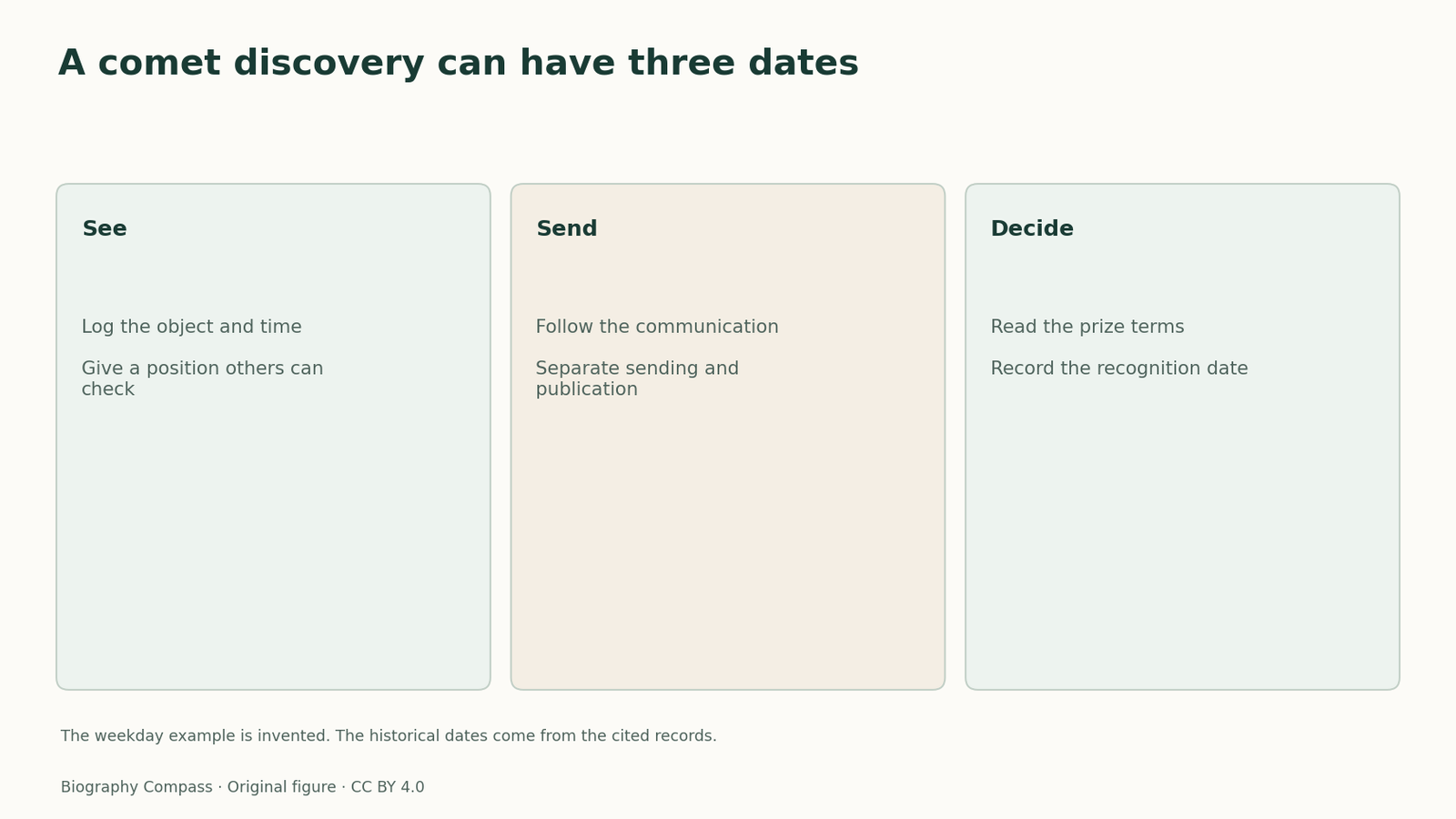
An astronomical discovery can carry several dates. A claim about when a comet was observed should not be dated by when the news reached another observer.
Reading the evidence
Three dates in a discovery record
The labels matter as much as the date values.
| Stage | Dated event | Question it answers |
|---|---|---|
| Observation | Time and position are recorded. | When and where was it seen? |
| Notice | A report is sent, received or printed. | When could others check it? |
| Award | An institution recognises a claim. | What decision was made under its rules? |
Chronology
A timeline of the turning points
Mitchell’s observation
Mitchell records a telescopic comet at Nantucket.
Publication
A notice recording her earlier observation appears in Astronomische Nachrichten.
Begin with an observing log
The report reproduced in the Mitchell family edition records Mitchell’s sighting on 1 October 1847, and a sighting by Francesco de Vico in Rome on 3 October. Each is an observing event. If two people claim the same object, an editor needs enough detail to decide whether they saw the same comet before comparing which observation was earlier.
The position relative to familiar stars and the recorded time give a later reader something to check. The editor’s account of the evening is a different record from the contemporary notice and correspondence included in the appendix.
Follow the notices and prize rules
Information passed from the Mitchells to the Bonds and was sent on for publication. The notice in Astronomische Nachrichten appeared in December. The prize rules printed alongside the letters placed emphasis on quick communication and required information about the time and position. The rules therefore add a question beyond who looked first. Did the news travel in a form the award process could act on?
The eventual medal is evidence of recognition. It is neither the first observation nor the day the observation entered print. Place it in a separate column.
Sources for this section: [1]
Order two invented messages
Suppose observer A records a new object on Monday and a notice arrives Friday. Observer B records the object on Tuesday and a notice arrives Wednesday. A made the earlier observation; B’s notice arrived first. Before awarding a prize, read what its rules actually require. Record which parts of the judgment could change if the observations described different objects or if one of the dates was uncertain.
Continue the chronology
Related history guides
Biography context
Explore United States through connected lives
Connected biographies
People in the records
1818–1889
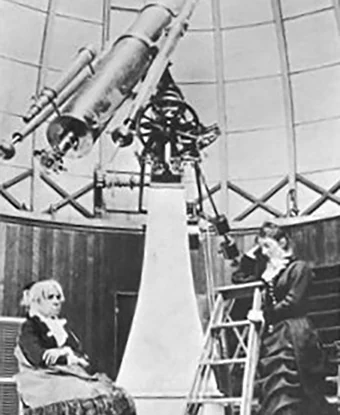
Maria Mitchell
Astronomer, teacher and Vassar observatory directorMitchell observed comets from Nantucket and later used Vassar’s observatory as a place for students to conduct research.Read biographyQuick answers
Common questions
- Does first publication always establish the earliest observation?
- No. Letters and notices can travel at different speeds. Compare the dated observing evidence separately.
Primary and institutional sources
How this history was checked
Dates, legal milestones and historical claims are checked against the official and institutional records below. This article was reviewed on 5 November 2026.