
The short answer
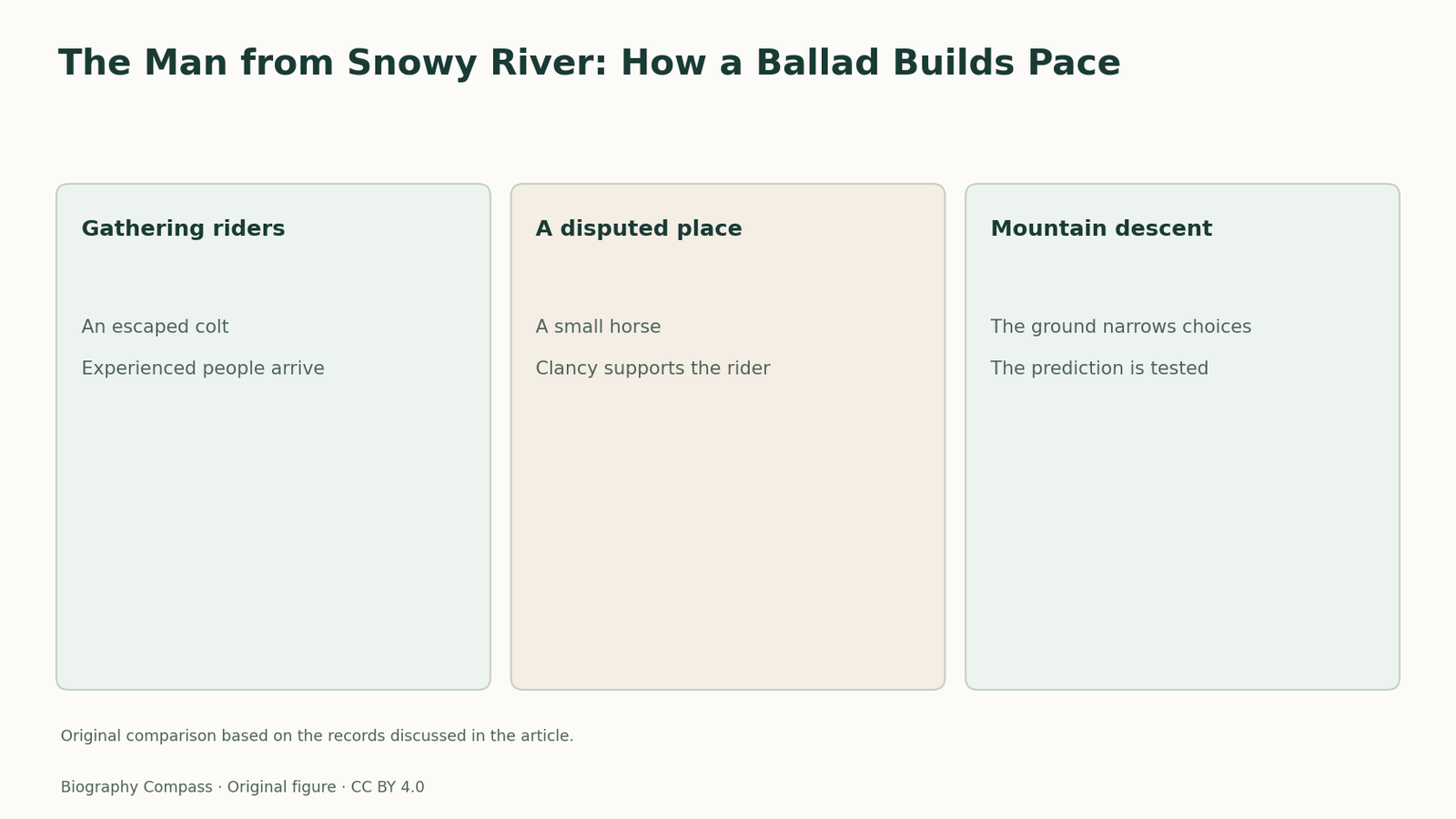
Paterson’s ballad announces a lost colt, gathers experienced riders and pauses over a young stranger’s chances. It quickens when the terrain changes. A reader can follow the speed of the story by comparing the amount of space devoted to a decision with the amount given to the movement that follows it.
Evidence comparison
What changes the speed?
Connect each stage of the ballad to what a reader already knows.
| Stage | Narrative job |
|---|---|
| Gathering | Establish the value of the colt and the reputation of the riders. |
| Debate | Make a prediction about the young rider’s chances. |
| Descent | Test earlier judgments through the choices terrain allows. |
The poem delays the chase
The opening identifies a colt that has escaped and gives the people gathering to recover it a reason to act. It then names accomplished riders and describes a young participant and his comparatively small horse. The sequence spends time on reputation before the chase has begun. That is an important part of its pace. A fast action scene becomes more legible if readers know whom others expect to succeed. The roll call gives later movement a social meaning because different riders begin with different claims to be taken seriously.
A disagreement gives movement a test
The horse’s size makes one observer doubt that the young rider can keep up. Clancy supports letting him join the chase. Those positions give a reader a prediction to test when the terrain becomes difficult. The poem could have started with an unsupported claim that a young rider was exceptional. It instead lets readers see that what counts as a promising horse and rider is open to disagreement. As the chase begins, each choice can be measured against both the physical setting and the judgement made before entering it.
Sources for this section: [2]
The descent changes the action
The mountain route creates a point at which an individual can take a different path from the rest. The resulting action reads quickly because the poem has already shown the group, the disputed rider and the kind of ground in question. A reader can mark where description is used to establish the problem and where verbs move the pursuit. This helps identify a form of narrative acceleration without needing to imitate a recitation. The change in pace comes in part from the reduction of choices that remain open once a rider commits to the slope.
Sources for this section: [2]
Identify the poem and the volume separately
The individual poem is associated with the Bulletin in 1890. The named book appeared in 1895 and presents it alongside other verse. That later context matters for a reader who encounters the title on a cover rather than above a single poem. A volume can repeat names and themes, giving the isolated action a wider setting. A reading note should specify whether it is making a claim about the ballad’s sequence, its first newspaper audience or its later place in a book. One title can point to either the poem or the larger publishing object.
Try a before-and-after pace chart
Mark each stanza as preparation, judgment, movement or consequence. Some will serve more than one purpose. Then move the argument about the young rider to the end in an imagined revision. The chase would remain physically possible, but its suspense would change. A reader who had no prediction to test could see that someone descended a mountain without knowing why the outcome unsettled the group’s earlier expectations.
Sources for this section: [2]
Biography context
Explore Australia through connected lives
Connected biographies
People connected to the work
1864–1941
Banjo Paterson
Poet, solicitor and journalistAndrew Barton Paterson combined legal and newspaper work with verse. The poems published as Banjo Paterson made terrain, speech and physical action part of their narrative method.Read biography1867–1922
Henry Lawson
Short-story writer and poetHenry Lawson wrote stories and poems for periodicals and books. His fiction made the details of housing, distance and work central to how readers encounter rural Australia.Read biographyQuick answers
Common questions
- What gets the riders moving?
- They gather after a valuable colt escapes and joins wild horses.
- Are 1890 and 1895 rival dates for the same edition?
- They refer to different events. The poem appeared in periodical form in 1890 and the named collection in 1895.
Primary and institutional sources
How this history was checked
Dates, legal milestones and historical claims are checked against the official and institutional records below. This article was reviewed on 13 November 2026.