
The short answer
How does a composed orchestral suite distinguish folk character from collected traditional tunes?
Read the evidence
Sources, interpretation and production roles
The records answer different questions about this work. The final exercise is an original teaching model.
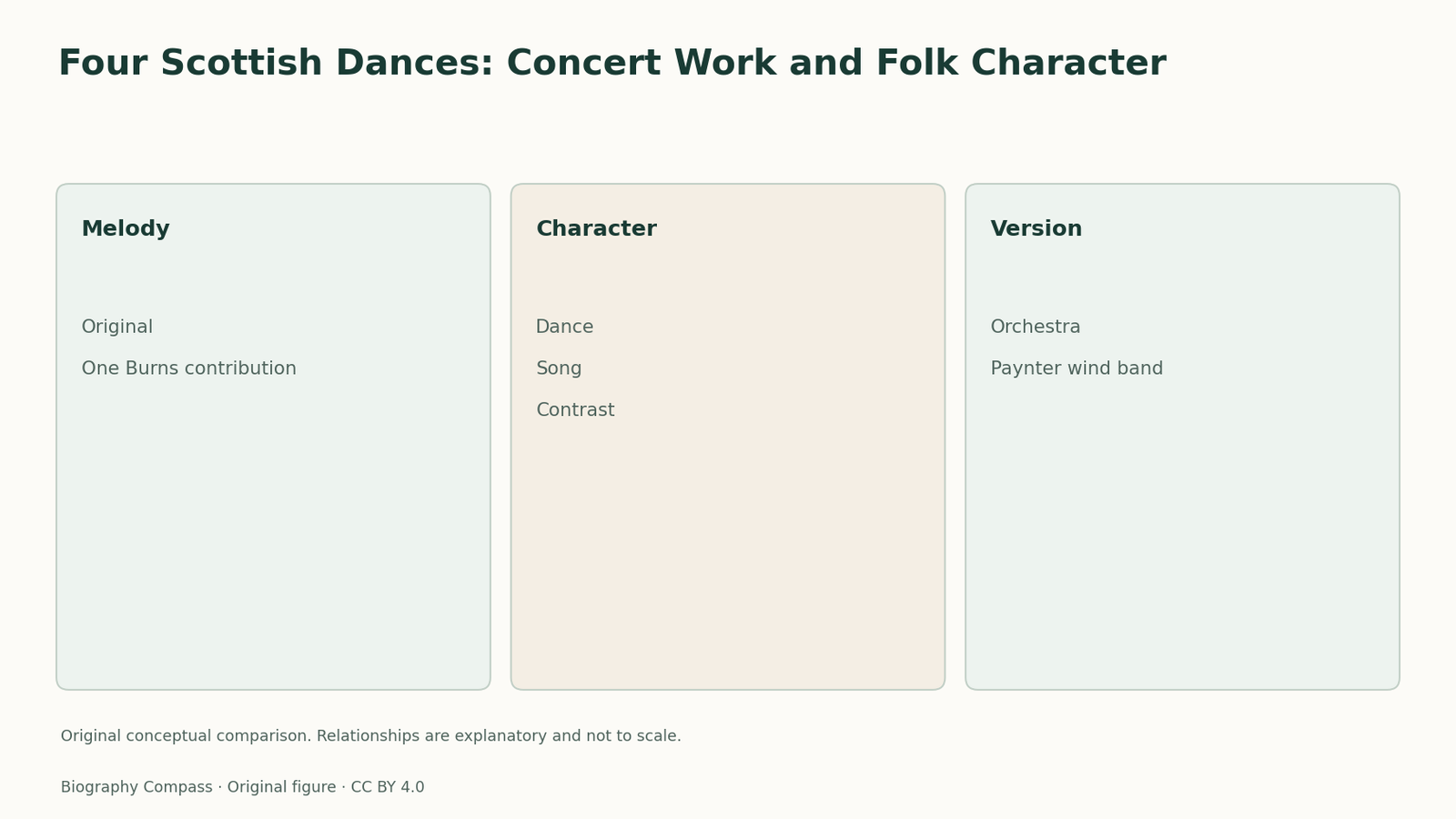
| Record or question | Supported reading | Boundary or contrast |
|---|---|---|
| Origin | Most melodies newly composed; one by Burns | Not all traditional material |
| Character | Dance and song types | Style does not prove collection |
| Version | Orchestra versus Paynter wind band | Different instrumental resources |
Four dances, not four anonymous folk quotations
Malcolm Arnold’s Four Scottish Dances, op.59, date from 1957. In his own programme note he identifies the melodies as original except for one composed by Robert Burns. That makes two shortcuts inaccurate: the set is neither entirely a collection of traditional tunes nor wholly without borrowed material. This guide asks how a newly composed concert work can evoke dance and regional character through its chosen forms. The composer’s own account distinguishes the source of a melody from the way a dance character can be composed around it. The distinction between melodic origin and stylistic character gives a concrete way into the piece.
Character can come from treatment as well as a tune
Arnold describes a slow strathspey, a lively reel, a movement in the character of a Hebridean song and a final fling. These are descriptions of character rather than evidence that every melody was collected from oral tradition. Our interpretation is that rhythm, pacing, instrumental colour and contrasts between movements can establish a recognizable world even when the composer supplies most of the tunes. The set can therefore be discussed as a designed sequence rather than a neutral archive. Moving from one kind of dance or song character to another changes the listener’s frame of reference, while the work remains an authored orchestral composition.
Sources for this section: [4]
The orchestra and the band are different realizations
The original catalogue identifies an orchestral work, while the publisher page inspected here presents John Paynter’s wind-band arrangement. Arnold’s accompanying original note refers to violin open strings in the final dance; that detail should not be read as the instrumentation of a wind band. Our analytical point is that arrangement preserves a work’s identity through changed resources, not by pretending those resources are unchanged. A melodic gesture may remain recognizable while its articulation, balance and colour require another solution. The arranger’s credit is consequently substantive. It names the person responsible for a new performing version rather than an invisible administrative change to the original title.
Exercise: separate origin, character and resources
Invent a short musical idea using a rhythm you associate with movement. Describe three independent decisions: whether the melody is new, what character it suggests and which instruments would play it. A possible answer uses an original tune in a dance-like rhythm, first for strings and then for a hypothetical wind ensemble. Explain why changing the ensemble does not automatically change the tune’s origin, and why a dance character does not prove a borrowed melody. Return to Arnold’s set and make two labels: original orchestral version and Paynter arrangement. The reference answer keeps Robert Burns’s contribution, Arnold’s composition and Paynter’s later arranging role distinct, giving the work a useful production history alongside its familiar title.
Continue the chronology
Related history guides
Biography context
Explore United Kingdom through connected lives
Connected biographies
People and related creative practices
1921–2006
Malcolm Arnold
Composer, conductor and orchestral trumpeterMalcolm Arnold brought an orchestral player’s practical knowledge into concert music, ballet and film, combining vivid instrumental writing with a wide expressive range.Read biography
1857–1934
Edward Elgar
Composer, conductor and recording artistEdward Elgar was an English composer whose orchestral and choral works grew from provincial musical work into an internationally recognised, intensely personal voice.Read biography1901–1956
Gerald Finzi
Composer, conductor and musical editorGerald Finzi combined composition with conducting, editing and practical support for other musicians, creating a body of vocal and instrumental music with a long performance life.Read biographyQuick answers
Common questions
- Is the opus number 59?
- Yes. The composer’s note and catalogue identify Four Scottish Dances as op.59.
- Are all its tunes traditional?
- No. Arnold says the melodies are original except for one composed by Robert Burns.
Primary and institutional sources
How this history was checked
The discussion uses Arnold’s published programme note and the specific original/arranged catalogue entries; no musical quotation, score analysis or complete listening review is presented. The reading exercises and comparisons are original analytical models. This article was reviewed on 8 November 2026.
- Faber MusicMalcolm Arnold
- Hannah Chan-Hartley / National Arts CentreMalcolm Arnold
- Malcolm Arnold SocietyAbout Malcolm Arnold
- Malcolm Arnold / Wise Music ClassicalFour Scottish Dances: composer’s programme note
- Malcolm Arnold Society / publishersMalcolm Arnold catalogue
- Birmingham Royal BalletMalcolm Arnold