
The short answer
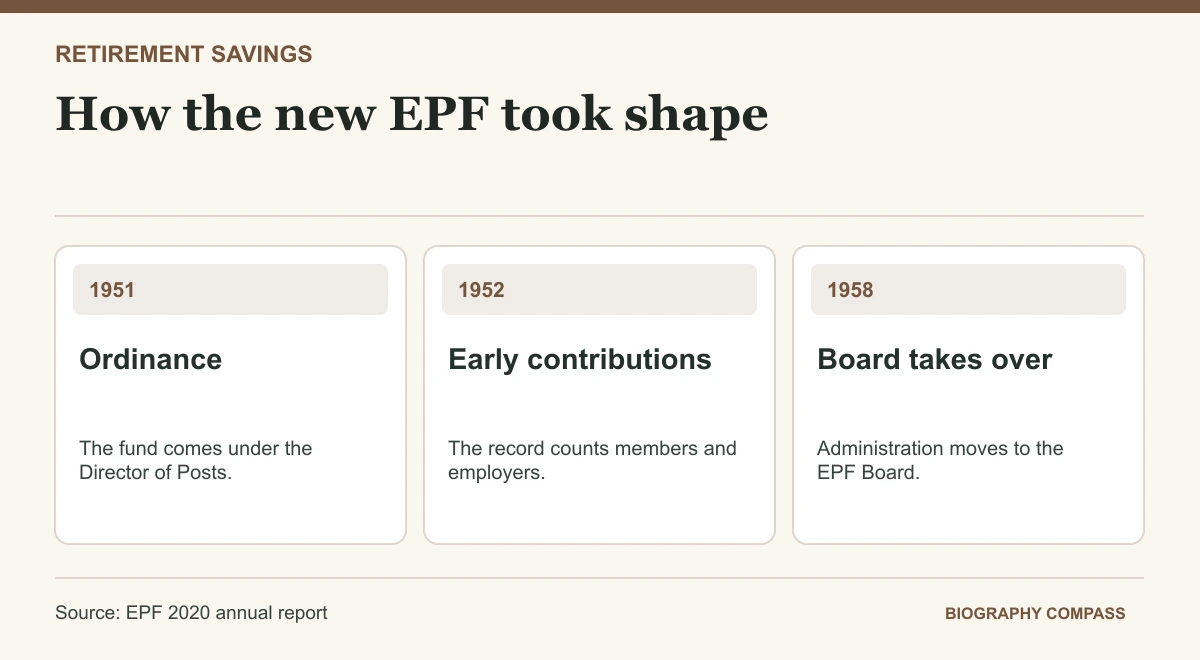
The Employees Provident Fund began under an ordinance in 1951, when it was placed under the National Director of Posts. Its first years show several layers of institution-building. Workers and employers had to contribute, the fund had to manage accumulated cash, and eventually a board took over its administration.
Reading the records
How an early provident fund works
The institutional history tracks who pays in, what the fund does with contributions and who manages it.
| Step | Evidence | Meaning |
|---|---|---|
| Collect | 1952 membership and employer figures | People and workplaces entered the arrangement. |
| Invest | 1956 securities milestone | Accumulated contributions were put to work. |
| Administer | 1958 transfer | The EPF Board became responsible for administration. |
Chronology
A timeline of the turning points
Legal basis
The EPF Ordinance established the fund under the National Director of Posts.
Contributions and membership
The retrospective records early contributions and registration.
First investments
The fund entered Federation, Singapore and municipal government securities.
Administrative transfer
The EPF Board took over from the National Director of Posts.
What a postal administrator did
The 2020 anniversary chronology places the new fund under the National Director of Posts. This is an administrative arrangement. It does not make an early member’s balance a Post Office Savings Bank deposit. The EPF was set up for employment-related savings, with a system built around contributions through employers and registration of members.
Read the early totals as different measures
The retrospective’s 1952 entry records 518,948 members and 11,918 registered employers, alongside RM2.6 million collected in contributions. Members measure reach among people. Employers show the number of workplaces registered, and the money figure records contributions. Dividing one number by another without the report’s period and definitions would not establish an individual worker’s balance.
Sources for this section: [1]
The body collecting contributions also needed investment and oversight
The chronology notes first short- and long-term investments in 1956. It then records the transfer of administration to the EPF Board in 1958. The modern EPF Act gives a separate legal reference for later rules. Using the founding evidence by date avoids projecting a modern administrative or investment framework onto a worker and employer in the early 1950s.
Continue the chronology
Related history guides
How PERKESO Began Insuring Malaysian Workers
Compare compulsory retirement savings with risk-based social protection.
Read the timeline1922–1948How Postal Workers Opened Malaya’s First Credit Co-operative
Compare a statutory retirement fund with a member-run savings and credit society.
Read the timelineConnected biographies
People in this history
Quick answers
Common questions
- Where was the EPF first administered?
- It was initially placed under the National Director of Posts.
- When did the EPF Board take over administration?
- The fund’s anniversary chronology gives 1958.
Primary and institutional sources
How this history was checked
Dates, legal milestones and historical claims are checked against the official and institutional records below. This article was reviewed on 19 November 2026.