
The short answer
A tribunal can believe that a witness was told something without finding that the event described actually occurred. The Mahon summary makes that distinction explicit in its treatment of reported payments and Ahern’s financial explanations.
Compare the records
What proposition does each statement address?
Keep the document, unit and inference limit attached to each entry.
| Record | Evidence or claim | Limit |
|---|---|---|
| Reported conversation | Gilmartin says O’Callaghan told him of payments | Accepted account does not itself prove receipt |
| Financial explanations | Important explanations rejected as untrue | Not equivalent to proving every alleged payment |
| Unidentified source | Inquiry could not identify true sources or determine the connection | Not a finding that all explanations were true |
| Dáil assessment | A named politician responds to the report | Not an additional criminal verdict |
Chronology
A timeline of the turning points
Final report
The Tribunal publishes findings and qualifications in its summary.
Dáil response
Selected parliamentary remarks illustrate a different institutional voice.
Two evidential links
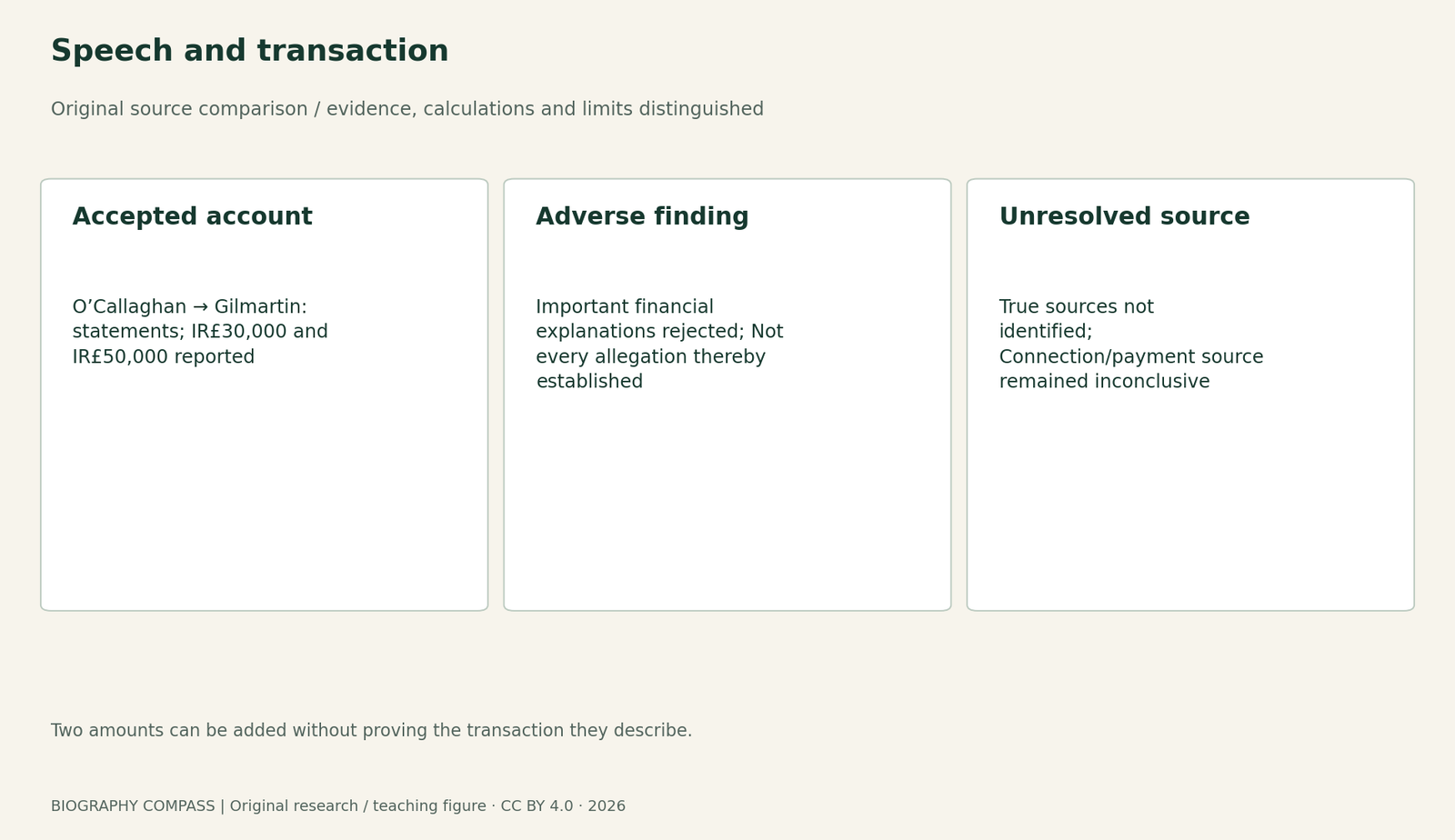
An accepted account of speech is kept separate from the underlying transaction.
Identify the exact portion of a very large report
This guide reads the Chapter 17 summary on printed pages 2480–2481 of the Mahon Tribunal’s final report, not the complete 3,270-page volume or every underlying hearing. The narrow question is what follows when an inquiry accepts testimony about a conversation. A biographical or political summary can become misleading if it removes the difference between what a witness directly experienced, what another person allegedly said and whether the underlying transaction was established. The source’s own qualifications are therefore central evidence, not optional cautionary decoration.
Sources for this section: [1]
There are two propositions in a reported payment
On page 2480 the Tribunal accepts Gilmartin’s evidence that O’Callaghan informed him of payments of IR£30,000 and IR£50,000 to Ahern. The same paragraph acknowledges that Gilmartin did not offer this as proof that the money had actually been paid or received. The accepted proposition concerns information communicated to a witness. The underlying payment is another proposition, needing evidence of its own. Writing that the Tribunal believed the witness therefore proved both payments would change the conclusion the report expressly preserved.
Sources for this section: [1]
An adverse credibility finding remains an adverse finding
Page 2481 states that important aspects of Ahern’s evidence were rejected and that much of his explanation of the source of substantial funds was considered untrue. That conclusion should not disappear simply because a further question remained unresolved. A defensible account can record a serious adverse finding about explanations without converting it into a finding that every allegation against the witness was established. Conversely, an inability to identify a source is not a declaration that every financial explanation was accepted.
Sources for this section: [1]
The inquiry states its unresolved causal question
The summary explains that the financial inquiry sought to identify sources of lodgements and movements through Ahern’s and associated accounts, and to establish or exclude a connection with O’Callaghan. It says the inquiries were inconclusive because the true sources had not been identified. It therefore could not determine whether the funds were made, initiated or arranged by O’Callaghan or other identifiable third parties. This is a stated limit on the inquiry’s conclusion. It should be reported alongside, rather than substituted for, the findings about untrue explanations.
Sources for this section: [1]
Parliamentary reaction has another speaker and purpose
The Dáil debated the report in March 2012. In selected remarks on 27 March, Eamon Gilmore condemned the conduct described while distinguishing criticism of politicians from an assertion that every politician was corrupt. Those remarks are evidence of a political response. They do not add a criminal verdict to the Tribunal’s summary or independently prove a particular payment. A source comparison should therefore label the inquiry’s finding, a witness’s account and a parliamentarian’s assessment as different voices rather than letting a forceful political speech silently expand the original conclusion.
Exercise: draw the two links
An invented editor’s note says: “Because the Tribunal accepted Gilmartin’s account of O’Callaghan’s statement, it proved Ahern received IR£80,000, convicted him of corruption and accepted all his financial explanations.” Draw two links: O’Callaghan speaking to Gilmartin, and money passing to Ahern. Label what the summary accepts and what it does not establish from that testimony. Then add the page 2481 findings about explanations and the unidentified source. Explain why adding 30,000 and 50,000 cannot repair a missing evidential link.
Sources for this section: [1]
Reference answer: preserve both the finding and the unknown
The summary accepts the account that the statements were made; it expressly separates that from proof that the money was paid or received. The numerical sum is IR£80,000, but arithmetic does not establish a transaction. The report rejects important financial explanations and records its inability to identify the true sources or determine the connection with O’Callaghan. It is an inquiry report, not a criminal conviction or an acquittal. A corrected note retains the adverse credibility findings and the unresolved source question together, without inventing a later prosecution or a comprehensive exoneration.
Sources for this section: [1]
Continue the chronology
Related history guides
Biography context
Explore Ireland through connected lives
Connected biographies
People connected with the records
1951–
Bertie Ahern
Fianna Fáil leader and Taoiseach, 1997–2008Bertie Ahern rose through Dublin politics, labour and finance ministries to lead Fianna Fáil and three governments. His public record includes the Northern Ireland peace process and adverse findings about his evidence to the Mahon Tribunal.Read biographyQuick answers
Common questions
- Does adding the reported amounts prove they were paid?
- No. The arithmetic answers a numerical question, not whether the underlying transaction occurred.
- Does inconclusive mean every explanation was accepted?
- No. The summary rejects important explanations while preserving an unresolved question about the funds’ sources.
Primary and institutional sources
How this history was checked
The sources have bounded reading scopes. Original exercises distinguish what a document establishes from what requires another record. This article was reviewed on 27 October 2026.