
The short answer
How did a utility-vehicle maker build a more ambitious SUV? Scorpio’s development connects senior leadership’s strategic support with engineers, suppliers and customers. The June 2002 launch was the outcome of that system, not an invention by one executive.
Chronology
A timeline of the turning points
R&D capability
Pawan Goenka joins Mahindra and helps build a product-development organisation.
Design direction
The Scorpio project develops through a brief, prototypes and customer feedback.
Launch
The SUV enters a market in which Mahindra seeks wider appeal beyond its utility heritage.
Operating consequences
Goenka moves into broader automotive leadership; later generations require further investment.
The commercial problem came before the engineering solution
Mahindra entered the 1990s with a long history in Jeeps, tractors and utility vehicles. Economic opening increased competitive pressure and the importance of customer expectations. Scorpio was intended to broaden the appeal of the automotive business beyond vehicles associated primarily with rugged work. The question was not simply whether Mahindra could manufacture another body on a familiar chassis.
Anand Mahindra supported the ambition to develop products and technological capability within the company. That strategic commitment created room for engineers and managers to work, but it did not supply a finished vehicle design. The project needed an appealing customer proposition, a realistic development budget and the ability to manufacture and service what it promised.
An engineering organisation had to be built and coordinated
Pawan Goenka joined Mahindra from General Motors in 1993 and helped strengthen product development. Contemporary accounts identify him with the Scorpio project, while also naming automotive head Alan Durante and other managers. The organisation learned through earlier products and prototypes rather than beginning in 2002 with an already complete set of processes and facilities.
Business Today’s 2002 account describes a development team divided into nineteen cross-functional groups. Engineers worked with manufacturing, purchasing and vendors so that decisions in one area could be tested against constraints elsewhere. This concurrent approach could reduce rework: a design that looks attractive still has to be built repeatedly, supplied reliably and sold at a price customers accept.
Customer feedback changed the brief
In a June 2002 interview Anand Mahindra described an initial larger people-carrier concept and market feedback obtained during development. The project’s direction evolved as the team considered what customers wanted. Research was therefore part of shaping the product, not merely a publicity exercise conducted after engineering had already fixed all the important choices.
The contemporary development account similarly stresses repeated customer input. That process connected appearance, performance and practicality with a broader market position. It did not guarantee that every buyer would like the vehicle, or establish that every subsequent sale resulted from a particular survey. Its significance is the deliberate attempt to make engineering choices responsive to a defined customer proposition.
In-house leadership included international contributions
Retrospective company descriptions celebrate Scorpio as an in-house development. The same history acknowledges assistance from firms including AVL in Austria and Hawtal Whiting in Britain. Contemporary reporting also describes work and components sourced through several countries, including powertrain and suspension contributions. These accounts support Indian project leadership without supporting an assertion that every part was designed and made internally.
The important capability was integration: specifying, evaluating and combining contributions into a vehicle Mahindra could produce and support. Outsourcing individual tasks differs from purchasing a complete vehicle and simply changing its badge. Conversely, managing an integrated programme does not erase suppliers’ intellectual and engineering work. Both the company’s internal development team and its external network belong in the account.
The launch joined cost, manufacturing and positioning
Scorpio launched in June 2002. Different retrospectives describe development costs around ₹550 crore, while contemporary reporting describes a roughly ₹600 crore project. The scopes and rounding are not reconciled in the reviewed material, so neither is treated as an exact audited universal total. Both accounts place cost discipline beside a substantial commitment for Mahindra.
Launch pricing, diesel performance, styling and marketing combined with production and distribution. These are complementary commercial tasks. A low development bill would not by itself ensure demand, while a successful launch would not remove later warranty, quality or investment obligations. Historical prices describe particular variants and conditions in 2002; they are not current vehicle quotations or evidence of present affordability.
The lasting change was a capability that needed renewal
Scorpio became commercially important to Mahindra and changed perceptions of its automotive ambitions. A 2003 succession report linked Goenka’s promotion to his development role, illustrating how a product programme could alter management responsibilities as well as sales. Later reporting emphasised that the original success would not sustain itself without new models, variants and continued investment.
The historical lesson is therefore broader than a launch celebration. A supported engineering organisation, customer research, supplier coordination and disciplined integration produced a vehicle with a distinct market position. Anand Mahindra supported the strategy; teams delivered the product. Subsequent market conditions and product generations remained separate challenges, so the 2002 achievement should neither be diminished nor treated as a permanent guarantee of competitiveness.
Continue the chronology
Related history guides
Connected biographies
Strategic support and collective engineering
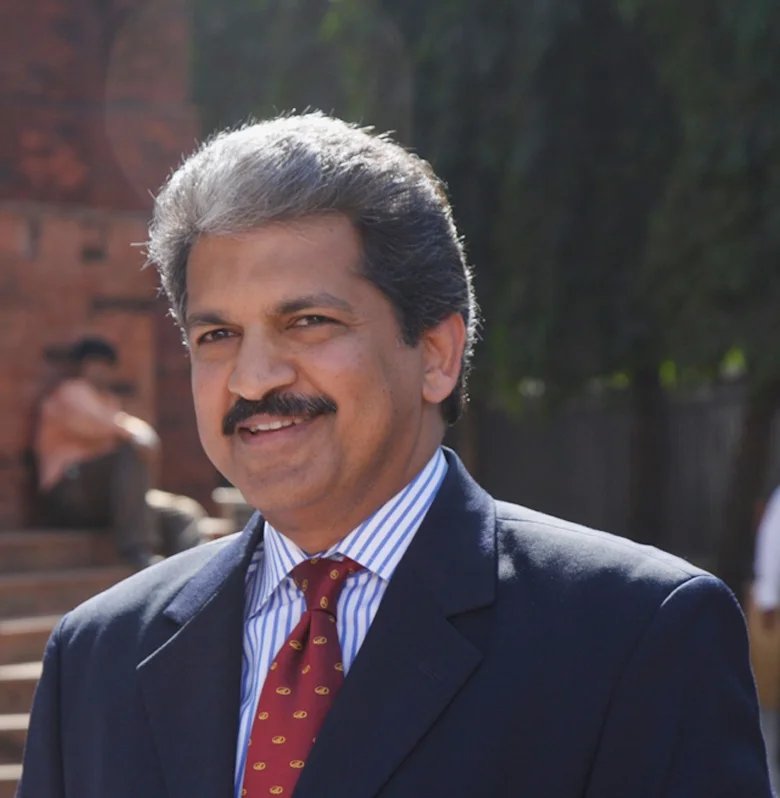
1955–present
Anand Mahindra
Mahindra business leader and non-executive chairmanAnand Mahindra is an Indian business leader who joined Mahindra Ugine Steel in 1981 and later led Mahindra & Mahindra. His career includes product-development investment, diversification, acquisitions, setbacks and a transition to non-executive chairmanship.Read biographyQuick answers
Common questions
- Did Anand Mahindra personally design Scorpio?
- No. He supported the strategy; engineering teams led by Pawan Goenka and many suppliers developed it.
- Was every component developed inside Mahindra?
- No. Internal project leadership included international specialist and supplier contributions.
- Why do development-cost figures differ?
- Reviewed sources use rounded figures and potentially different scopes. This article does not impose one exact total.
- Is the image a 2002 launch photograph?
- No. It is a complete 2007 portrait of Anand Mahindra, used as later context.
Primary and institutional sources
How this history was checked
Contemporary launch reporting is compared with later company recollections. Supplier credit, approximate cost scopes and the difference between launch and later generations are retained. This article was reviewed on 23 October 2026.
- MahindraCurrent Anand Mahindra leadership profile
- Mahindra & MahindraAnnual Report 2025–2026: actual November 2021 non-executive transition
- Mahindra & MahindraAnnual Report 2019–2020: education and early industrial assignments
- The Economic TimesAnand Gopal Mahindra: birth, nationality and career profile
- MahindraOur Story: JC Mahindra, KC Mahindra and Ghulam Mohammed, 1945
- MahindraFebruary 2020 postponement of planned executive-chair transition
- Mahindra / Pawan GoenkaScorpio development retrospective: design, suppliers and cost
- Business Today / Abir PalScorpio development: cross-functional teams and supplier contributions, September 2002
- The Times of India / Byas AnandAnand Mahindra interview at Scorpio launch, 22 June 2002
- Mahindra & MahindraSsangYong capital-allocation decision, 3 April 2020
- Reuters / Aditi ShahMahindra seeks to give up control of struggling SsangYong, 12 June 2020
- Naandi FoundationAnand Mahindra: board and education programmes
- Nikitamnm / Wikimedia CommonsAnand Mahindra: complete own-work photograph, 2007
- Creative CommonsAttribution-ShareAlike 3.0 Unported licence
- ETAutoPawan Goenka and Scorpio’s development choices, 2025
- Business Standard / RediffM&M firms up succession plan, 9 April 2003
- Business StandardScorpio to shift gears: continuing investment, 13 June 2012