
The short answer
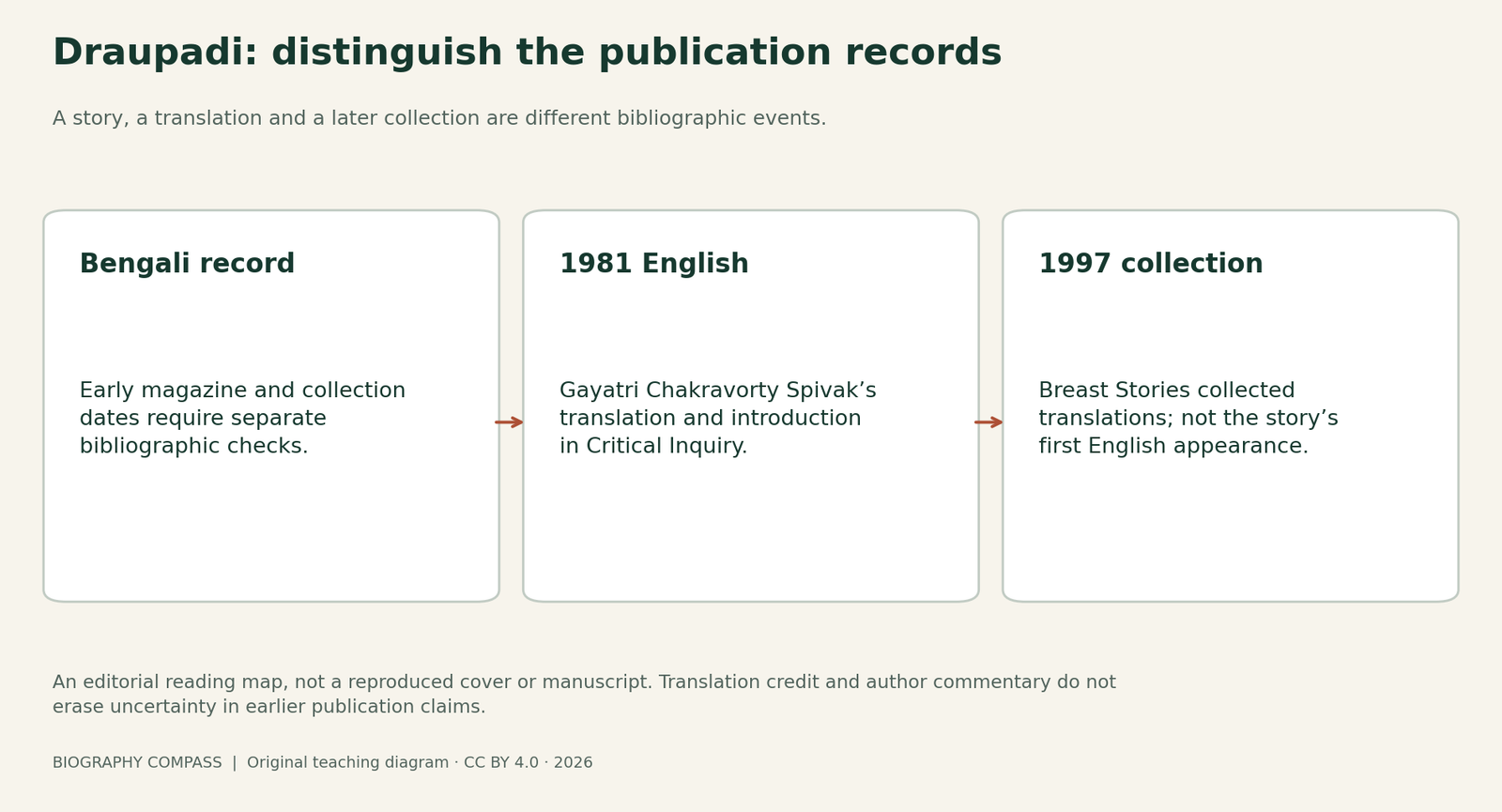
The 1981 publication contains a Bengali writer’s story, an English translation and a translator’s critical foreword. Reading those layers separately makes authorship, interpretation and historical context easier to assess.
Original attribution exercise
Which voice is making the claim?
A title shared across a story, translation and foreword does not make every sentence the same kind of evidence.
| Country | What to attribute | How to check |
|---|---|---|
| Devi’s story | Fictional narration and characters in the specified edition. | Read the story passage and retain the translator credit. |
| Spivak’s foreword | The translator’s critical framing and interpretation. | Identify the foreword heading and cite its page. |
| Publisher synopsis | A short promotional description of the work. | Use it for scope, not a claimed full close reading. |
| 2003 interview | Devi’s spoken account in a documented conversation. | Distinguish interview date, editorial notes and quoted reading. |
Chronology
A timeline of the turning points
Bengali collection context
Bibliographies identify Agnigarbha; an earlier periodical appearance is reported but not independently verified here.
English journal publication
Critical Inquiry publishes the story translated with a foreword by Spivak.
Collected in Breast Stories
Seagull publishes the collection with Spivak’s translation and critical material.
Author interview
Devi discusses writing and reads a selection for SPARROW’s Global Feminisms interview.
The credit line resolves a misleading catalogue shortcut
The publisher’s authorised first-page sample says Draupadi is by Mahasveta Devi and is translated with a foreword by Gayatri Chakravorty Spivak. Mahasveta is a spelling variant of Mahasweta, not a second author. The current journal metadata foregrounds Spivak, which can cause a citation exported without inspection to obscure the original writer. The correct reading preserves three roles: Devi wrote the Bengali story; Spivak produced the English translation; Spivak wrote the foreword. Translating and framing a story are intellectual contributions, but neither transfers its original authorship.
Sources for this section: [1]
Treat each publication as a separate bibliographic event
Critical Inquiry identifies volume 8, number 2, Winter 1981, pages 381–402, in the issue Writing and Sexual Difference. Breast Stories is a later Seagull collection, dated 1997, whose table of contents separately lists Spivak’s foreword and Draupadi. These dates are not competing answers to one question. The Bengali collection Agnigarbha is documented in later bibliographies as 1978, while a 2019 scholarly article reports an earlier 1977 Parichay appearance. The original periodical issue and first collection’s title page were not inspected here, so this guide does not label 1978 the verified first appearance of the story.
The foreword supplies a critical argument, not just plot assistance
On page 381, Spivak begins with Senanayak, the military officer, and draws a qualified analogy between his interpretive knowledge and the position of a privileged scholar studying others. She distinguishes the capacity to identify with an enemy in theory from action within an exploitative system. The source is evidence of Spivak’s argument and her chosen point of entry into Devi’s story. It should not be attributed automatically to the fictional narrator, to Devi in an interview or to every reader’s final interpretation. A foreword can direct attention powerfully while remaining a particular critical reading.
Sources for this section: [1]
Keep the fictional character in her social setting
Seagull’s synopsis identifies Dopdi Mejhen as a tribal revolutionary who suffers sexual violence in custody and turns the evidence of that violence into resistance. This is a brief account of the story’s situation, not a documentary identification of a real victim. The wording also prevents reducing Dopdi to a timeless symbol of womanhood detached from coercive institutions and community. Devi’s wider advocacy concerned dispossession, labour and the loss of control over forests and land. That public record helps explain a field of concern, but cannot prove that every event or character in the fiction is a literal representation of it.
Listen to the author without making her interview settle every reading
In the archived interview conducted by Anjum Katyal on 23–25 March 2003, Devi discusses stories arising from long reflection and then taking form rapidly. Asked about feminism, she emphasises writing about society and women who are usually overlooked, and questions whether public discussion reaches people needing help. This is her account of practice and commitment at that interview. It does not prohibit feminist interpretation, nor does a critic’s label establish her personal allegiance to a complete theoretical system. The date printed on the transcript should control citation; a later upload date is not when the conversation occurred.
Sources for this section: [4]
Read a selected ending as a selection
The authorised interview transcript includes Devi reading an extract from Draupadi in Bengali, accompanied by English text. It presents Dopdi’s refusal to accept clothing after custodial violence and the officer’s fear before an unarmed woman. A cautious interpretation can ask how shame, control and vulnerability change in that confrontation. It should not convert defiance into a claim that the harm is undone, that state power has disappeared or that every survivor must respond similarly. This guide inspected the publisher’s first page and the archived interview selection, not an entire copy of Breast Stories or the whole journal story.
Worked exercise: repair a citation and an attribution
An invented reading note says: “Spivak wrote Draupadi in 1997; its narrator compares academic research with military power.” Identify two source confusions and rewrite the note so another reader could verify it.
Suggested answer: “Mahasweta Devi wrote the Bengali story. Spivak translated it into English and supplied the foreword published in Critical Inquiry in 1981; the work later appeared in Breast Stories in 1997. The scholarly analogy belongs to the inspected opening of Spivak’s foreword.” A full citation should name the edition and page used. If the note concerns the story’s narration, the researcher must inspect and cite that passage separately. The exercise corrects roles and sources without supplying a substitute for reading the full work.
Connected biographies
People behind the sources
1926–2016
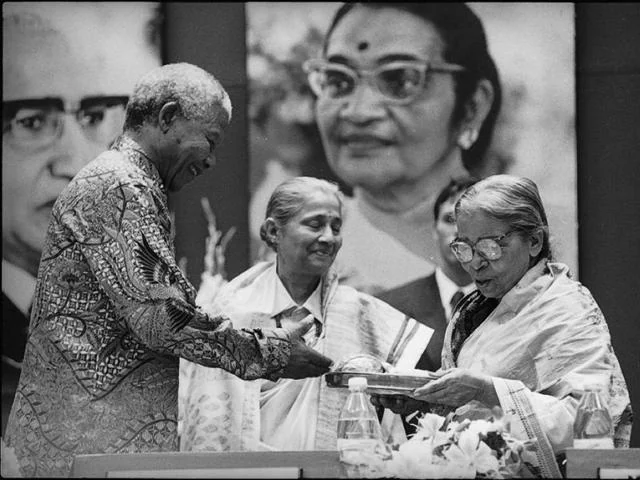
Mahasweta Devi
Bengali writer, teacher, editor and social activistMahasweta Devi combined Bengali fiction and historical research with journalism, editing and sustained advocacy. Her work examined how land, labour, caste, gender and state power shaped the lives of people pushed outside comfortable national narratives.Read biographyQuick answers
Common questions
- Who wrote Draupadi?
- Mahasweta Devi wrote the Bengali story. Gayatri Chakravorty Spivak translated it into English and wrote the critical foreword.
- Why do 1981 and 1997 both appear?
- 1981 identifies the Critical Inquiry publication of translation and foreword; 1997 identifies Seagull’s Breast Stories collection.
- Was the complete collection read for this guide?
- No. The authorised publisher first-page sample, publisher contents and synopsis, and an archived author-interview selection were inspected. The access limit is explicit.
Primary and institutional sources
How this history was checked
The source notes distinguish originals and samples actually inspected from bibliographic records. Teaching exercises are original examples, with no new experimental findings implied. This article was reviewed on 27 October 2026.
- Critical Inquiry, University of Chicago PressDraupadi by Mahasveta Devi, translated with a foreword by Gayatri Chakravorty Spivak (1981), DOI 10.1086/448160
- Seagull BooksBreast Stories: publication details and synopsis
- University of Chicago Press, distributing Seagull BooksBreast Stories: author/translator credits and table of contents
- SPARROW / Global Feminisms, University of MichiganMahasweta Devi interview, Anjum Katyal, 23–25 March 2003
- University of California, Irvine LibrariesGayatri Chakravorty Spivak bibliography: 1981 translation and foreword
- University of Warwick doctoral thesis repositoryBengali Agnigarbha bibliography (1978)
- Department of English, Sukumar Sengupta MahavidyalayaMiddle Flight 8.1 (2019), article discussion on printed page 103
- Ramon Magsaysay Award FoundationMahasweta Devi: 1997 award citation and acceptance response