
The short answer
Knowing a destination need not mean writing the journey in order. MacLeod’s account of a draft gives us a precise occasion to separate the order of making from the order in which a reader encounters the result.
Selected passages and original choices
Make the change visible
The historical example and the new writing plan have different jobs.
| Choice | Composition plan | Reader’s possible sequence |
|---|---|---|
| Midpoint | A destination can be drafted now. | The ending need not appear here. |
| Return | Complete and revise earlier material. | Preparations must work on a first reading. |
| Alternative | Changing the ending changes the route. | Clues should permit more than hindsight. |
Chronology
A timeline of the turning points
Interview publication
A working method described to Kruk.
Separate publishing record
No Great Mischief appeared.
A reported working method
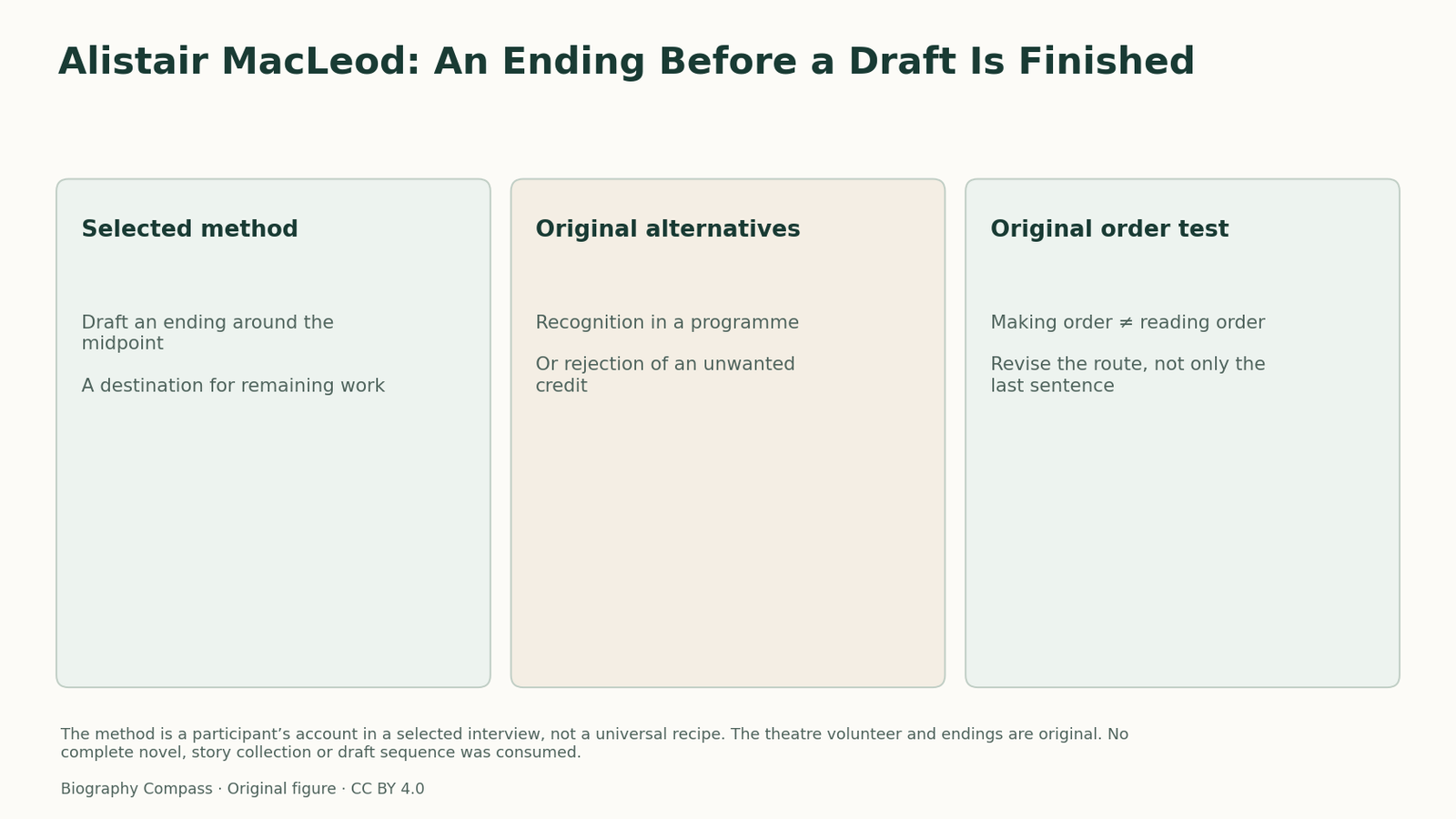
MacLeod tells Kruk that he often writes a concluding paragraph or line when about halfway through a story. It supplies a destination for what remains to be written.
The statement concerns composition. It does not mean that a reader should encounter the ending halfway through the finished work. Nor does a destination determine every route: revision can change the significance of what looked like a necessary earlier event.
A different kind of pressure
The later publishing history of No Great Mischief includes Douglas Gibson’s repeated encouragement to finish a long-running manuscript.
A self-chosen ending and an external request for completion are different pressures. One gives a narrative direction; the other asks for deliverable work. The records do not show that one explains every delay or that the 1999 novel followed exactly the method described for stories.
Original task: prepare either ending
Invent an unfinished story about a volunteer who writes programmes for a neighbourhood theatre but is never named in them. At the midpoint, draft this ending: “For the first time, the announcement used her name.” List three earlier details that could prepare it without making the final announcement a foregone conclusion. Then replace the destination with “She tore her name out of the programme.” Which preparations now need to change? These sentences and events are ours.
Reference route to the first ending: show her quietly correcting a list; let another volunteer notice the correction; establish that acknowledgments can be amended before the performance. None guarantees public recognition. For the second ending, retain the list but add an unwanted public credit or disagreement about the work. The same printed name can then become something she rejects rather than desires.
Reference answer: distinguish two sequences
One composition plan is: draft a beginning and part of the middle; write the destination; return to complete and revise the middle. The reader may still receive beginning, middle and ending in that order. The two orderings answer different questions.
Do not add a prophecy that announces the exact final action. Test whether each preparatory detail also makes sense before the ending is known. If every detail only points mechanically to the last sentence, revise for competing possibilities. This is an original planning exercise, not an account of an uninspected MacLeod manuscript.
Continue the chronology
Related history guides
Biography context
Explore Canada through connected lives
Connected biographies
The wider writing life
1936–2014
Alistair MacLeod
Writer and teacherA teacher who returned to Cape Breton to write.Read biographyQuick answers
Common questions
- Does this show how No Great Mischief was drafted?
- No. The exercise uses an attributed story-writing method and original invented material, not the novel’s uninspected drafts.
Primary and institutional sources
How this history was checked
The selected passages below ground this study. The exercises and reference responses are original. This article was reviewed on 31 October 2026.