
The short answer
What can a reader learn from Note G without pretending that its unbuilt engine produced an execution log? Follow the stated inputs and reused results, distinguish cards from storage, and test the limits of the familiar first-programmer claim.
Original source comparison
What does each record allow us to say?
The records concern publication, design, learning and later interpretation, rather than a completed nineteenth-century computer run.
| Country | What the evidence supports | What it does not establish |
|---|---|---|
| 1843 Note G | Specifies dependencies and a proposed sequence of operations. | An execution log from the complete Analytical Engine. |
| Inputs listed for n=4 | Six stated numerical data, including three earlier Bernoulli values. | Total storage columns or total operation cards. |
| Mathematical correspondence project | Documents an education through surviving study materials. | That every letter has been independently inspected for this guide. |
| Turing’s 1950 discussion | Shows a later response to an argument associated with Lovelace. | The original 1843 wording, a personal meeting or a modern AI performance result. |
Chronology
A timeline of the turning points
French account
Menabrea’s earlier memoir supplied the text later translated.
English publication
Lovelace’s translation appeared with Notes A–G.
Worked stage
Note G specifies six numerical data for its B7 example.
Later interpretation
Turing discussed a Lovelace argument in a different technological setting.
Keep the memoir and the notes in view
The 1843 English publication combines Lovelace’s translation of Luigi Menabrea’s earlier French memoir with her own Notes A–G. Babbage’s Analytical Engine is the design being explained. Menabrea, Babbage and Lovelace therefore have connected but different roles. The York University transcription identifies the English publication as Scientific Memoirs, volume 3, pages 666–731. It also marks editorial adjustments to some mathematical typography. This guide uses selected passages of that transcription; it does not claim that every displayed symbol has been checked against a first-edition page or that every surviving letter between the collaborators has been read.
Operation and variable selection are distinct
The notes separate what arithmetic operation should happen from which stored quantities should take part. In a familiar modern expression, writing divide is insufficient: the reader also needs the numerator, denominator and destination of the result. Lovelace’s account distinguishes operation cards and variable cards rather than using a single undifferentiated idea of a card. That separation helps explain how the same underlying arithmetic resources might be used for many calculations. It also makes operation order important. Describing the design as merely a collection of numbers misses the instructions and organised storage relationships that give those numbers a computational role.
Sources for this section: [1]
Note G presents one stage within a longer calculation
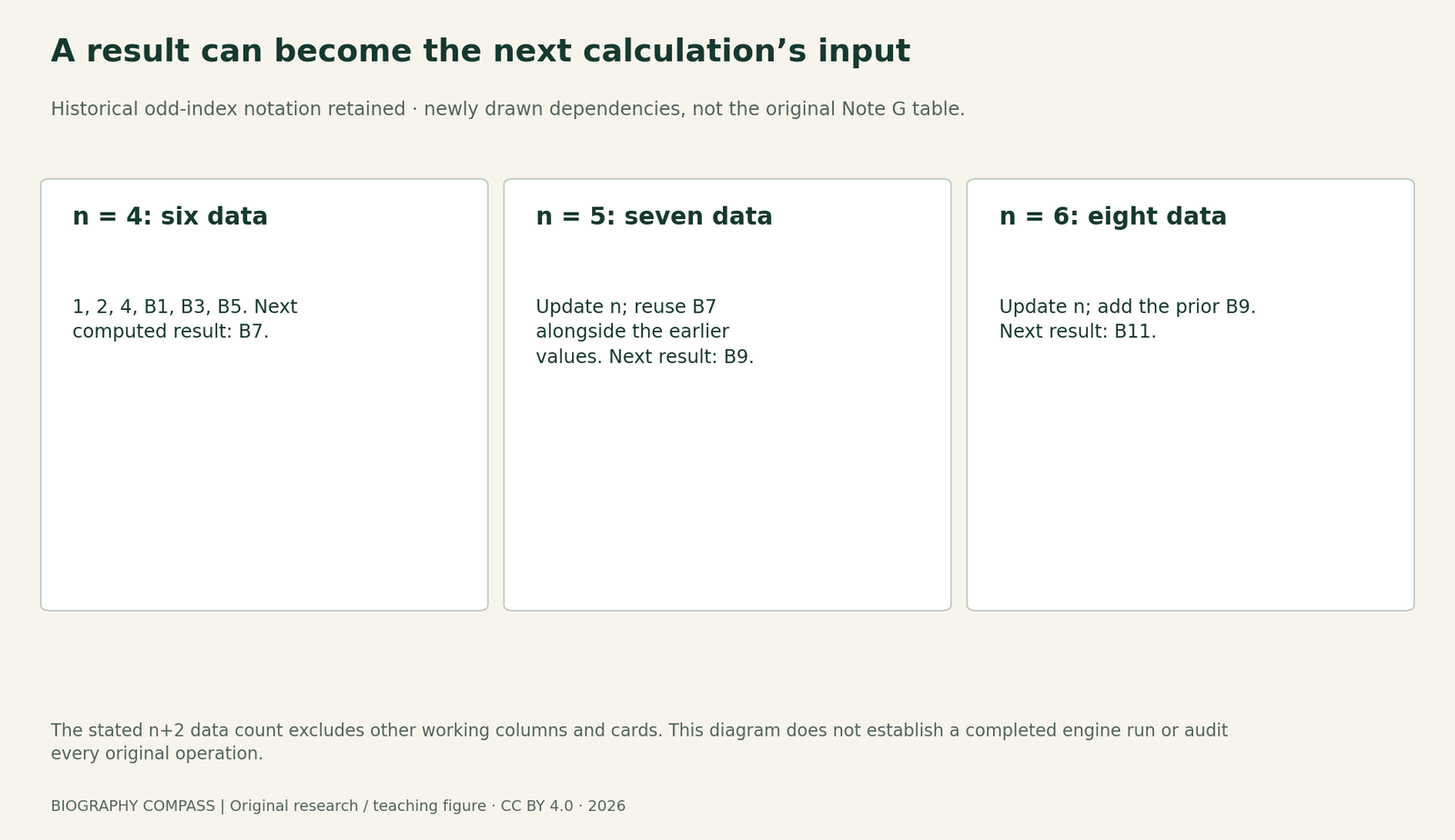
Lovelace singles out the computation called B7 in the note’s historical notation, with earlier values B1, B3 and B5 already available. Her example takes n=4. The stated numerical data are 1, 2, n and those three earlier Bernoulli values: six items, matching n+2. They are not the whole storage capacity of the proposed engine. Working quantities and destinations appear elsewhere in the procedure. Nor should the odd historical subscripts be silently replaced with modern Bernoulli numbering. A reader can follow the dependence on previously obtained values without assuming that the notation is identical across every later textbook.
Sources for this section: [1]
A result may later become an input
The note explicitly explains why earlier Bernoulli values appear on result columns even though they now function as data. In the continuing calculation, the engine would first obtain one value and then use it when finding a later one. A storage location therefore need not have the same conceptual role throughout a whole computation. This is a small but powerful reading point: labels such as input and result describe relationships within a particular step. The original teaching diagram here represents that dependency. It is a newly drawn explanation, not a reproduction of the historic table or a simulation proving that every printed operation is correct.
Sources for this section: [1]
Try an input-count and order exercise
Use only the rule stated in the note. When n=4, list the six data items. For n=5, assume the next previously calculated Bernoulli value is available: how many items are now needed, and which item is added? Repeat the count for n=6. Does an input count of eight mean that the whole machine uses only eight storage columns? For a separate, invented arithmetic illustration, take a=8 and b=2. Compare a/b with b/a, and a−b with b−a. Explain why specifying the operation without the order of its operands does not determine the intended result.
Sources for this section: [1]
Reference answer: count inputs without counting the whole engine
The n=4 data are 1, 2, 4, B1, B3 and B5. For n=5 the rule gives seven items and adds the prior B7, while changing the value of n to five. For n=6 there are eight items, adding the prior B9 and again updating n. These counts do not include every working column, card or later result, so they do not establish total hardware requirements. In the separate example, 8/2=4 whereas 2/8=0.25; 8−2=6 whereas 2−8=−6. This checks a general issue of operand order. It neither identifies nor repairs a particular disputed line in the original Bernoulli table.
Sources for this section: [1]
The notes state possibilities with conditions
Note A considers operating on things other than number when their underlying relations can be expressed in a suitable symbolic form. Music is an illustration of a possibility, not an archived output from a working music-generating engine. Note G also warns against exaggerated expectations and ties the engine’s powers to what people know how to instruct it to perform. The two passages belong together: a broad account of possible symbolic applications is accompanied by an account of limits. Later readers may debate machine creativity, but the nineteenth-century text should not be converted into a prediction of every present-day artificial-intelligence system.
Sources for this section: [1]
A historical first needs a specified comparison
The Computer History Museum describes the published stepwise explanation and records debate about the close collaboration with Babbage. Oxford’s mathematical-history project examines Lovelace’s education through surviving papers, moving beyond either unqualified celebration or dismissal. Neither approach requires a claim that she ran the first program on an actual completed engine. Turing’s 1950 essay later discussed a Lovelace objection about originality; that is evidence of a later interpretation, not a substitute for the 1843 wording. Read the memoir, notes, design history and manuscript scholarship as different kinds of evidence. A clear comparison is more informative than an undefined race for a single title.
Continue the chronology
Related history guides
Connected biographies
People behind the work
1815–1852
Ada Lovelace
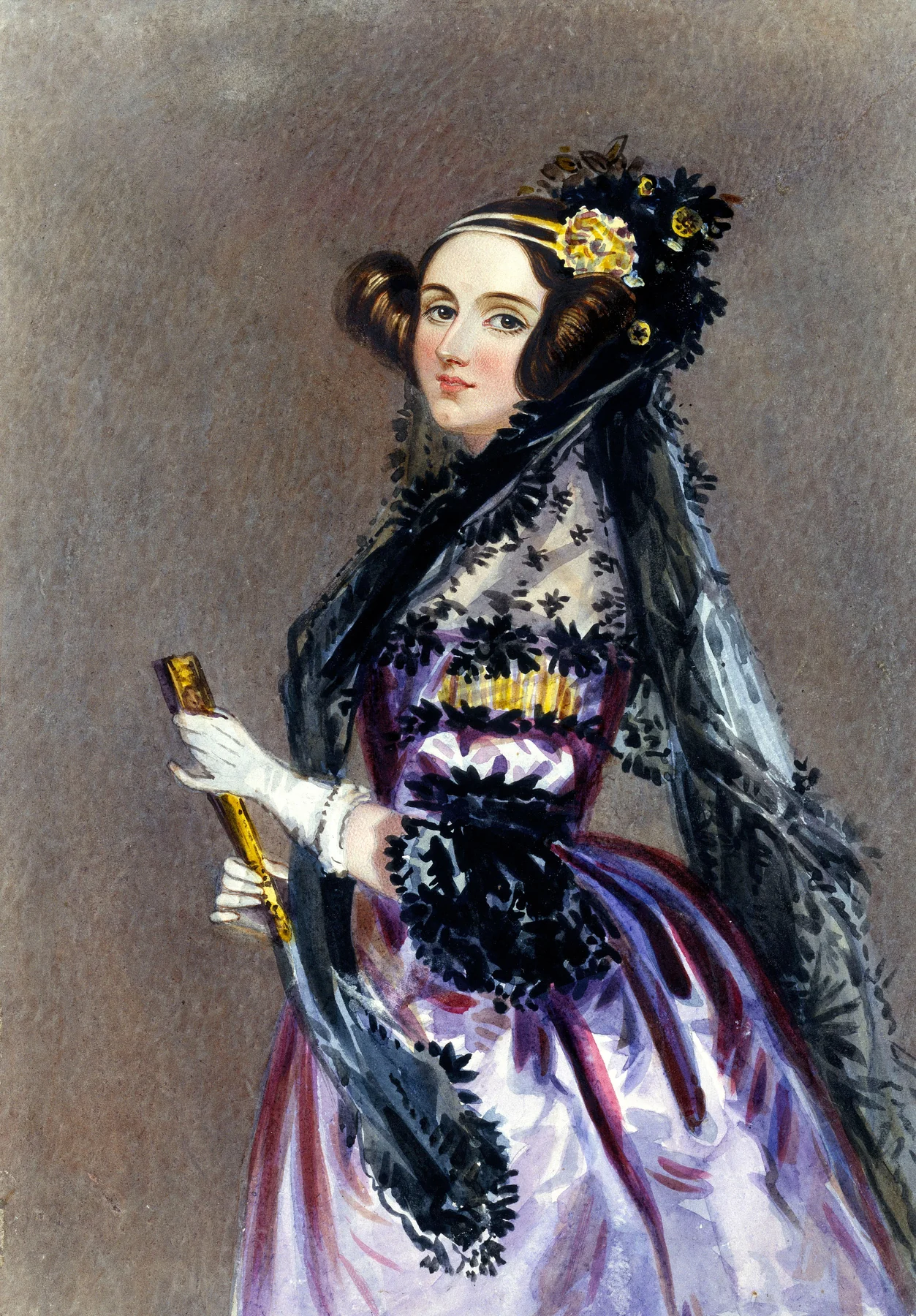
Mathematical writer and early computing interpreterAda Lovelace translated Luigi Menabrea’s description of Charles Babbage’s Analytical Engine and added substantial explanatory notes. Her mathematical education, collaboration with Babbage and account of how operations could manipulate symbols provide a more useful history than a simple contest over a “first programmer” label.Read biographyQuick answers
Common questions
- Is B7 here the same label used in every modern Bernoulli convention?
- No. The guide preserves the historical notation and does not silently relabel it as a modern sequence.
- Does the exercise audit every operation in Note G?
- No. It checks stated data counts and a separately invented operand-order example, not every line of the historic table.
Primary and institutional sources
How this history was checked
Compare the identified original texts, participant accounts and institutional records; the teaching examples are separately labelled. This article was reviewed on 27 October 2026.
- Luigi Menabrea and Ada Lovelace; York University transcriptionSketch of the Analytical Engine, 1843: translated memoir and Notes A–G
- Computer History MuseumAda Lovelace: the Babbage Engine history
- University of Oxford Mathematical InstituteThe mathematics of Ada Lovelace: research project
- Clay Mathematics InstituteAda Lovelace’s mathematical papers and correspondence project
- Alan M. Turing; University of Maryland, Baltimore County hosted copyComputing Machinery and Intelligence, 1950, text reproduction