
The short answer
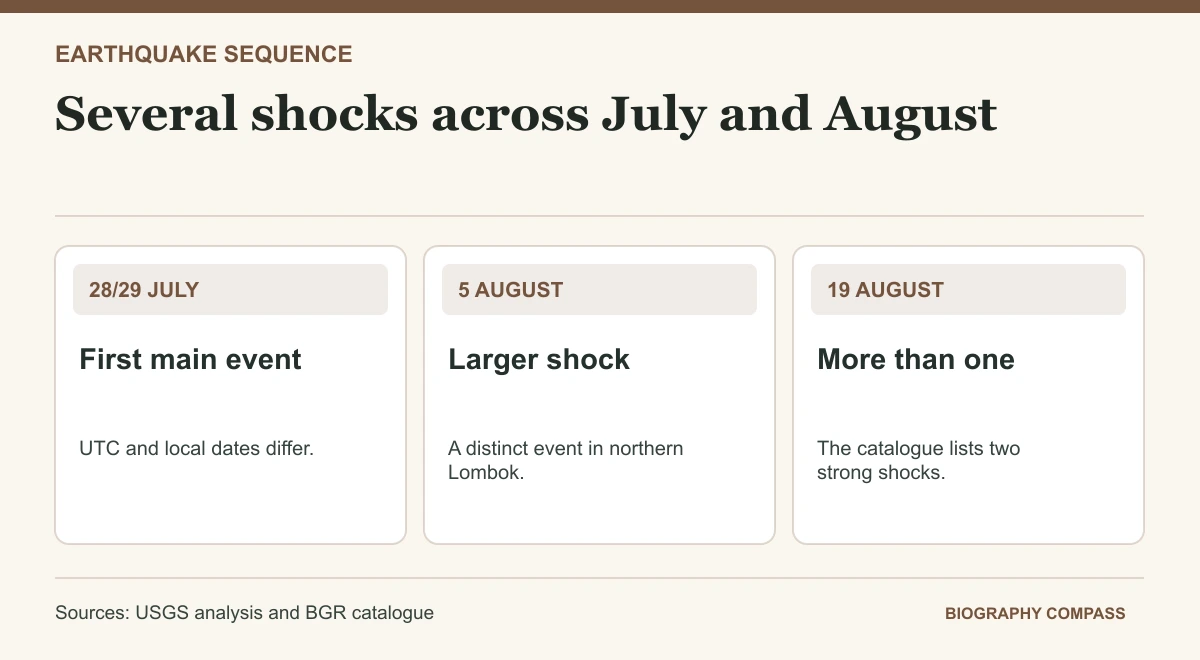
Lombok’s 2018 earthquakes formed a sequence. A catalogue can place the first major shock on 28 July by UTC and 29 July locally. Several more strong events followed in August at different locations. Comparing their times and measurements prevents a record of multiple ruptures from being reduced to a single date.
Reading the records
Three ways to locate a sequence
Time, ground shaking and surface displacement constrain different properties.
| Record | Measures | Use |
|---|---|---|
| Time catalogue | Origin times, with a time standard | Establish the order of the events. |
| Relocated aftershocks | Refined hypocentres | Show how later activity was distributed. |
| Radar interferometry | Surface change along a satellite view | Constrain deformation associated with fault slip. |
Chronology
A timeline of the turning points
First major earthquake
The seismological sequence begins with a magnitude 6.4 event in the analysis.
Larger earthquake
The sequence included a magnitude 6.9 event in northern Lombok.
Further strong shocks
The BGR catalogue lists two large events on this date.
The day changes with the clock
The first main event occurred late on 28 July in UTC. It was already 29 July on Lombok, where central Indonesian time is ahead of UTC. The two dates in earthquake studies and local reporting can therefore identify the same origin. The August events require their own entries. Combining time of day, time standard and the sequence makes it easier to match individual shocks.
Why the large August events should be kept distinct
The relocated seismic study distinguishes the larger 5 August shock from the subsequent earthquake activity and a large 19 August shock farther east. A catalogue also lists two strong events on 19 August. The spatial sequence matters because a single labelled epicentre cannot describe where all the shaking and deformation occurred across the weeks.
How satellite measurements add evidence
Interferometric radar compares images to estimate how the ground moved along a satellite’s line of sight. Researchers used those displacements to model buried fault slip in Lombok. Surface motion and the location of an earthquake are related, but they are not the same measurement. A combined interpretation can account for more observations than drawing a line through the epicentres alone.
Continue the chronology
Related history guides
Connected biographies
People in this history
Quick answers
Common questions
- Why is the first Lombok earthquake dated 28 or 29 July?
- The first event was late on 28 July UTC and early on 29 July in Lombok.
- Was there only one major earthquake?
- No. Studies distinguish several large earthquakes during a July to August sequence.
Primary and institutional sources
How this history was checked
Dates, legal milestones and historical claims are checked against the official and institutional records below. This article was reviewed on 19 November 2026.