
The short answer
How does a seasonal allegory connect political anxiety, figure composition and popular imagery?
Read the evidence
Sources, interpretation and production roles
The records answer different questions about this work. The final exercise is an original teaching model.
| Record or question | Supported reading | Boundary or contrast |
|---|---|---|
| Te Papa object/essay | c.1938 painting shown in a 1939 context of impending war. | The dating is approximate; the work is not a literal report from a battlefield. |
| Cinema comparison | The curator links Winter with Snow White’s wicked queen. | Other possible sources are qualified rather than conclusively identified. |
| Original relationship model | Separates role, historical setting and visual reference. | No protected figure, pose or film frame is reproduced. |
Seasonal figures near a historical threshold
Te Papa dates Winter’s Approach to around 1938 and records its production in Auckland. William McAloon’s essay places its 1939 exhibition against worsening events in Europe. The painting uses Winter and Summer as figures, allowing a seasonal encounter to suggest a threat to peace. Its historical force comes from that conjunction of allegorical form and contemporary circumstances, not from treating the figures as portraits of two named political leaders.
Sources for this section: [2]
A comparison with popular cinema
The museum essay connects the threatening Winter with the wicked queen in Disney’s Snow White and the Seven Dwarfs. It also records proposed sources for Summer’s pose without presenting one as conclusively established. These are claims about available visual languages: cinema, advertising and older painting could coexist within a serious allegory. A popular reference does not make the political subject trivial, nor does a possible older model cancel the contemporary comparison.
Sources for this section: [2]
Figure composition as public argument
White’s training and teaching emphasised the arrangement of bodies. Her broader work makes clear that this ability served political scenes, female allegories and biblical subjects. In Winter’s Approach, the relationship between a threatening figure and a vulnerable one can carry an argument before a viewer identifies every potential source. The action of approaching links the title to a change still in progress. An allegory can make danger perceptible without narrating a specific future military event. The seasonal title is effective because it names a transition rather than a completed destruction. Read with the exhibition date, the approach can convey foreboding without requiring the painter to have predicted every later event of the war.
Original exercise: describe the relationship first
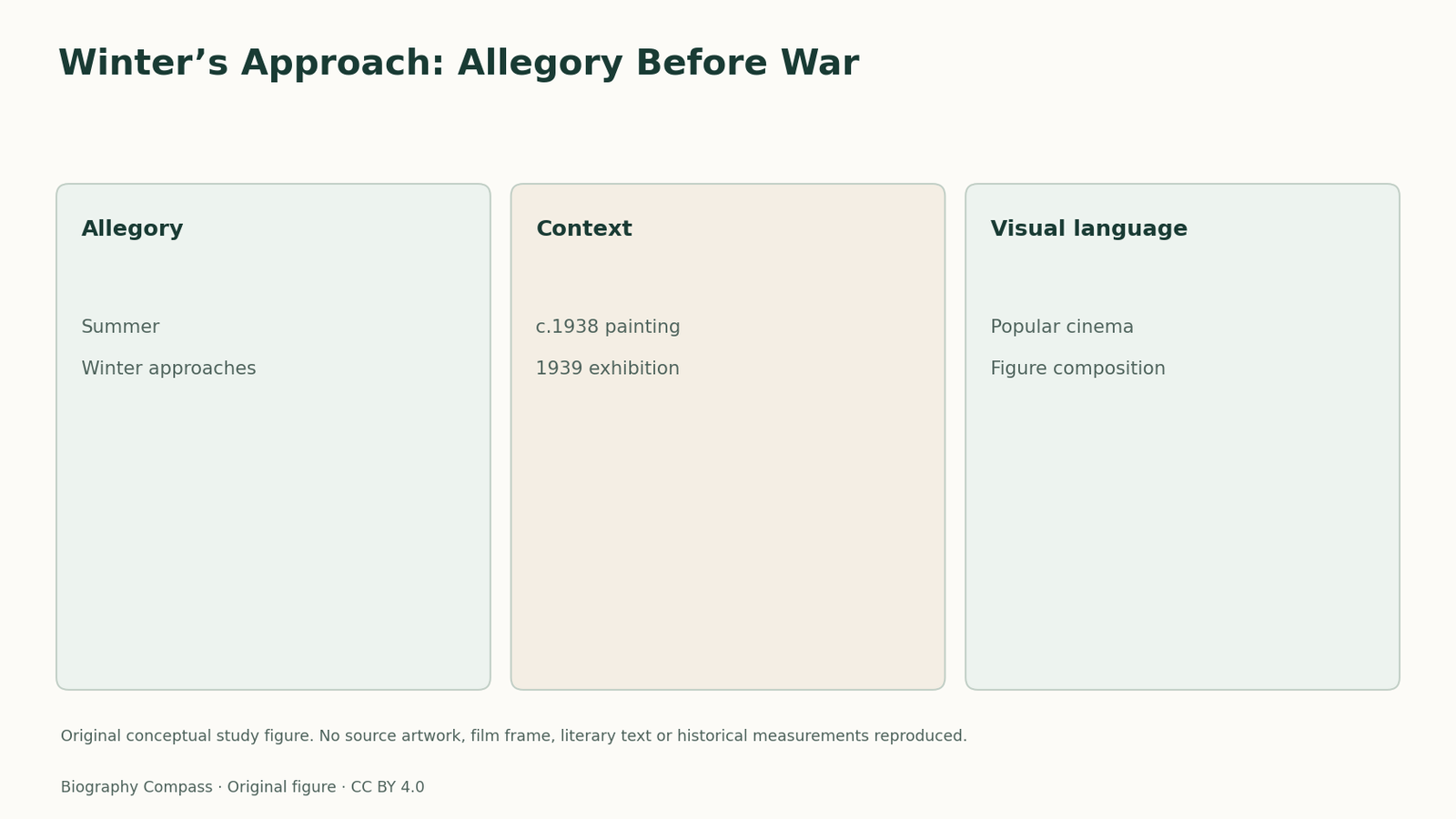
Use three blank cards labelled Summer, Winter and Viewer. Under the first two, list a role rather than a copied costume or pose: vulnerable and threatening. Under Viewer, formulate a question about what is about to happen. A possible answer describes an approach that places the first figure at risk. Add a second layer naming the museum’s 1939 exhibition context, and explain how that setting may sharpen the relationship into an anxiety about war. Finally add the cinema comparison as a separate visual reference. This order produces a connected reading: a relationship is constructed, a historical audience encounters it and a familiar screen image may contribute to its force. It avoids making the whole interpretation depend on recognising a single film character. The diagram is a new explanatory model, not a reproduction of White’s painting. It can support a short classroom discussion about how an allegory addresses public events through invented personifications while remaining a made image, with its own colour, design and staged action.
Continue the chronology
Related history guides
Biography context
Explore New Zealand through connected lives
Connected biographies
People and related creative practices
1903–1984
Lois White
New Zealand painter and art teacherLois White combined a long teaching career with paintings that used staged figures and allegory to address war, social relationships and religious subjects.Read biography1919–1987
Colin McCahon
Painter, gallery worker and art teacherColin McCahon was a New Zealand painter whose work joined landscape, religious questions and written language. Employment in galleries and teaching ran alongside an evolving practice that drew on local places and international art.Read biography1899–1988
Evelyn Page
New Zealand painterEvelyn Page sustained a long figurative career in Christchurch and Wellington, joining close observation of people with an expansive use of colour.Read biographyQuick answers
Common questions
- Does the Snow White connection make this a Disney illustration?
- No. The museum proposes a visual relationship within White’s independently composed political allegory.
Primary and institutional sources
How this history was checked
Sources include production records, institutional collections and the specifically identified passages discussed here. Interpretations and teaching models are distinguished from credits and publication facts. This article was reviewed on 8 November 2026.