
The short answer
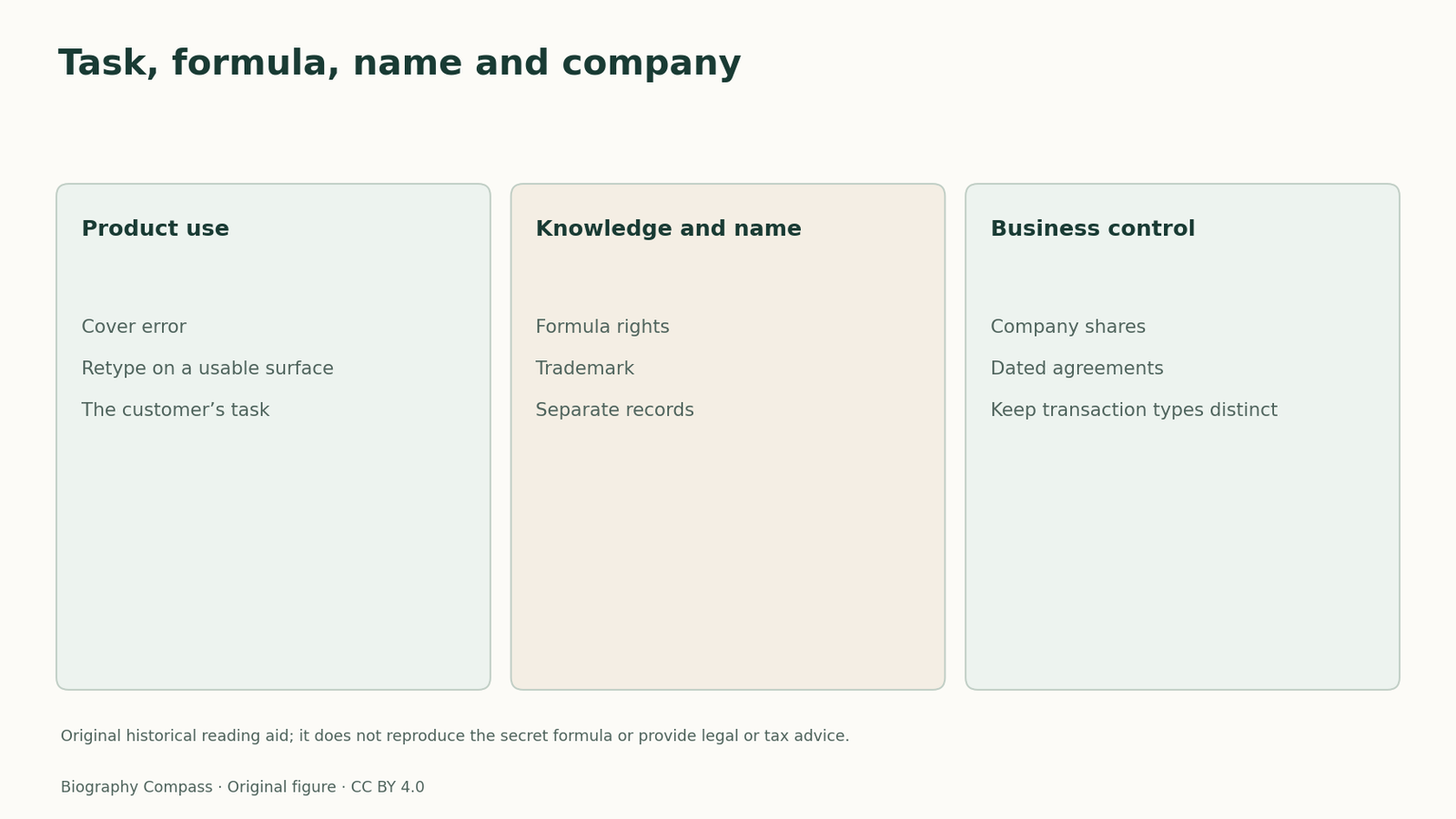
The name on a bottle, the knowledge used to make its contents and the shares in the business selling it are different assets. Liquid Paper’s history becomes clearer when the record keeps them separate.
Evidence and interpretation
Four boxes, different questions
Keep the product’s use separate from the forms of control recorded in the history.
| Question | Question it answers | Do not substitute |
|---|---|---|
| Correction task | What problem does the fluid solve? | A formula or ownership record. |
| Formula rights | Who can use or transfer the knowledge? | The name alone. |
| Trademark | Which product identifier is transferred? | A chemistry patent. |
| Company shares | Who owns an interest in the corporation? | Every separate asset transfer. |
Begin with the task the product performed
The Lemelson-MIT account explains how a paint-like mixture covered a typing mistake, creating a surface on which the typist could type again. It relates the idea to Graham’s experience as both secretary and painter.
That describes a workflow: make an error, cover it, allow a usable surface and retype. It does not identify the exact chemical formula or establish a patent. A useful history can explain the task without publishing a recipe or assuming every later formulation was identical.
Sources for this section: [1]
What the court record separates
The 1983 tax opinion records a trademark transfer that excluded formula ownership, followed by a 1970 assignment of formula rights in return for royalties. Its background dates the Gillette stock-purchase agreement to September 1979.
A company can use a formula under one arrangement while ownership of its brand or shares is governed by another. A change to one arrangement therefore need not imply that all the others changed on the same date. This is why a simple sequence of “invented, patented, sold” is too coarse for this particular history.
Sources for this section: [2]
How to handle an attractive but conflicting summary
The USPTO’s historical article explicitly calls the formula a trade secret. Its account differs from the court record on the sale year.
The MIT summary says the product was patented, but supplies no patent number. The selected legal record supports the more specific formula-rights account; it does not establish a chemistry patent.
Prefer the dated agreement described in the opinion for that transaction, while preserving the difference between an agreement date and every possible closing or payment event. A court’s account is especially useful for the dispute it addresses; it is not automatically the best source for a childhood scene or the first kitchen experiment.
An asset-mapping exercise
Draw four boxes: the correcting task, the manufacturing knowledge, the product name and the incorporated business. Ask which box a trademark transfer points to, which a formula agreement points to and which a stock purchase points to. Then ask whether buying shares and transferring a formula must be the same act.
Reference answer: the name, formula and company boxes respectively; they are distinct acts even when a transaction connects them. The correcting task explains why a customer might want the product, not who owns an asset. This historical exercise does not decide any reader’s present legal or tax position. It helps keep an entrepreneurial life attached to the actual record rather than a simplified invention legend.
Continue the chronology
Related history guides
Biography context
Explore United States through connected lives
Connected biographies
The working life
1924–1980
Bette Nesmith Graham
Inventor and businesswomanGraham turned an office problem into a business.Read biographyQuick answers
Common questions
- Why separate Liquid Paper’s formula, brand and company?
- The opinion records different agreements for the formula, the trademark and the shares. The product’s use answers a different question.
Primary and institutional sources
How this history was checked
Selected passages and records support the discussion below. Original reasoning and invented classroom cases are labelled; no whole-archive or product-testing claim is made. This article was reviewed on 4 November 2026.