
The short answer
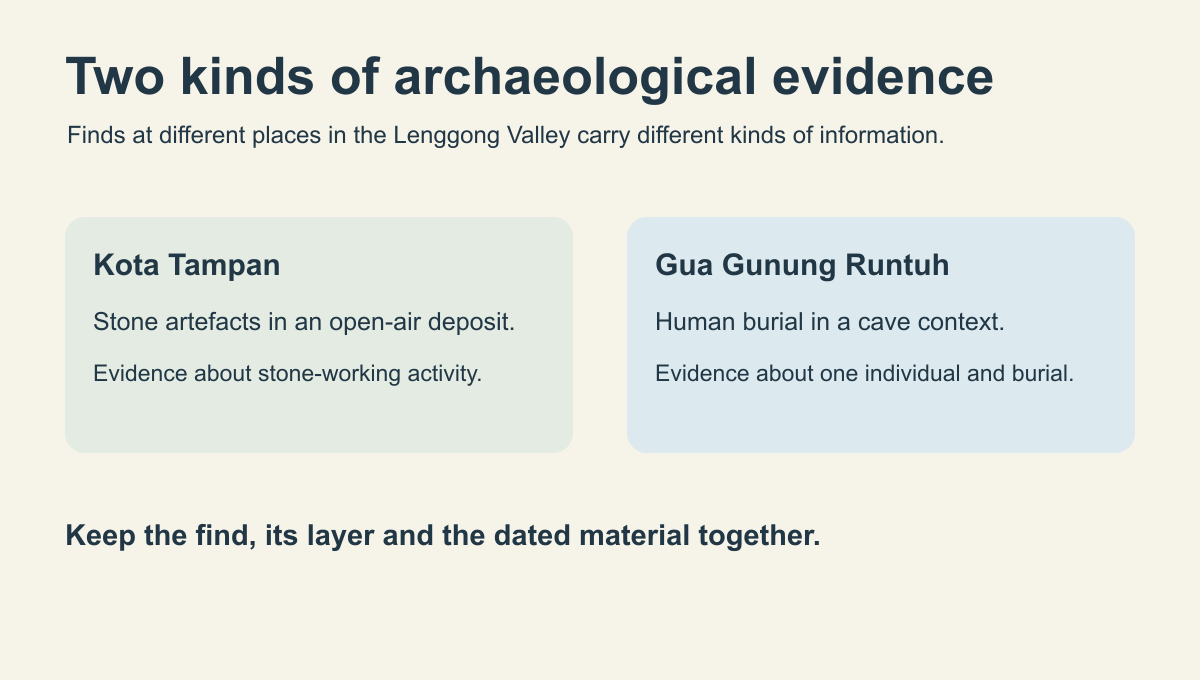
Lenggong’s World Heritage property includes open-air archaeological sites and caves. Stone artefacts at Kota Tampan record how people worked material in one place. The burial known as Perak Man, found in Gua Gunung Runtuh, preserves a different kind of evidence. Each find has to be read with its layer, associated material and dating method.
Dating and interpreting finds
Keep the object with its archaeological context
The two examples preserve different materials in different settings.
| Site | Evidence examined | Question it can inform |
|---|---|---|
| Kota Tampan | Stone artefacts and the deposit in which they occur | How stone was worked there and what evidence dates that activity. |
| Gua Gunung Runtuh | Human remains and burial context | What can be learned from one burial and its associated evidence. |
| The inscribed valley sites | Multiple open-air and cave contexts | How findings from different periods can be studied within one region. |
Chronology
A timeline of the turning points
Zuraina Majid identifies the Kota Tampan open site
Malaysia’s nomination describes research on the stone artefacts and associated deposit.
Researchers record a prehistoric burial
The skeleton becomes widely known as Perak Man.
The Committee inscribes the Lenggong property
The decision treats the open-air and cave evidence as complementary.
What a stone-tool context can establish
Malaysia’s nomination associates archaeologist Zuraina Majid and Universiti Sains Malaysia with the Kota Tampan research. Descriptions of the wider assemblage help researchers distinguish stone-working activity from an isolated object. The relation of the artefacts to surrounding deposits then becomes important for assigning an age.
The nomination relates part of this chronology to volcanic ash attributed to the Toba eruption. The interpretation depends on how the ash and finds occur together in the deposits. That evidence is different from measuring the age of material associated with an individual burial.
What the Perak Man burial adds
The burial was found in Gua Gunung Runtuh. The Committee reports its age as a radiocarbon result in years BP. Treat that number as part of the published dating record. A calendar range would require information about the measurement and its calibration.
A burial can support questions about one person and the treatment of their remains. The valley’s workshops support questions about technology and activity at different places. Putting these results on one timeline requires keeping their contexts separate.
Why the four sites were inscribed together
The Lenggong listing recognises four sites organised in two clusters along the valley. A map shows the protected archaeological contexts. The nomination describes the sequences used to connect finds to periods. Reading them together helps explain why an open-air workshop and a cave burial belong in a regional archive without carrying the same kind of evidence.
Continue the chronology
Related history guides
Connected biographies
People connected to this history
Quick answers
Common questions
- Where was Perak Man found?
- At the Gua Gunung Runtuh cave within the Lenggong Valley archaeological property.
- What is Kota Tampan known for?
- Stone artefacts interpreted in the context of an open-air workshop and its surrounding deposits.
Primary and institutional sources
How this history was checked
Dates, legal milestones and historical claims are checked against the official and institutional records below. This article was reviewed on 19 November 2026.