
The short answer
What does a theory paper establish when its result is that a common assumption has not yet been tested?
Read the evidence
An evidence audit before the experiment
A measurement has to distinguish the alternatives it is being used to test.
| Record | What it establishes | What remains open |
|---|---|---|
| Evidence in one interaction | Support for symmetry in that domain | Whether another interaction has the same property |
| Summed rate | How many events were observed overall | An asymmetry between exchanged classes |
| Separated comparison | How the two classes differ | Experimental controls and interpretation |
A rule can have stronger evidence in one domain
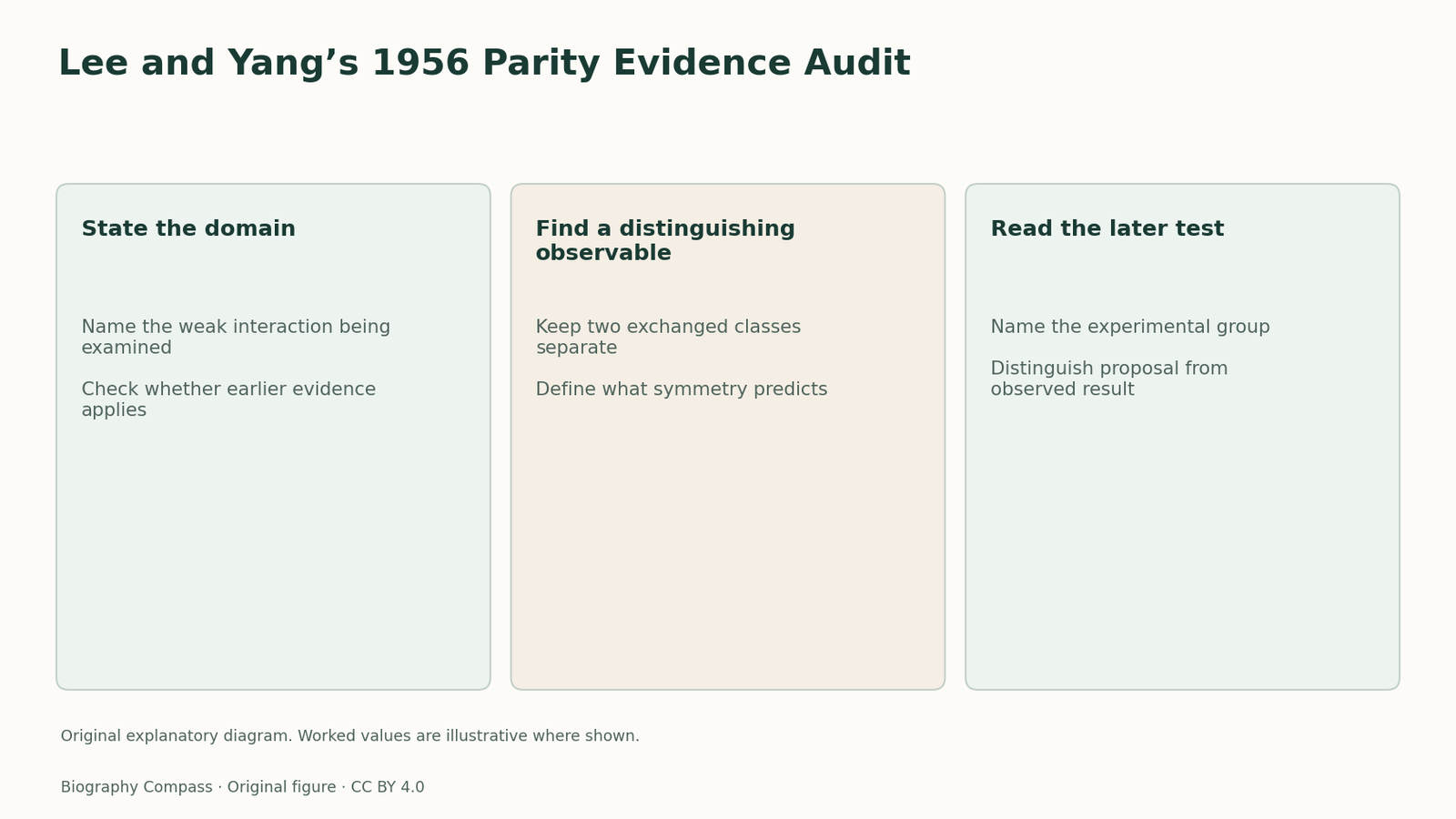
Parity conservation means that a process and its spatially inverted version obey the same physical law. Familiar examples from electromagnetic processes had made the principle highly useful. Lee and Yang asked a narrower question in 1956: what observations had established that symmetry for weak interactions? Evidence from another kind of interaction could give motivation but could not substitute for a discriminating weak-interaction measurement. Their review therefore treated the scope of the evidence as part of the physics. A widespread assumption can have different levels of support when it is applied to different processes.
Check what an existing measurement actually compares
A measurement can be accurate and still be irrelevant to the proposed symmetry test. If it combines data from a process and its inverted counterpart without recording the difference, a possible asymmetry can disappear in the combined number. The issue is not merely the number of observations. It is whether the recorded variable changes in the way the competing theories predict. Lee and Yang’s paper looked for comparisons in which the signs of the alternatives could remain visible. It proposed several classes of observations rather than relying on one historic instrument.
An invented audit of a summed rate
Suppose a sample reports 120 events after summing two classes whose labels would exchange under a chosen transformation. An exactly symmetric model could give 60 and 60. A second model could give 75 and 45, with the same total. If the report contains only the total, neither model is excluded by that number. These are teaching counts, not an experiment from the paper. The example clarifies how an evidence gap can persist even in a field with many measured rates. Finding the gap means identifying a missing comparison rather than claiming that any data already gathered must be wrong.
Sources for this section: [2]
From an audit to a set of tests
The 1956 paper discussed experiments in different kinds of weak decay. A proposed observation specifies what should be compared and how an asymmetry would bear on the symmetry claim. It does not specify the measured outcome before the experiment is done. The cobalt-60 investigation led by Wu supplied one important experimental answer, while other experiments investigated other decay chains. Reading the proposal separately preserves a valuable distinction. It explains why a test could answer a question that earlier measurements left open, regardless of whether one subsequently needs to understand the detailed apparatus.
Credit the stages of the inference
The evidence audit, proposed comparisons and experimental observations each contribute to the history. The point of beginning with the 1956 paper is to see how Lee and Yang made a hidden assumption available for direct examination. The point of reading an experimental paper next is to see which comparison was realised and how the result was checked. A defensible historical account therefore names the interaction, the observable and the contribution of each group. A claim that a principle was simply overturned in one paper erases the evidentiary chain that made the result informative.
Continue the chronology
Related history guides
The Wu Parity Experiment: Evidence, Controls and Collaboration
How did the cobalt-60 experiment test parity? Follow the five researchers, polarisation measurements, warm-up controls and limits of the 1957 report.
Read the timeline1964The Two-Pion Decay That Broke CP Symmetry
Read the neutral-kaon decay evidence, see why two-body kinematics helped identify a rare channel, and distinguish the finding from later tests.
Read the timeline1920s–1960sHow Symmetry Limits Quantum Transitions
Use an original parity example to see how reflection symmetry constrains a quantum transition, and distinguish an allowed transition from an observable line.
Read the timelineBiography context
Explore United States through connected lives
Connected biographies
Researchers and collaborators
1926–2024
Tsung-Dao Lee
Theoretical physicist of symmetry and matterFollow Tsung-Dao Lee from wartime studies in China to Chicago and Columbia, including his collaboration with Chen Ning Yang on the 1956 parity question.Read biography1922–2025
Chen-Ning Yang
Theoretical physicist of statistical mechanics and symmetryFollow Chen Ning Yang from wartime study in China to Chicago and Princeton, including his collaborations with Tsung-Dao Lee on phase transitions and parity.Read biography1912–1997
Chien-Shiung Wu
Experimental nuclear physicist and physics educatorChien-Shiung Wu developed demanding experiments to test nuclear theory. Her collaboration with four National Bureau of Standards physicists showed that parity symmetry fails in beta decay, changing how physicists understood weak interactions.Read biographyQuick answers
Common questions
- Was the 1956 paper the experimental demonstration?
- It examined existing evidence and proposed comparisons. Experimental teams supplied later measurements.
- Why is a summed rate often insufficient?
- Different distributions across exchanged classes can yield the same total.
Primary and institutional sources
How this history was checked
Dates, legal milestones and historical claims are checked against the official and institutional records below. This article was reviewed on 13 November 2026.