
The short answer
What does Lee Chang-dong’s screenplay award establish about Poetry, and how can we recognise the wider work that made the film? Festival and production records answer related questions at different levels.
Original comparison of primary records
Three records, different kinds of claim
The comparison preserves individual recognition and collaborative labour.
| Country | What is recorded | Question or limit |
|---|---|---|
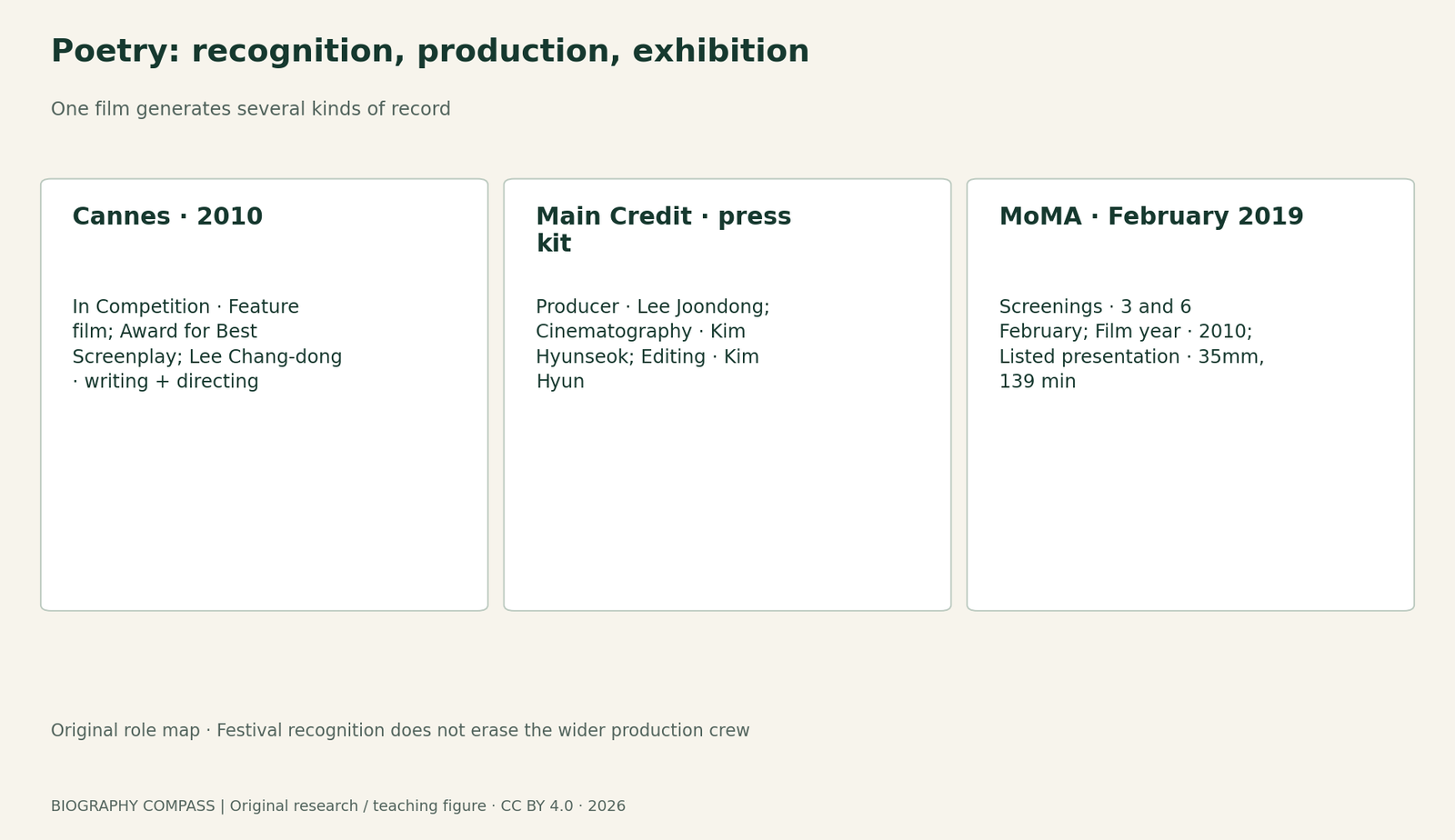
| Cannes film entry | 2010 competition and Best Screenplay; Lee credited as director and screenwriter. | An award category does not describe every production task. |
| English press kit | Lee Joondong: producer; Kim Hyunseok: cinematography; Kim Hyun: editing. | Credits identify roles, not a numerical ranking of creative value. |
| Director’s comments/conversation | Lee’s publicly stated questions about poetry, filmmaking and audience space. | Intention is not a universal audience response. |
| MoMA exhibition entry | 2010 film; 139 minutes; 35mm; February 2019 screenings. | An exhibition date is not a first production year. |
Chronology
A timeline of the turning points
Film and production record
Cannes competition entry; English press kit lists writing, directing and crew roles.
Screenplay recognition
Cannes records the Award for Best Screenplay.
Museum exhibition
MoMA lists two screenings of the 2010 film.
Begin with the category rather than a general prize claim
Cannes identifies Poetry as a 2010 feature in competition and records the Award for Best Screenplay. The same page credits Lee Chang-dong as director and screenwriter. Write those fields separately before combining them into a sentence: the film was selected, the screenplay received a named award, and one person held two credited roles. The phrase “won Cannes” loses the category and makes comparison with other awards difficult. This inquiry asks how an individual distinction sits within a collective film production. It reads public records and written commentary; it does not claim an assessment based on watching the completed film.
Sources for this section: [1]
The production credit page reveals a wider working group
On file page three of the English press kit, the Main Credit table pairs screenplay and directing with Lee Changdong, production with Lee Joondong, cinematography with Kim Hyunseok and editing with Kim Hyun. The layout was visually checked so that the two columns were not accidentally merged during text extraction. These role labels describe distinct responsibilities within the same production. They do not calculate the percentage of artistic value contributed by each person. A useful original map places the screenplay award beside this credit network, allowing recognition of Lee’s work while retaining the people whose tasks shaped the film as experienced by an audience.
Sources for this section: [2]
Match a performer to a character without confusing authorship
The Cannes cast list pairs Junghee Yun with Mija, while the press kit uses the order and spelling Yun Junghee and names the character Yang Mija. The shared film and character provide a basis for relating the entries despite presentation differences. A cast credit concerns a performed role; it does not identify the writer of a character’s poem or prove that the performer’s life matches the fiction. Keep a simple cross-reference in the notebook with source spelling, role and film year. That practice prevents two name orders from becoming two invented performers and keeps the character distinct from the actor.
A director’s stated question is evidence of an intention
The press kit’s next page places Director’s Comments beside a synopsis. Lee connects the continuing writing of poetry with the problem of continuing to make films. This statement establishes a question he publicly offered to readers and viewers. It does not settle every meaning of the finished work. The synopsis introduces a woman attending a poetry class and then confronting a harsh reality, providing orientation rather than a substitute for viewing. Keep the labelled director statement separate from the promotional synopsis in notes. They have different speakers and functions even though the production package presents them next to one another.
Sources for this section: [2]
The written conversation offers a testable viewing question
In Claude Mouchard’s conversation with Lee on file pages seven and eight, the director relates seeing carefully to both poetry and film, and describes leaving space for the audience. A productive next question is how a particular sequence distributes what is shown, withheld or left unresolved. That question should guide an identified viewing, with timestamps and an explanation of the inference made. Here it remains a proposed study, not a reported observation about camera movement or sound. The interview records Lee’s account of the project, while a viewer may find additional tensions or effects that the publicity discussion does not exhaust.
Sources for this section: [2]
A later screening record belongs on another timeline
MoMA’s entry identifies Poetry as a 2010 South Korean film, written and directed by Lee, with a duration of 139 minutes and 35mm presentation. It separately lists screenings on 3 and 6 February 2019. The press kit also gives 139 minutes and 35mm among its technical fields. Agreement helps identify the film, while the dates describe different events: production year and museum exhibition. Neither the museum listing nor a press-kit technical field certifies the format of every release or a researcher’s own viewing. A research log should name the version actually encountered if later analysis depends on a particular screening.
Exercise: edit a festival programme paragraph
Audit this proposed paragraph: “Poetry won the 2010 Palme d’Or. Lee Chang-dong produced and photographed it alone, and MoMA’s 2019 listing means the film first appeared in that year. The director’s press-kit remarks prove that all viewers interpret its gaps in the same way.” Classify each assertion using the award field, Main Credit table, museum dates and director conversation. Replace the paragraph with a concise account that preserves the screenplay distinction, names at least two separate production roles and leaves a genuine question for a viewing seminar. Do not invent a reaction from an audience that the records do not describe.
Reference answer: credit labour and leave interpretation open
The recorded Cannes category is Best Screenplay, not the Palme d’Or. The press kit names Lee Joondong as producer and Kim Hyunseok as cinematographer; Lee Changdong holds screenplay and directing credits. MoMA distinguishes the film’s 2010 year from its February 2019 screenings. The director’s account cannot prove a universal audience response. A defensible replacement states these specific credits and dates, then asks how a selected sequence might create space for viewers to make an ethical or narrative inference. That question requires viewing evidence still to be gathered. The result is a programme note that supports discussion without using an award as a substitute for either collaboration or interpretation.
Continue the chronology
Related history guides
Hwang Sok-yong: How Editions Make Workers and Translators Visible
Compare At Dusk and Mater 2-10 in Booker records, then use an author–translator interview to investigate labour, chronology and translation credit.
Read the timeline2016–2025Autobiography of Death: Following a Poem Cycle Across Languages
Follow Kim Hyesoon’s poetry from a 2016 Korean record to English and German editions, comparing poem structure, translators and distinct prize credits.
Read the timelineBiography context
Explore South Korea through connected lives
Connected biographies
Writers and filmmakers in focus
1954–present
Lee Chang-dong
Film director, screenwriter, novelist and former culture ministerLee Chang-dong moved from fiction and teaching into screenwriting and directing, creating films whose international records distinguish his work from collaborators’ performances and awards.Read biographyQuick answers
Common questions
- Was the full film watched for this guide?
- No. The scope is the festival record, English press-kit text and museum screening entry. Viewing questions are proposed as further work.
- Is the press kit a complete screenplay?
- No. It includes credits, a synopsis, comments and a conversation. Those materials do not establish that a complete screenplay was consulted.
Primary and institutional sources
How this history was checked
Read the identified primary records within the stated scope. Comparisons, exercises and figure designs are original teaching material; complete books and films were not inspected. This article was reviewed on 27 October 2026.
- Festival de CannesPoetry: 2010 competition, screenplay award, credits and cast
- Pinehouse Film / UniKorea; hosted by Festival de CannesPoetry: English press kit, credits, director comments and Claude Mouchard conversation
- Museum of Modern ArtPoetry: written and directed by Lee Chang-dong, 2019 screening record