
The short answer
How can a skirt become a record of wartime memory through collage?
Compare the records
What the sources allow us to say
Read the object record alongside the contextual account.
| Record | Evidence | Reading limit |
|---|---|---|
| Gallery exhibition account | Heavy Skirt connects collage with the mother’s garment. | A material association does not identify every fragment. |
| Artist interview | Explains memory, reconstruction and lived experience. | Personal testimony is one situated historical perspective. |
Follow the artist’s explanation
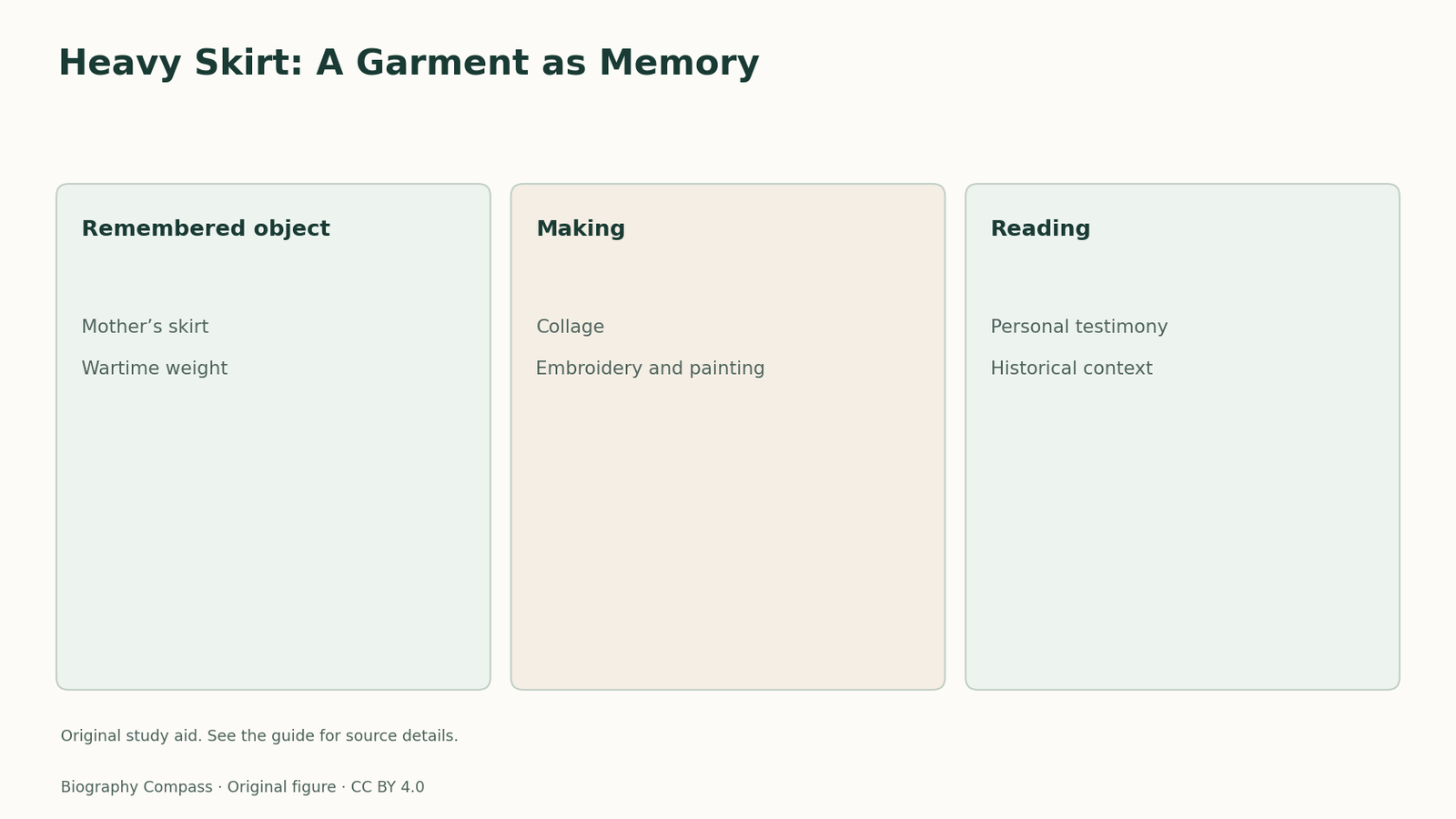
In the 2010 interview, Seckon relates Heavy Skirt to the garment his mother wore while pregnant with him and during the war. The weight of the clothing and the difficulty of the life around it become connected in his account. Begin with that relationship, because it explains why a domestic object could carry the exhibition’s title. The skirt is significant through its place in a remembered life, rather than simply serving as a general symbol attached to every Cambodian woman.
Sources for this section: [2]
The assembled surface has another task
QAGOMA describes Seckon’s paintings as layered surfaces combining collage, embroidery and illustrated elements from myth, popular culture and history. The artist’s archived text also places making within his response to difficult experiences and environmental concerns. Read these statements together to understand why joining materials matters. The surface can hold references with different origins at once. A fragment need not fit into a complete chronological narrative in order to make a remembered pressure or association available to the viewer.
Compare testimony and a historical claim
Make two columns headed remembered object and public history. Put the mother’s garment in the first, then identify which broader circumstances the sources explicitly connect with it. A careful answer recognises the artist’s first-person account while leaving the precise date of an individual incident open if it is not supplied. Explain how collage can bring several references together without proving their chronological order. This exercise preserves the force of personal testimony while preventing a vivid artistic account from being mistaken for an exhaustive history of the war.
Continue the chronology
Related history guides
Biography context
Explore Cambodia through connected lives
Connected biographies
Read the artist’s biography
b. c. 1970
Leang Seckon
Painter and mixed-media artistA Cambodian artist who brings autobiographical memory, collage and environmental concerns into layered images.Read biographyQuick answers
Common questions
- Why does the title refer to a skirt?
- Seckon connects it to the garment his mother wore during pregnancy and his childhood, joining its physical weight with the burden of wartime life.
Primary and institutional sources
How this history was checked
The listed records support the facts. Observation exercises and arguments are Biography Compass editorial interpretations. This article was reviewed on 7 November 2026.