
The short answer
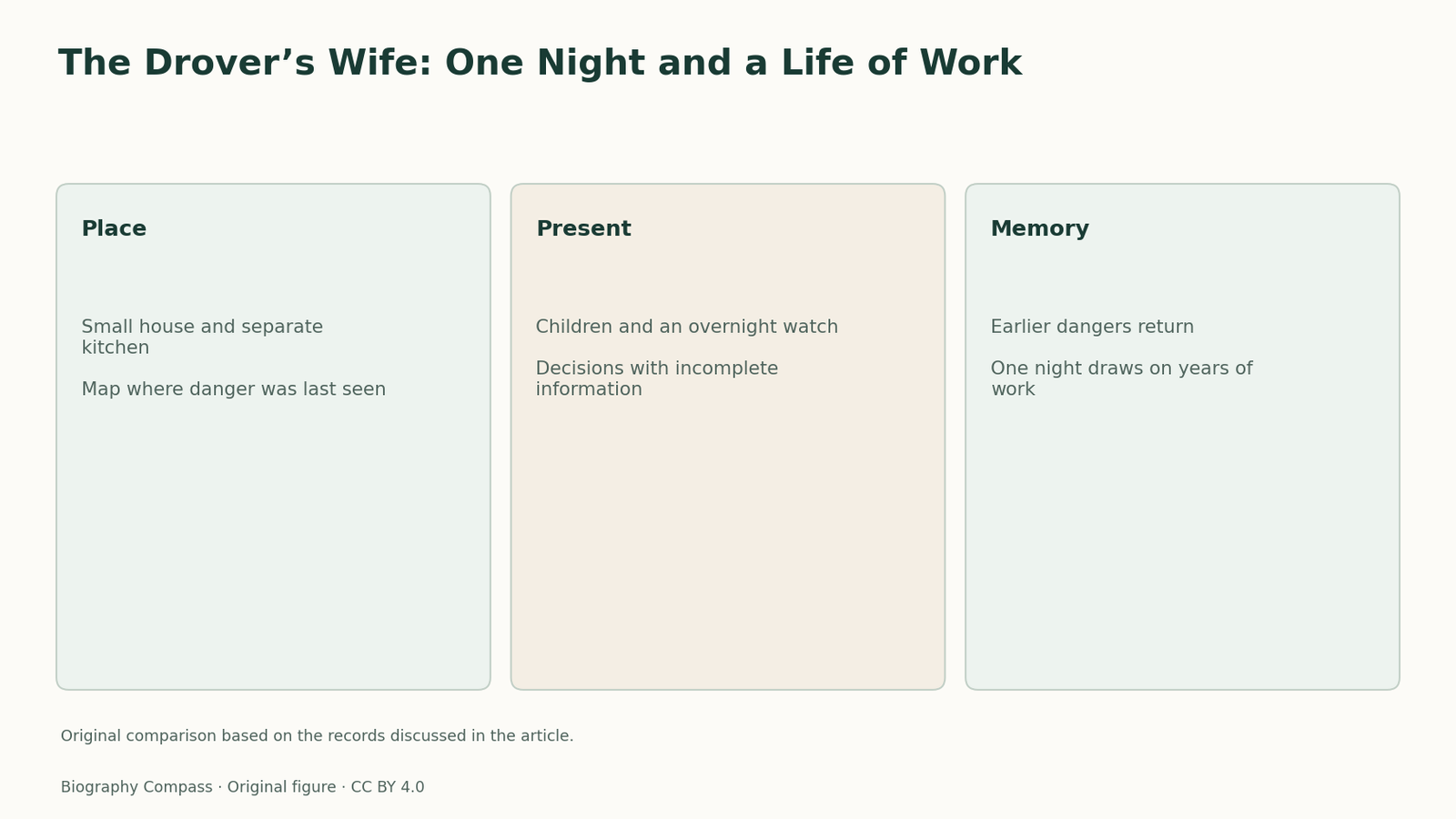
The drover’s wife has to keep children safe while a snake is under the house. The story uses the overnight wait as a frame through which earlier dangers can re-enter the present. Place and time are both part of the problem she must manage.
Evidence comparison
Time and action in the story
Connect the present threat with practical knowledge from other occasions.
| Narrative layer | Function |
|---|---|
| Snake under the house | Creates an immediate uncertainty about location. |
| Household arrangements | Shows decisions made under that uncertainty. |
| Remembered emergencies | Gives the present decisions a longer history. |
Draw a map of the danger
The story opens with a small house and a comparatively large detached kitchen. After the children see a snake, their mother has to judge where it has gone and where they can safely stay. The relation between the two buildings becomes part of the action. A simple map can clarify what the reader knows before trying to explain the suspense. Mark the house, kitchen, children and the last observed path of the snake. Then mark what is uncertain. That last mark is important because the mother must act while her knowledge of the animal’s movement remains incomplete.
Sources for this section: [2]
One watch contains several lengths of time
The threat keeps the mother and children close to a particular place as daylight fades. Recollection makes the time span wider. The text turns to earlier emergencies, including efforts to protect the household during a fire and a flood. These scenes can be read as more than a collection of difficult experiences. Each gives a practical reason for the woman’s present caution. The story puts knowledge acquired over years to work within one night. A reader can use the distinction between a remembered event and an immediate choice to see how a very short narrative can describe repeated work.
Read objects as decisions already made
The woman brings bedding and firewood, positions the children and pays attention to the dog’s behaviour. Each action creates a temporary arrangement that can be revised if the threat changes. The dog supplies information through its attention to a place near the partition. None of this makes the household suddenly safe. It does give the woman ways to monitor and respond. Reading the objects in this way lets a group describe how the text builds suspense without relying only on a statement about courage. The decisions show what knowledge and resources the situation demands.
Sources for this section: [2]
The publication record helps set a boundary
The story became part of While the Billy Boils after appearing earlier in periodical form. A reader who discusses the version in the digitised collection can say so. That prevents a comparison of adaptations, later retellings or paintings from treating all works with a shared title as the same evidence. It also makes close reading easier to reproduce. The floor, the dog and the recalled events can be found in the selected text, rather than inferred from an image or a later account. The arrangement of time is specific to this story’s presentation.
An exercise in temporal order
Write the night’s events in the order in which they occur. Then mark the places where the narration brings in an earlier danger. If a past episode makes a present decision more intelligible, put a line between them. This shows how the story can be organised around one problem while making readers consider a much longer period of family work.
Sources for this section: [2]
Continue the chronology
Related history guides
Biography context
Explore Australia through connected lives
Connected biographies
People connected to the work
1867–1922
Henry Lawson
Short-story writer and poetHenry Lawson wrote stories and poems for periodicals and books. His fiction made the details of housing, distance and work central to how readers encounter rural Australia.Read biography1857–1929
Barbara Baynton
Short-story writer and novelistBarbara Baynton wrote fiction about work and exposure in rural settings. Her collection Bush Studies appeared in London after difficulty finding an Australian publisher.Read biographyQuick answers
Common questions
- What immediate event organises the story?
- A snake goes beneath the house, so the mother must arrange an overnight watch while protecting the children.
- Why does the story include earlier emergencies?
- Recollection gives context to the decisions being made during the present watch.
Primary and institutional sources
How this history was checked
Dates, legal milestones and historical claims are checked against the official and institutional records below. This article was reviewed on 13 November 2026.