
The short answer
A repeating arrangement can have a simple period and a more complicated internal pattern. This lesson keeps the geometry of repetition separate from how contributions within one repeated unit combine.
Original record and worked interpretation
Same period, different internal response
All values are stipulated and dimensionless.
| Invented pair | Even-index I | Odd-index I |
|---|---|---|
| A:(3, 1) | 16 | 4 |
| B:(2, 2) | 16 | 0 |
| Unchanged | Period a | Two occupied sites |
Chronology
A timeline of the turning points
Selected lecture
Positions and strengths are distinguished.
Original warm-up
A one-dimensional repeated pair.
The historical distinction
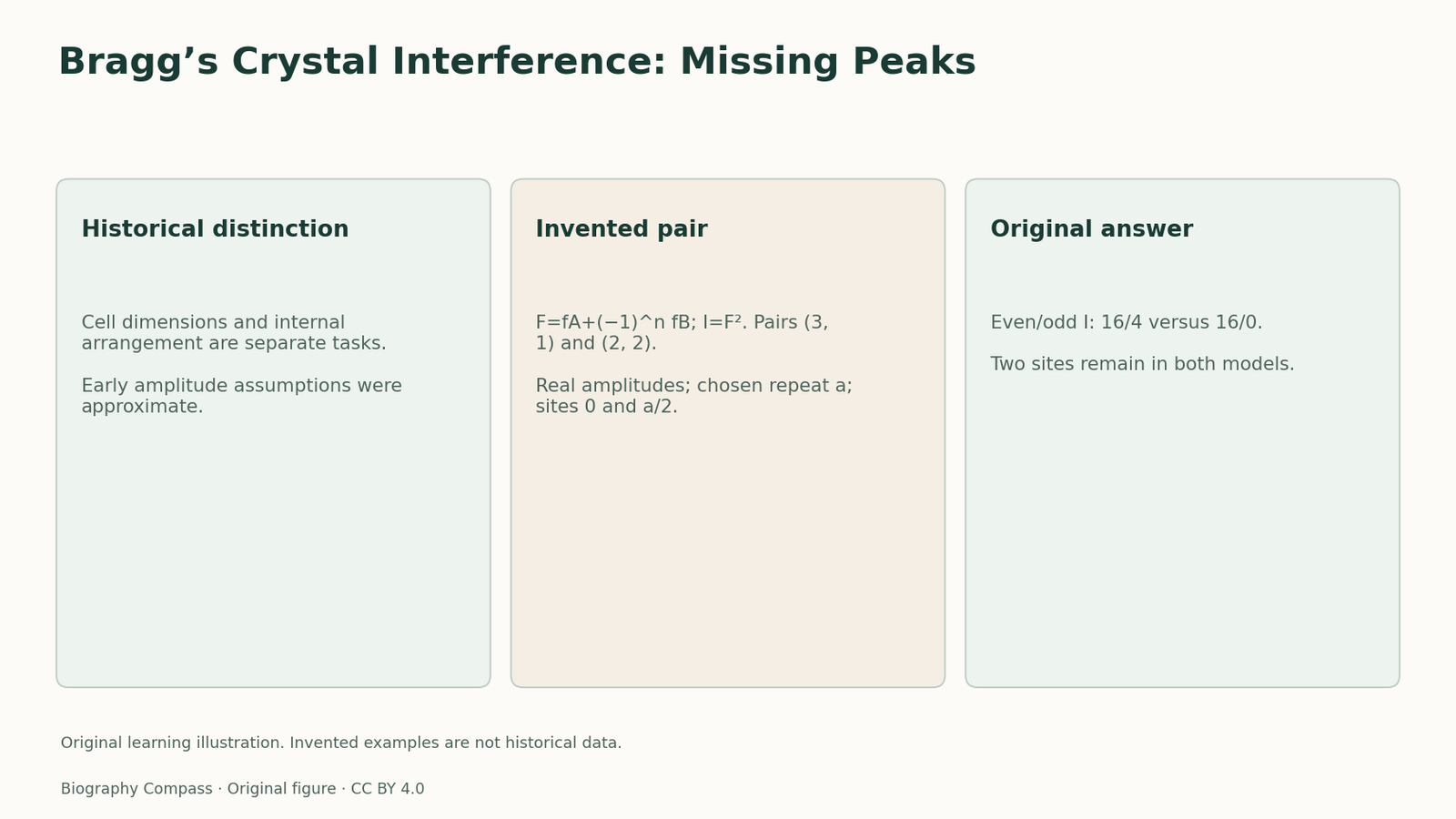
On printed 378–379, Lawrence first determines cell dimensions, then considers how atoms are grouped within that cell. Interference changes reflection strengths. He also states that early weight-based scattering assumptions were approximate.
That qualification matters: a successful elementary picture is not a complete theory of scattering, and the lesson below is deliberately smaller than a three-dimensional crystal.
Sources for this section: [1]
Define the original pair model
Stipulate a one-dimensional period a with two contributions: amplitude fA at 0 and fB at a/2. At integer index n, define F(n)=fA+(−1)^n fB and intensity I(n)=F(n)². All amplitudes are real, in arbitrary units; this definition omits absorption, thermal motion and any dependence of f on n. Here a is a chosen repeat length; it need not be the smallest possible period.
For pair A, let fA=3 and fB=1. For pair B, let both equal 2. Find even-index and odd-index intensities, and decide whether either pair contains fewer contributing sites.
Sources for this section: [1]
Reference answer: cancellation is not absence
Pair A gives even F=4 and odd F=2, hence intensities 16 and 4. Pair B gives even F=4 and odd F=0, hence 16 and 0. Both models contain two occupied sites; the vanished odd-index response in B is cancellation under the stated rule.
The period a is unchanged. Equal even-index intensities alone do not distinguish the pairs. An odd-index observation supplies different information, provided the detector can distinguish a real weak signal from its background.
Sources for this section: [1]
What the warm-up cannot solve
The exercise demonstrates non-uniqueness from incomplete information, not a method that reconstructs arbitrary structures. Real reflections have additional experimental and physical factors. Do not turn the invented amplitudes into atomic weights, or identify either pair with a specific salt. The lecture’s distinction survives while its historical approximations remain visible.
Sources for this section: [1]
Continue the chronology
Related history guides
Biography context
Explore United Kingdom through connected lives
Connected biographies
The researcher behind the record
1890–1971
Lawrence Bragg
Crystallographer and research directorCrystallographer and shared physics laureate.Read biographyQuick answers
Common questions
- Does a missing peak prove a missing atom?
- No. The stipulated pair model cancels an odd-index amplitude while retaining both sites.
- Is this a sodium-chloride reconstruction?
- No. It is a one-dimensional invented model with real, constant amplitudes.
Primary and institutional sources
How this history was checked
Read the selected historical passages alongside the labelled original analysis. Invented inputs are not reconstructed measurements. This article was reviewed on 31 October 2026.