
The short answer
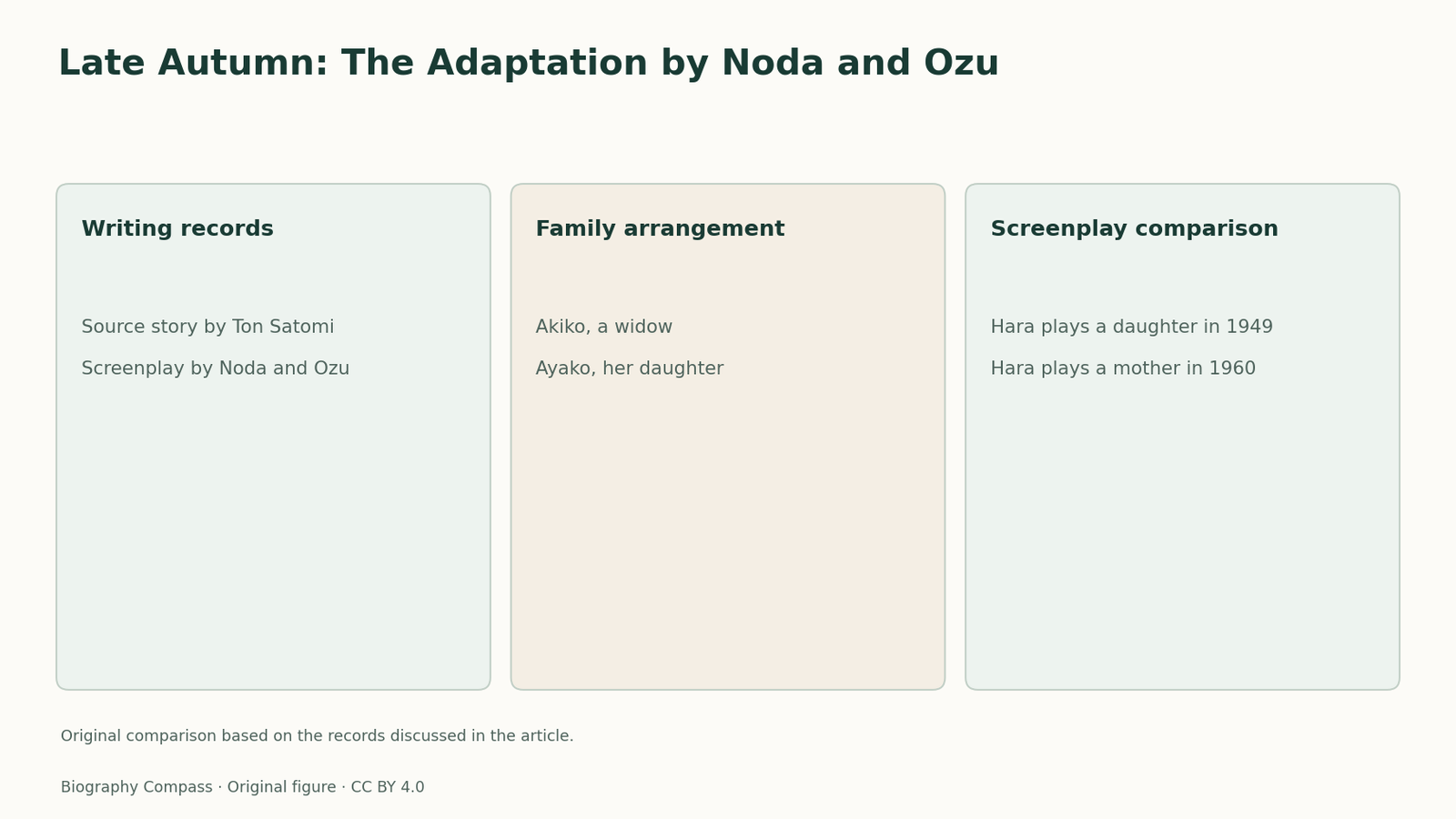
Late Autumn is easy to connect to Late Spring because both films concern marriage in a household shared by a parent and daughter. Their source and screenplay credits also deserve to be read separately.
Evidence comparison
Two levels of writing and one cast comparison
The records allow source, adaptation and performance to be checked separately.
| Credit or comparison | Names |
|---|---|
| Original story | Ton Satomi |
| Screenplay | Kōgo Noda and Yasujirō Ozu |
| Mother and daughter | Setsuko Hara as Akiko, Yōko Tsukasa as Ayako |
Separate the original story and screenplay
The Japanese Film Database identifies Ton Satomi’s contribution as the original story and names Noda and Ozu as screenwriters. Criterion lists the same three people under their corresponding functions. The terminology gives a reader a way to ask different questions. One concerns where the film’s source is credited. Another concerns the screenplay prepared for this production. A plot resemblance to another Ozu film is a third matter. It can be illuminating as a comparison between films, but it does not replace either of the two documented writing credits for Late Autumn.
The relationship that sets the story in motion
Setsuko Hara plays Akiko Miwa, a widow, and Yōko Tsukasa plays her daughter Ayako. Friends of Akiko’s late husband become involved in thinking about a match for Ayako. The Japanese database’s synopsis identifies a complication in their reasoning. They begin to think that a marriage for the mother will make a marriage for the daughter easier. A choice presented to one person thus depends on what other people assume about someone else. Following the direction of that assumption gives a reader a clearer account of the story than listing everyone who eventually discusses marriage.
Compare a similar problem with Late Spring
Late Spring places Hara on the daughter’s side of a conversation about a household’s future. Late Autumn casts her as the widowed parent. Draw the two households before comparing their plots and then add the people who intervene in each. The visual comparison immediately changes the question from whether the films are alike to how an intervention moves through each set of relationships. The writing credits support treating the resemblance as a sustained subject of collaboration. The source credit for the later film and the different relations prevent that resemblance from doing all the explanatory work.
What a synopsis can establish about misunderstanding
The Japanese database explains that Ayako comes to believe her mother has agreed to remarry and then learns that her mother did not know about the plan. The reader can separate what the people proposing the match intend from what Akiko actually knows. That separation is important because a proposed arrangement can govern a scene before it is true. If a viewing note says only that someone plans to marry, it loses the difference between a confirmed decision and a story passed from one character to the next. The distinction makes the adaptation’s social problem easier to follow.
Build a map of the information people have
Write Akiko, Ayako and the friends on three cards. Draw an arrow when a person hears a proposal, adding a different mark if someone confirms it. On a direct viewing, check whether a scene supplies a fact, an assumption or a correction. The exercise can be repeated for Late Spring to compare how two screenplays distribute knowledge of proposed marriages. This gives a reader an observable element of narrative design to discuss, while leaving the exact division of responsibility between the co-writers open unless a draft or testimony provides more evidence.
Continue the chronology
Related history guides
Biography context
Explore Japan through connected lives
Connected biographies
People connected to the work
1893–1968
Kōgo Noda
ScreenwriterKōgo Noda was a Japanese screenwriter who repeatedly collaborated with Yasujirō Ozu, including on Late Spring, Tokyo Story and Late Autumn.Read biography1903–1963
Yasujirō Ozu
Film director and screenwriterYasujirō Ozu moved from silent comedy to carefully organised family dramas, developing long collaborations and a visual style recognised beyond Japan.Read biographyQuick answers
Common questions
- Who is credited with the original story for Late Autumn?
- Ton Satomi is credited for the original story.
- Who plays Akiko and Ayako?
- Setsuko Hara plays Akiko Miwa and Yōko Tsukasa plays Ayako.
Primary and institutional sources
How this history was checked
Dates, legal milestones and historical claims are checked against the official and institutional records below. This article was reviewed on 13 November 2026.