
The short answer
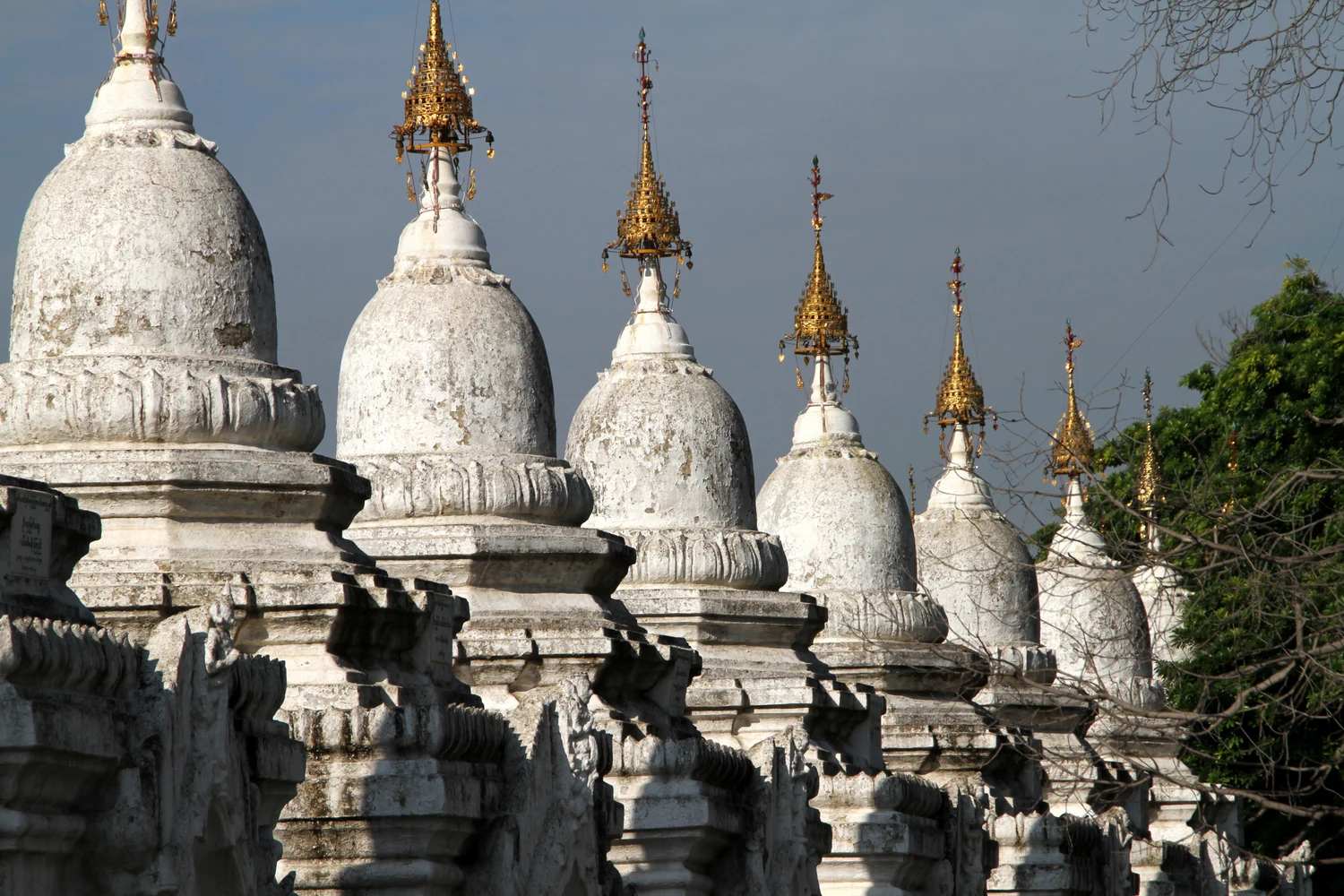
The rows of small shrines at Kuthodaw in Mandalay house 729 slabs carrying the Pali Buddhist canon. King Mindon’s undertaking began with editing and copying on palm leaf. The choice to put the text on stone changed how the canon could be housed, consulted and preserved.
Compare the records
What each stage preserved
Text, material and event each have their own date in the research record.
| Stage | Medium | What a reader can examine |
|---|---|---|
| Editing | Palm leaves | The textual exemplar prepared under royal patronage |
| Inscription | Marble slabs | A fixed witness to the wording of that recension |
| Recitation | Council proceedings | The history of collective verification |
| Documentation | Images of stone surfaces | Letter forms and readings across slabs |
Chronology
A timeline of the turning points
A new manuscript copy is commissioned
The edited palm-leaf canon provides an exemplar.
The text is carved onto marble
Inscribed slabs are set in individual shrines.
A council convenes in Mandalay
Monks recite and verify the canon.
UNESCO registers the inscriptions
The shrine collection enters Memory of the World.
From leaves to stone
The Pali Texts project traces the work to 1857, when Mindon ordered a new set of the canon copied onto palm leaves. That edited version supplied the text for the carvers. The lapse between making an exemplar and finishing the stones matters for textual history. A carved reading reflects decisions already made about which manuscript wording to copy.
Why the council has a later date
The project places carving between 1860 and 1868. The Fifth Buddhist Council met in Mandalay in 1871 and involved the oral recitation and verification of the canon. These events are often mentioned together because both belonged to Mindon’s patronage of Buddhist learning. Keeping their dates in sequence explains how an inscribed version could already exist when the council assembled.
What counts as a page at Kuthodaw
The familiar comparison with a book refers to the succession of inscribed surfaces. A slab is a physical object housed in a shrine, and the writing continues across many such objects. A catalogue or photographic project must keep the slab identifier and side attached to each image. Otherwise a sharply legible photograph can lose its place in the text. The 2013 Memory of the World registration concerns this documentary collection.
Continue the chronology
Related history guides
The Myazedi Inscription: Four Languages on Two Pillars
Compare the single dedication preserved on the Myazedi pillars.
Read the timeline1992 onwardHow the Digital Library of Lao Manuscripts Was Built
Follow a Lao manuscript project that links physical leaves, microfilm and digital images.
Read the timelineConnected biographies
People connected to this history
Quick answers
Common questions
- How many slabs carry the canonical text?
- The Kuthodaw collection contains 729 inscribed slabs of canonical text.
- Was the carving finished before the 1871 council?
- The Pali Texts project dates carving to 1860–1868 and the Fifth Buddhist Council to 1871.
Primary and institutional sources
How this history was checked
Dates, legal milestones and historical claims are checked against the official and institutional records below. This article was reviewed on 19 November 2026.