
The short answer
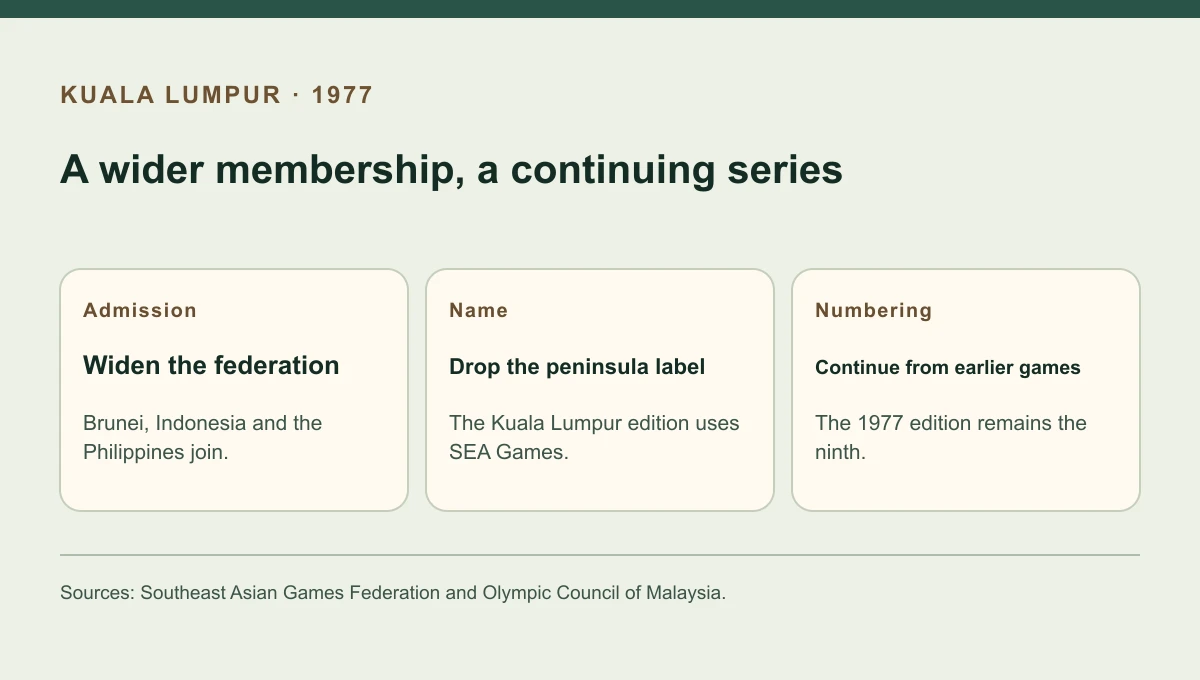
Kuala Lumpur hosted the first competition under the name Southeast Asian Games in 1977. It was already the ninth event in the series. The name broadened after Brunei, Indonesia and the Philippines entered the federation, while the organisers kept the numbering that linked the new tournament to the Peninsular Games.
Read membership and numbering separately
What changed in Kuala Lumpur
Three parts of the institution changed at different levels.
| Element | 1977 outcome | How to recognise it |
|---|---|---|
| Membership | Brunei, Indonesia and the Philippines join | Compare the federation’s lists of founders and later members. |
| Title | The Games drop “Peninsular” | The ninth edition is known as the SEA Games. |
| Numbering | The sequence continues | Kuala Lumpur is the ninth, while Jakarta is the tenth in 1979. |
Chronology
A timeline of the turning points
Officials consider wider membership
A reduced turnout in Bangkok increases interest in opening the federation.
New members join
Brunei, Indonesia and the Philippines are welcomed into the federation.
Kuala Lumpur holds the ninth Games
The shorter SEA Games name appears while the previous numbering continues.
Why the federation widened
The Olympic Council of Malaysia describes a reduced turnout at the 1975 Games and records Malaysia’s proposal to expand the federation. It offered to host again with the participation of Brunei, Indonesia and the Philippines. The federation’s member list identifies all three as entrants in 1977. As an institutional decision, membership expanded the group that could take part in organising and sustaining the series.
Two kinds of first
Kuala Lumpur was the first host under the shortened SEA Games name, while the competition was still the ninth edition. Keeping the number carried forward the record from Bangkok 1959. Pelita Brunei dates the competition to 19–26 November 1977. That date range marks the sporting event and should be kept separate from the February decision admitting the new members.
Follow the change through later hosts
The next two editions show how expansion affected the rotation. Indonesia hosted in Jakarta in 1979, and the Philippines followed in Manila in 1981. Brunei’s National Olympic Council also traces its participation back to the 1977 change. These records show what a wider federation meant after the first new competition. Member organisations could send delegations and, when their turn came, organise an edition of their own.
Continue the chronology
Related history guides
How Kuala Lumpur Took Over the 1965 SEAP Games
Read how Kuala Lumpur first hosted the competition while it still used the SEAP name.
Read the timeline1958–1959How Bangkok Hosted the First SEAP Games in 1959
Read why the original Bangkok competition was called the SEAP Games.
Read the timeline1972–1973How Toa Payoh Became Singapore’s 1973 SEAP Games Village
See how Singapore organised its first edition under the earlier name.
Read the timeline1977–1981How Manila Hosted the Philippines’ First SEA Games
Follow the Philippines from its admission to organising the Games in 1981.
Read the timeline1998How Kuala Lumpur 1998 Added Commonwealth Games Team Sports
Compare a different multi-sport expansion in Kuala Lumpur two decades later.
Read the timeline2023How Cambodia Hosted Its First SEA Games in 2023
Follow Cambodia’s eventual first time as host of the wider regional federation.
Read the timelineConnected biographies
People connected to this history
Quick answers
Common questions
- Why are the 1977 SEA Games also called the ninth Games?
- The SEA Games name was newly adopted, and the numbering continued the earlier SEAP series.
- Which countries joined the federation in 1977?
- Brunei, Indonesia and the Philippines joined.
Primary and institutional sources
How this history was checked
Dates, legal milestones and historical claims are checked against the official and institutional records below. This article was reviewed on 19 November 2026.
- Olympic Council of MalaysiaHistory of the SEAP and SEA Games
- Southeast Asian Games FederationFounding members and later members
- Olympic Council of AsiaKuala Lumpur 1977 games record
- Brunei Darussalam National Olympic CouncilBrunei’s SEA Games participation history
- Pelita Brunei, Information DepartmentHistory of SEA Games participation (8 August 2007 archive)