
The short answer
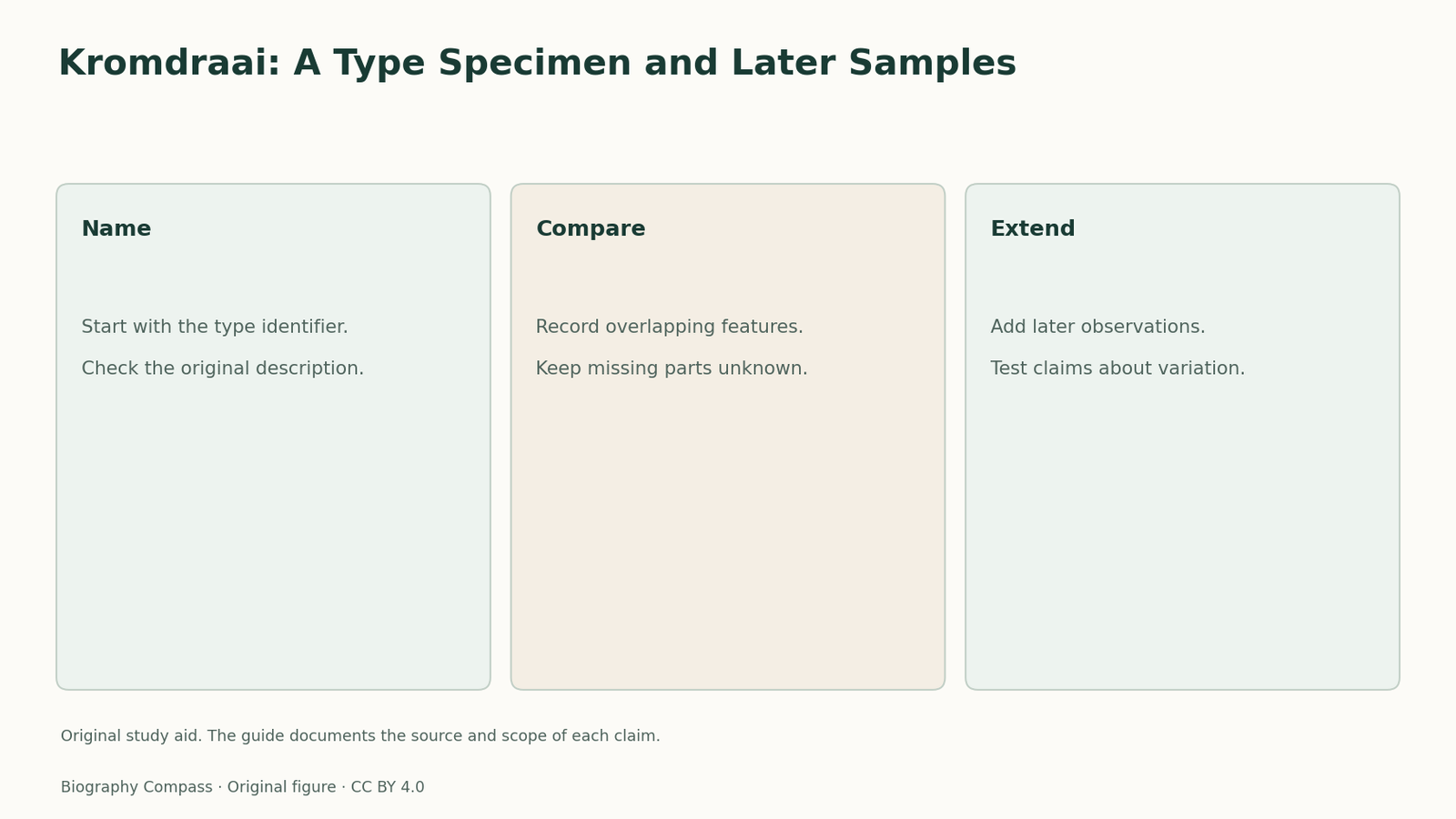
A name can be tied to one reference specimen even when researchers need a much larger sample to understand differences among individuals.
Evidence at a glance
What can the type specimen tell us about later fossils?
Match each piece of evidence to a specific inference.
| Evidence | What it supplies | How to read it |
|---|---|---|
| TM 1517 | Anchors the historical name. | Read the naming record first. |
| Later specimen | Preserves overlapping or different features. | Document the actual comparison. |
| Sample | Makes variation testable across individuals. | Keep age and preservation in view. |
Chronology
A timeline of the turning points
Naming report
Broom publishes the original description.
Later fossil study
Researchers compare Kromdraai and Drimolen material.
Locate the name’s reference
PaleoCore links the name Paranthropus robustus to Broom’s 1938 report and identifies TM 1517 as the type. A type record answers a naming question. It gives researchers a specimen against which to read the original description and subsequent usage. It does not imply that every assigned individual had exactly the same shape, nor that every later fragment can be matched to it directly.
Ask what a new sample contributes
A later study compares fossils from Kromdraai and Drimolen with other material. It uses observations that were unavailable in the first account to investigate similarities and differences. A newly described part can widen the set of features available for comparison. A difference in one structure may instead be connected to age, preservation or ordinary variation. Readers should ask how the researchers assess the competing explanations.
Sources for this section: [3]
Run a small identification exercise
On an invented worksheet, let the reference specimen preserve features A and B. Specimen X preserves A and B, while specimen Y preserves B and a third feature C that is missing from the reference. X offers a direct two-feature comparison. Y adds an observation about C, but no direct check of C against the reference is possible. Label what is observed and what would have to be inferred before assigning Y.
Keep the naming and sample records linked
Write the type record in one row and each new comparison in its own row. Add locality, visible anatomy and the reason for a proposed assignment. This structure keeps changes in an interpreted sample traceable. A new anatomical observation can change the discussion of variation without requiring anyone to forget the specimen that anchors the historical name.
Continue the chronology
Related history guides
Biography context
Explore South Africa through connected lives
Connected biographies
The researcher behind the records
1866–1951
Robert Broom
Physician and vertebrate palaeontologistBroom studied South African fossils across several animal groups and described a new hominin from Kromdraai.Read biographyQuick answers
Common questions
- Does every fossil assigned to a species become a type specimen?
- No. The type anchors the name. Other fossils can contribute evidence about the range and features of the group.
Primary and institutional sources
How this history was checked
Publication dates and specimen records describe different events. Invented exercises are labelled. This article was reviewed on 5 November 2026.