
The short answer
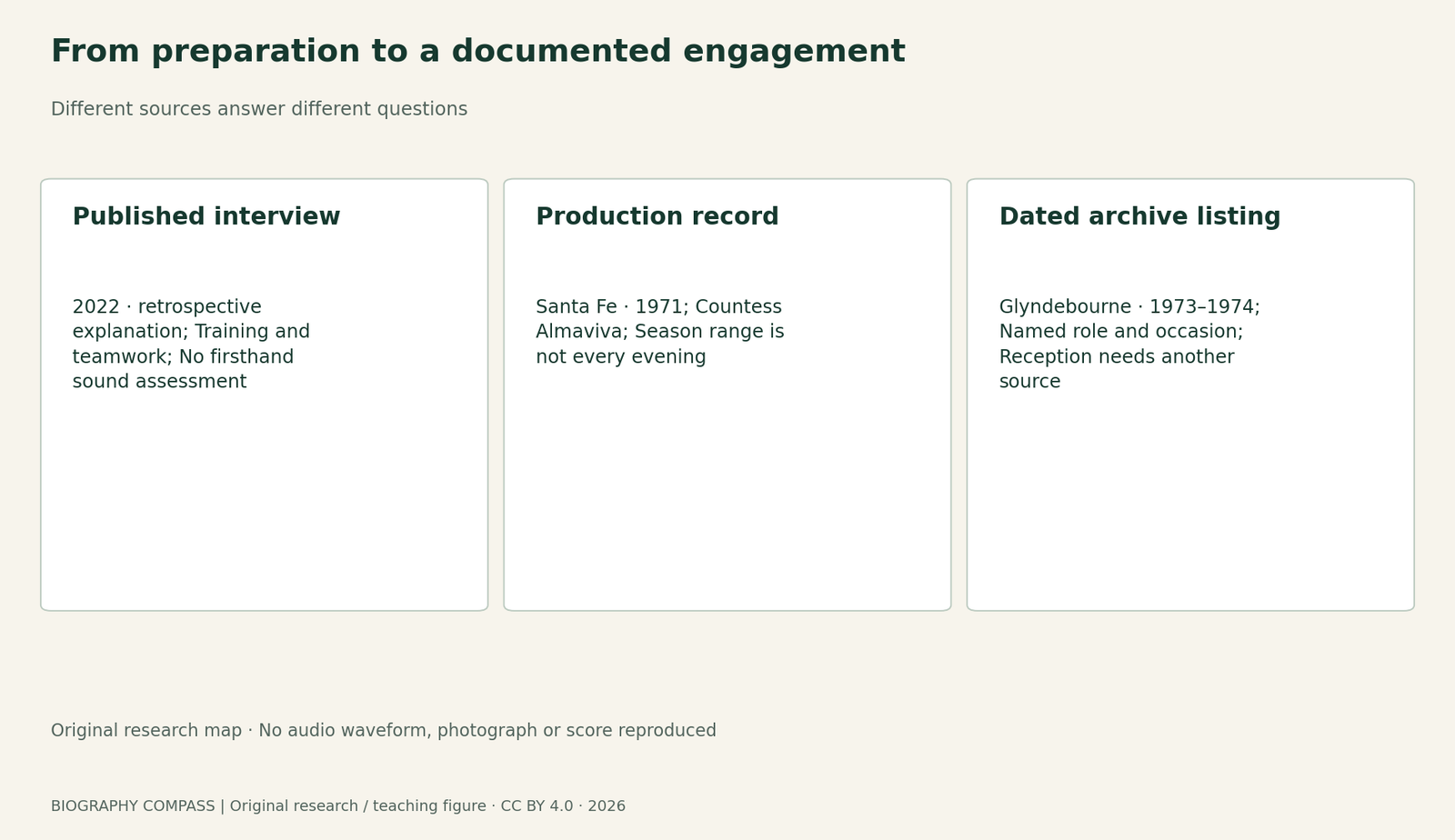
How does a singer’s account of preparation relate to the records of where she performed? Te Kanawa’s interview and company archives answer different parts of that question.
Original evidence comparison
Match the question to the record
These sources provide complementary evidence without becoming substitutes for one another.
| Country | What the record establishes | What it cannot establish alone |
|---|---|---|
| Published interview | The singer’s retrospective explanation of practice. | The sound or quality of an uninspected performance. |
| Production entry | Role and production date range. | Presence on every evening in the range. |
| Dated archive listing | A recorded engagement on a named date. | A complete account of rehearsal or reception. |
| Original research model | A set of questions about preparation and collaboration. | A measured causal ranking of teachers or rehearsals. |
Chronology
A timeline of the turning points
Santa Fe season
The company lists Te Kanawa as the Countess in its July–August production.
Glyndebourne records
Dated Countess appearances appear in the company archive.
Published interview
Te Kanawa reflects on training, collaboration and mentoring.
Start with a dated conversation and its actual scope
Emma Robertson’s interview with Kiri Te Kanawa was published by The Talks on 17 August 2022. This guide uses the published questions and answers, rather than the embedded music video or an audio excerpt. The distinction changes the claims available to a reader: a transcript records a retrospective explanation, whereas listening might support an observation about a particular performance. Begin a research note with the publication date, speakers and format. Then add the scope actually consulted. That small habit prevents a biographical interview from accidentally becoming evidence that its reader has heard the singer’s voice.
Sources for this section: [1]
Training is a continuing activity in her account
Te Kanawa describes keeping lessons and coaching throughout her career and stresses the contribution of teachers and colleagues. This is evidence for how she understood professional development. It does not measure the relative contribution of every teacher or establish a universal training schedule. A useful interpretation is that preparation continued after fame, rather than ending with student qualifications. To test a stronger claim about a particular role, look for rehearsal records, correspondence or a dated interview about that production. The general recollection can generate a question without supplying every answer to it.
Sources for this section: [1]
Separate an engagement from a single evening
Santa Fe Opera’s record places The Marriage of Figaro between 30 July and 27 August 1971 and lists Te Kanawa as Countess Almaviva. That establishes a production window and her role in the company’s record. It does not, by itself, certify her presence on every date in that window. An editor should preserve the level of precision the record actually provides. A season can be entered as a season, while a dated cast sheet can support a particular evening. Converting a date range into several asserted appearances would add evidence that the researcher has not obtained.
Sources for this section: [2]
A company debut and a breakthrough can be different events
The Academy of Achievement’s biography distinguishes Te Kanawa’s 1970 Covent Garden appearances from the celebrated Countess in December 1971. Its 2008 interview also asks her about having performed the role earlier at Santa Fe. This supplies a specific reason to avoid compressing the whole sequence into a single debut. A company debut identifies a first engagement there; a role debut identifies a first performance of a character; a breakthrough describes a change in attention or opportunity. Before using the word debut, name which of those relationships is intended and which source establishes it.
A performance list helps identify the next object to investigate
Glyndebourne’s archive lists Te Kanawa as Countess Almaviva in 1973 and 1974, and in Strauss’s Capriccio in 1998. A reader can follow an individual entry to investigate an identified production instead of treating the artist’s entire career as one event. The list provides dates and roles, not a verdict on vocal colour, dramatic timing or audience response. Those questions call for an identified recording or contemporary reception evidence. Even a review would be one observer’s response. A strong research paragraph therefore names the performance before discussing how it sounded or was received.
Sources for this section: [3]
Compare kinds of labour without ranking unsupported causes
An original working model can place three activities beside one another: individual preparation, rehearsal with collaborators and presentation before an audience. The interview helps formulate questions about the first two; the company records locate occasions for the third. The arrows between them are questions to investigate, not numerical estimates. A cast list cannot prove that one lesson caused a successful evening, and a retrospective statement cannot establish the content of a lost rehearsal. This model is useful because it lets the researcher describe collaboration while keeping the missing causal evidence visible.
Exercise: edit three claims before publication
Consider these proposed sentences: A, “Te Kanawa sang the Countess at Santa Fe in the 1971 production”; B, “she sang every performance between 30 July and 27 August”; C, “her 2022 interview proves that a particular 1971 performance was technically flawless.” Identify which sentence is supported, which needs a dated cast record and which confuses types of evidence. Then rewrite B and C with a clear research limit. This is an editing exercise using the records above, not a request to judge a performance without listening to it.
Reference answer and a next research step
A is supported by Santa Fe’s role and production record. B requires evidence for each evening; a defensible revision says that the production ran during that period and listed her in the role. C is unsupported: the interview supports a statement about her account of continuing training, while a performance assessment needs an identified performance and a stated basis for judgment. The next step is to choose one evening and locate its programme, recording or review. Record an unavailable item as unavailable. That produces a bounded inquiry that another reader can repeat and extend.
Continue the chronology
Related history guides
The Bone People: Publication, Editions and the Booker Record
Compare Spiral’s publishing account, a launch invitation and Booker metadata to identify edition dates, collective labour and unresolved bibliographic differences.
Read the timeline1909–2003Gillian Whitehead’s Alice: Text, Music and Family Evidence
Read the Alice catalogue to separate Gillian Whitehead’s music, Fleur Adcock’s text, family correspondence and programme commentary without claiming a full score study.
Read the timelineConnected biographies
Artists in focus
1944–present
Kiri Te Kanawa
Operatic soprano and mentorKiri Te Kanawa developed an international soprano career through training, opera-house work, recordings and concerts, later supporting younger New Zealand singers.Read biographyQuick answers
Common questions
- Were the embedded recordings heard?
- No. This guide reads the interview text and company metadata. It makes no firsthand musical assessment.
- Why does the guide avoid an exact Met debut date?
- A primary Metropolitan Opera performance record was not obtained. The learning question can be answered using the accessible interview and company records.
Primary and institutional sources
How this history was checked
Read the identified records within their stated scope. The comparisons, exercises and diagrams are original teaching material; they do not reproduce a book, score or performance. This article was reviewed on 27 October 2026.
- Emma Robertson; The TalksKiri Te Kanawa: It’s coming from your heart, 17 August 2022
- Santa Fe OperaThe Marriage of Figaro 1971: production and artist records
- GlyndebourneKiri Te Kanawa: Opera Archive performance list
- Academy of AchievementDame Kiri Te Kanawa: biography and 9 April 2008 interview transcript