
The short answer
How can two founder-linked programmes both support opportunity while using different instruments? Compare educational scholarships with repayable start-up loans before ranking their reported beneficiary counts.
Original source comparison
Compare mechanisms before totals
Keep the institution, date, unit and question attached to each observation.
| Country | What the record supports | What it cannot establish |
|---|---|---|
| University exhibition | Curated scholarship history and a dated cumulative snapshot. | No annual graduation rate or counterfactual estimate of scholarship effects. |
| 2024 Hope Store prospectus | Eligibility process, repayable instrument and historical maximum loan. | No guarantee that every supported person borrowed the maximum or that terms are current. |
| 2024 Beautiful Foundation report | Reported annual programme activity and a separately labelled lending line. | No count of 220 new maximum loans, uniform recipient grant or causal impact estimate. |
Chronology
A timeline of the turning points
KFAS founded
FKI dates establishment of the scholarship institution.
Family legacy fund
Suh dies; company chronology dates Beautiful World Fund to this year, with operator attributing formation to his family.
University exhibition snapshot
Curated text records scholarship students and a PhD-student subset.
Hope Store prospectus and annual report
Historical loan rules and annual activity use distinct units and accounting lines.
Begin with the instrument and intended pathway
Chey Jong-hyun established the Korea Foundation for Advanced Studies in 1974. Decades later, Suh Sung-whan’s family legacy helped fund Hope Store, which supports women heading single-parent households to start businesses. Both programmes can be described as philanthropic support, but that broad word conceals important differences. An overseas scholarship helps finance education; a loan creates an obligation to repay under agreed terms. Comparing their designs begins with the recipient, the instrument, the service attached to it and the proposed route toward opportunity. Shared charitable language does not make the transactions equivalent.
Read the university exhibition as a curated record
The University of Chicago Library’s 2024 Forest of Leaders exhibition combines archival material with selected Korean student histories. Its text identifies KFAS overseas scholarships, financial support and preparation before matriculation. The acknowledgements name KFAS and SK collaborators, which matters when judging the exhibition’s perspective. It can document named people, study paths and the institution’s account of its work without acting as an independent experiment. Selected alumni achievements cannot establish the average experience of all applicants or prove that every outcome resulted from the scholarship rather than other resources, prior attainment and later opportunities.
Sources for this section: [2]
A cumulative count is not an annual graduation rate
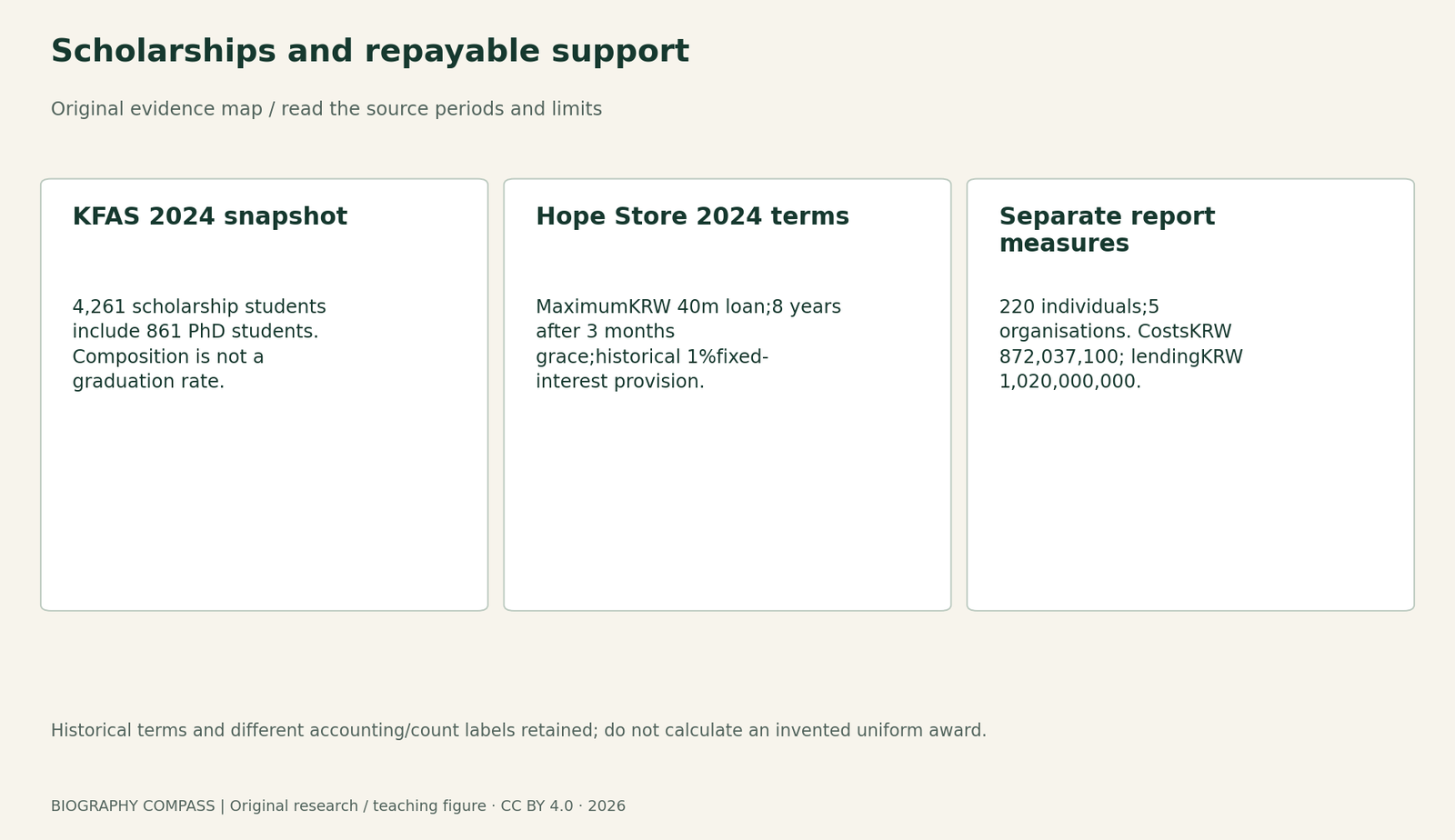
The exhibition text reports 4,261 scholarship students, including 861 PhD students, as a 2024 snapshot. Retain those labels: it does not call the 861 a count of newly completed doctorates in 2024. The numerator and denominator are not an entering class followed to graduation, so their ratio cannot be a completion rate. An undated current institutional website might publish a larger total without contradicting the older exhibition. Growth, a new cutoff date or a different programme boundary can change counts. The original label and publication context belong beside any number reused in a biography or chart.
Sources for this section: [2]
Hope Store’s prospectus describes repayable support
The Korean 2024 prospectus says Hope Store is financed through the Beautiful World Fund formed by Suh’s family in accordance with his wishes. It describes start-up loans up to KRW 40 million, including a shop’s lease deposit, plus consulting and other practical support. The stated repayment period is eight years after a three-month grace period, with a fixed 1% interest provision described in the document. These historical rules show that the cash is not simply an unrestricted gift. They do not establish current eligibility in October 2026, and this comparison is a reading exercise rather than advice to borrow.
Sources for this section: [3]
The annual report uses another accounting frame
The Beautiful Foundation’s 2024 annual report records Hope Store programme costs of KRW 872,037,100, individual support of 220 and support for five organisations. A separate financial footnote gives KRW 1,020,000,000 as Hope Store lending expenditure. Those lines have different accounting roles. Calling their sum “grants handed to 220 new borrowers” would introduce both a new transaction label and an unsupported recipient population. The programme includes case management, consulting and other services, and its report says repayments support other participants. A person receiving support need not have received a new maximum-size loan that year.
Sources for this section: [4]
Separate delivery evidence from impact evidence
A prospectus documents the operator’s rules; an annual report describes its recorded activity; an exhibition presents a selected institutional history. Each is useful primary evidence for a different question. None alone gives a clean counterfactual: what would have happened to the same people without support? To evaluate longer-term effects, seek consistent cohorts, follow-up periods and outcomes such as completed study, business continuity, household stability or participant-defined goals. Record selection and attrition as well as successful stories. Fair comparison can identify different mechanisms without declaring one founder more generous or one programme more effective solely because its headline count is larger.
Exercise: rebuild four evidence cards
An invented donor brochure claims: “KFAS graduated 861 of 4,261 students in 2024, a 20.2% success rate. Hope Store gave 220 new borrowers KRW 1,892,037,100 in grants, and every person received KRW 40 million.” Rewrite four cards labelled Population and date, Educational measure, Financial instrument, and Reported activity. Preserve the exact numbers but attach a defensible meaning to each. Calculate 861/4,261 to one decimal place and explain why arithmetic alone does not validate the brochure’s label. Then propose one question for a future evaluation of each programme without using one programme’s cumulative total as the other’s annual denominator.
Reference answer: attach the right noun to each number
The population card identifies a cumulative institutional scholarship snapshot in the 2024 exhibition, not one annual student intake. The educational card keeps “4,261 scholarship students, including 861 PhD students”; 20.2% is their reported composition, not a graduation success rate. The instrument card identifies a historical loan ceiling of KRW 40 million, not a grant or universal award. The activity card separates KRW 872,037,100 programme costs, KRW 1,020,000,000 lending expenditure and 220 supported individuals. Suitable evaluation questions ask about degree completion over a defined cohort’s follow-up and business or household outcomes over a specified interval. Neither can be answered by adding unlike financial lines or comparing unaligned headcounts.
Continue the chronology
Related history guides
Biography context
Explore South Korea through connected lives
Connected biographies
People and institutions
1929–1998
Chey Jong-hyun
SK Group chairman (1973–1998); Korea Foundation for Advanced Studies founderChey Jong-hyun led the business now known as SK from textiles into energy, chemicals and telecommunications. He also established the Korea Foundation for Advanced Studies in 1974.Read biography1924–2003
Suh Sung-whan
Pacific Chemical founder; cosmetics and tea entrepreneurSuh Sung-whan established Pacific Chemical in 1945 and developed cosmetics manufacturing, research and marketing. His interests also extended to tea cultivation, museums and charitable institutions.Read biographyQuick answers
Common questions
- Does 861 divided by 4,261 give a graduation rate?
- No. The exhibition labels these as scholarship students and an included PhD-student group, not a single intake followed through completion.
- Was the KRW 40 million figure a standard gift to everyone?
- No. The 2024 prospectus describes a maximum repayable start-up loan.
- Can the two programmes be ranked by these headcounts?
- No. Their instruments, reporting periods, recipient populations and outcome measures differ.
Primary and institutional sources
How this history was checked
Read the dated primary records alongside the original exercise. Access and translation limits are stated below. This article was reviewed on 27 October 2026.
- Federation of Korean Industries, Digital Business MuseumChey Jong-hyun: institutional life chronology
- University of Chicago Library with KFAS and SK collaboratorsForest of Leaders exhibition text and item checklist, 2024; PDF pp. 1–4 and 32–33
- The Beautiful Foundation / Hope Store2024 Hope Store start-up loan programme prospectus, five pages
- The Beautiful Foundation2024 annual report: Hope Store programme and financial footnote
- AmorepacificOur History: dated company milestones