
The short answer
A musician’s name can appear as album artist, featured performer, composer, actor or project founder. These are useful connections, but they are not interchangeable credits. Comparing release metadata with a theatre announcement shows how to document a creative contribution without claiming to have heard or seen the work.
Original source comparison
What can each record establish?
Keep the source’s purpose, unit and limit attached to its information.
| Record | Evidence supplied | Limit or next question |
|---|---|---|
| Recording catalogue | Title, version, date, artist billing and release line. | Not automatically a full creative-personnel list or reuse licence. |
| Theatre announcement | Named roles for a particular scheduled production. | Not an assessment of the performance or every other version of the work. |
| Participant process account | A musician’s description of developing ideas. | Not proof a planned album was issued or who worked on every track. |
Chronology
A timeline of the turning points
Development initiative
Rainmaker established NBO MTI in November.
Theatre announcement
New Victory named composer, performers and other production roles.
Joint recording
Bald Men Love Better listed Bien and Aaron Rimbui.
Standard album
Alusa Why Are You Topless? listed sixteen songs.
Start by naming the work and version
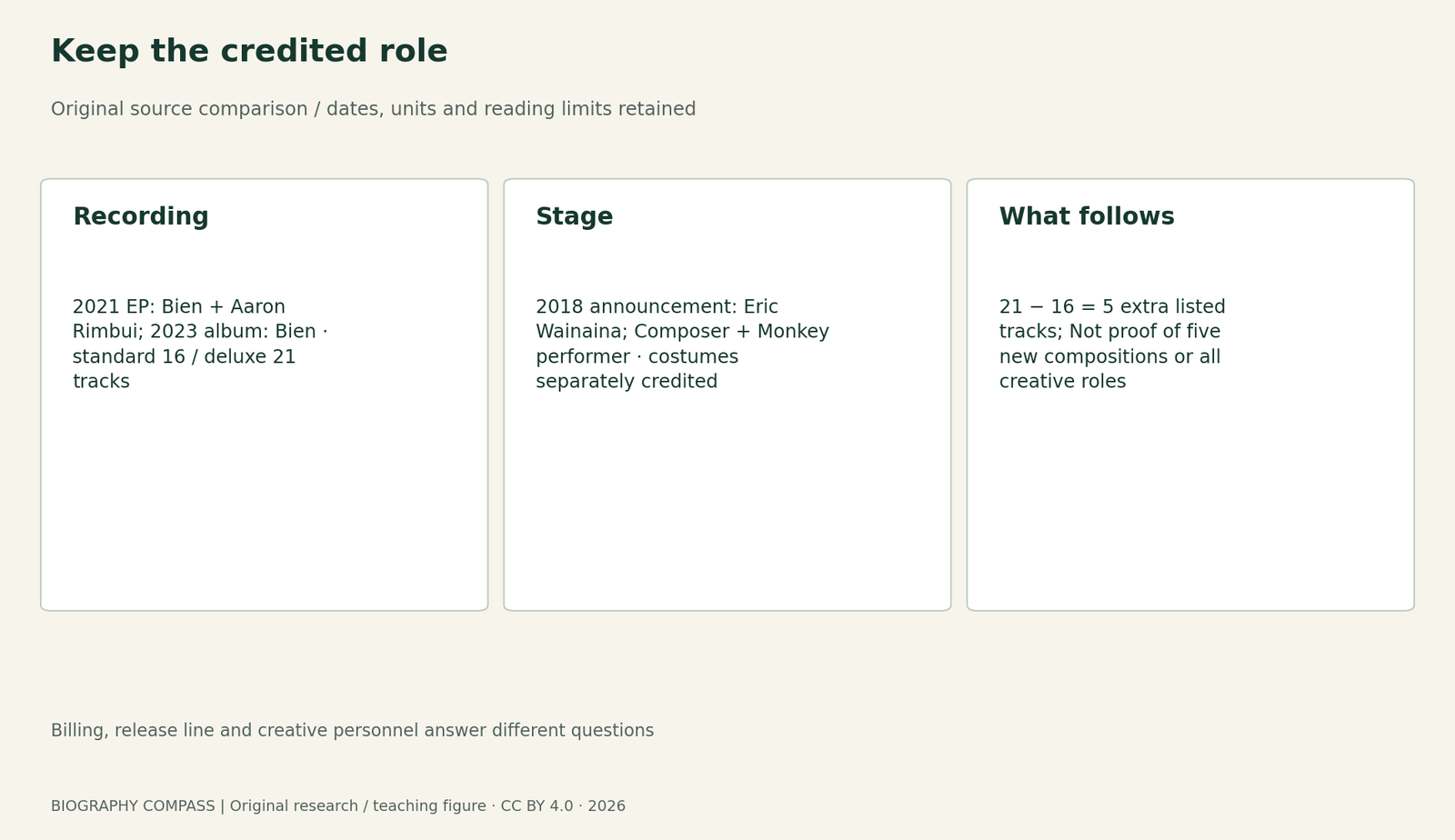
Apple Music lists Bald Men Love Better as a 2021 EP jointly billed to Bien and Aaron Rimbui. It separately lists Bien’s Alusa Why Are You Topless? as a 2023 album, with sixteen songs in the standard version and twenty-one in a linked deluxe version. The group connection to Sauti Sol does not turn either record into a band-wide credit. A useful first row therefore includes title, format, version, date and billed artist. These are release fields. They do not disclose every track’s writer, arranger, performer or producer, and the page’s editorial musical description is not this guide’s own listening judgment.
A phonogram line is a different kind of field
The 2023 standard album record names Exodus Entertainment and Africori, with an exclusive licence to Warner Music Africa. That information should be retained as a release-line statement rather than used to invent creative personnel. A company named there is not automatically the person who composed every song or operated the recording equipment. Nor does a platform listing provide permission to reproduce the cover or audio. When the research question concerns creative labour, seek the relevant personnel credits; when it concerns the release, preserve the particular record and version. One line should not be made to answer every question about a production.
Sources for this section: [2]
Theatre credits attach roles to a particular production
The New Victory Theater’s September 2018 announcement names Eric Wainaina as composer and as the performer playing Monkey in Tinga Tinga Tales: The Musical. It also names other performers, the band, choreography and costume design. The accompanying production-company account is different again from those artistic roles. A scheduled October presentation is an announcement, not a review or proof of every completed show. NBO’s later history records workshops, readings and development activity, which also need their own labels. A composer can perform in a production while remaining distinct from its costume designer and from every other musician onstage.
An account of making music supplies process evidence
Abura describes recording an idea, developing it at the piano and sometimes working with a producer. This participant account identifies stages that a brief release listing may omit. It does not document the personnel on every finished recording. Likewise, an interview discussing a planned album cannot establish that the album was released. Comparing a creative-process account, a release record and a production announcement makes three different questions available: how an idea developed, what was issued and who was credited in a specific stage project. None requires replacing a missing personnel list with an assumption about the most prominent name.
Original exercise: repair a mixed credit sheet
An invented credit sheet says, “Bien’s 2023 album was made by all of Sauti Sol; its deluxe edition contains five newly composed songs; the company in the release line wrote every track. Eric Wainaina’s Monkey role proves he designed the costumes.” Using only the records described here, mark each claim as supported or not established. Calculate the difference between the two listed track counts, then explain what that difference actually counts. Create separate fields for billed recording artist, release-line companies, stage composer, stage performer and costume design. Do not fill a field from a different work merely because the same person appears nearby.
Reference answer: preserve the task behind the name
The four claims are not established by these records. The count difference is 21 − 16 = five additional listed tracks, not proof of five new compositions; extras might have other relationships that require a track-level comparison. The album is billed to Bien, and the release-line companies belong in their own field. The stage announcement credits Wainaina as composer and Monkey performer, while naming Ann McCreath of KikoRomeo for costumes. That stage credit does not establish the album’s personnel. A good sheet can contain an explicit unknown. The purpose is to preserve documented collaboration, not to make every field appear complete by silently borrowing a role from elsewhere.
Continue the chronology
Related history guides
Biography context
Explore Kenya through connected lives
Bien-Aimé Baraza
Distinguish group association, joint billing and a solo release.
Explore the biographiesRead the biographyEric Wainaina
Follow the musician’s separately credited recording and theatre work.
Explore the biographiesRead the biographyAchieng Abura
Compare a participant’s account of composition and development.
Explore the biographiesConnected biographies
People in this guide
Contemporary
Bien-Aimé Baraza
Singer and songwriterBien-Aimé Baraza, known professionally as Bien, is a Kenyan singer and songwriter associated with Sauti Sol and a separate solo recording career. His releases include the joint EP Bald Men Love Better with Aaron Rimbui and the album Alusa Why Are You Topless?.Read biographyContemporary
Eric Wainaina
Singer, songwriter, composer and theatre artistEric Wainaina is a Kenyan musician whose career spans group singing, solo albums and musical theatre. His work includes Sawa Sawa and theatre projects that place him in distinct roles as composer, performer and collaborator.Read biography1963–2016
Achieng Abura
Singer, songwriter, pianist and mentorAchieng Abura was a Kenyan musician whose career moved from gospel recording into Afro-fusion and Afro-jazz. Her work included songwriting, piano, performance and mentoring, alongside a public concern for social and environmental questions.Read biographyQuick answers
Common questions
- Does the guide evaluate the sound or stage performance?
- No. It compares written records and metadata; audio, video and performances were not inspected.
- Do five more listed tracks prove five new compositions?
- No. A track count does not identify the relationship between versions; that would need a detailed track comparison.
Primary and institutional sources
How this history was checked
Sources are listed with exact reading scopes. No complete novel, translation collection, album, film, music video or stage performance was inspected. This article was reviewed on 27 October 2026.
- Apple Music; supplied release metadataBald Men Love Better - EP
- Apple Music; supplied release metadataAlusa Why Are You Topless?
- Earth AgencyBien: artist representation
- The New Victory TheaterTinga Tinga Tales: New Victory press release, 17 September 2018
- NBO Musical Theatre Initiative; RainmakerBrief History: Nairobi Musical Theatre Initiative
- Kenya Yearbook Editorial BoardAchieng Abura – Afro-jazz songbird with a cause, 6 May 2022