
The short answer
How do minimal dialogue and repeated work organise the account of a household?
Read the evidence
Sources, interpretation and production roles
The records answer different questions about this work. The final exercise is an original teaching model.
| Record or question | Supported reading | Boundary or contrast |
|---|---|---|
| Speech | Very little ordinary dialogue | Not an absence of music or sound |
| Labour | Repeated water-carrying | A structure for duration |
| Production | Professional actors and credited craft | Documentary-like does not equal unmediated |
An everyday necessity becomes the film’s structure
The Naked Island is a 1960 feature about a family living on a small island without a supply of fresh water. Criterion’s description identifies rowing to another shore, collecting water and returning with it as a central recurring task. That cycle gives the film a structure different from a story driven chiefly by spoken explanations. Our reading question concerns repetition: what changes when work that a conventional plot might summarize instead occupies a viewer’s attention? The discussion draws on the distributor’s record and Haden Guest’s critical account. The household’s practical dependence on another shore gives a repeated journey both a spatial shape and a purpose that has to be renewed.
Little dialogue does not mean an absent soundtrack
The film’s avoidance of ordinary spoken dialogue can be mistaken for silence in a technical sense. The credits make that inaccurate: Hikaru Hayashi composed the music, while Kunie Maruyama is credited for sound. Guest describes a restrained recurring musical theme whose repetition accompanies the cyclical labour. Our interpretation distinguishes three kinds of organization: bodily work, environmental or produced sound and composed music. They can align without performing the same task. Repeated movement can show effort, while a returning theme can link separate instances into a pattern. This gives composer and sound worker a place alongside the director and performers in an account of the film’s form.
Documentary-like realism remains a made performance
Guest emphasizes that Shindo used professional actors on an uninhabited island. The distributor names the cast and identifies Kiyomi Kuroda’s cinematography and Toshio Enoki’s editing. These are not incidental qualifications to an otherwise unmediated record. Our reading is that the work’s documentary-like appearance and its organized performance can coexist. A family’s routines are presented through chosen framing, duration and sequence, with actors performing the parents and children. Calling the film simply a documentary would conceal those decisions. Conversely, recognizing construction does not make its attention to labour meaningless; it clarifies how cinema can direct sustained attention towards work that everyday spectators might overlook.
Exercise: compare a summary with a cycle
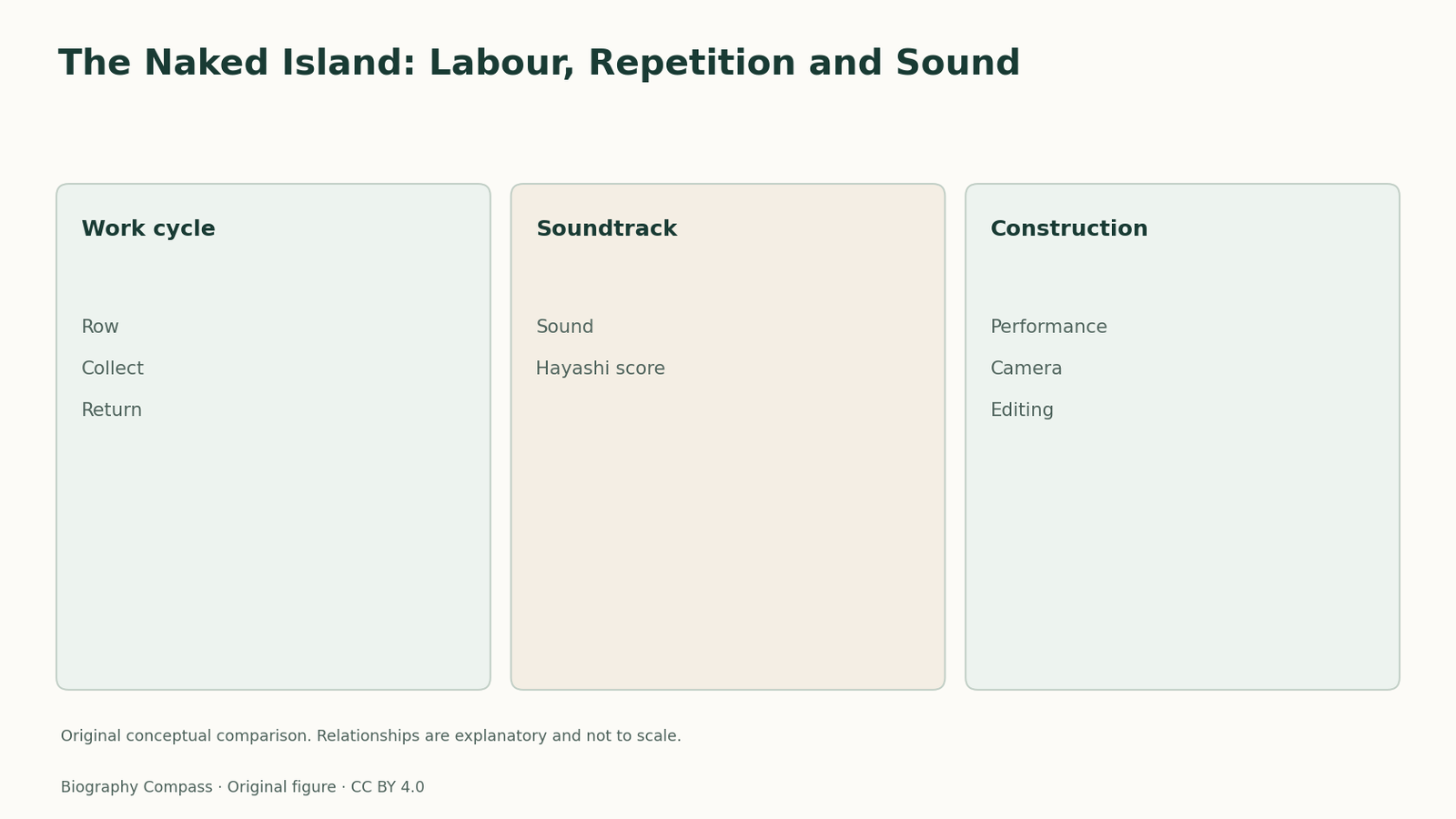
Invent a task that must be repeated, such as carrying water to a garden. Write a single sentence summarizing a whole day, then a plan for three short passages showing the same action at different times. A possible answer lets the first establish necessity while the repeated plan creates duration, effort and variation. Add a returning musical motif to the plan and identify it as a separate compositional decision rather than the sound of the task itself. Finally assign a performer, camera operator and editor to their respective responsibilities. The model helps connect the documented water cycle and Hayashi score with the film’s collaborative construction, by separating the duration of a task from the way an ensemble of film workers presents it.
Continue the chronology
Related history guides
Biography context
Explore Japan through connected lives
Connected biographies
People and related creative practices
1912–2012
Kaneto Shindo
Screenwriter, director and independent producerKaneto Shindo combined a long screenwriting career with independent direction, returning to hardship, war, desire and the possibilities of cinematic sound and image.Read biography1898–1956
Kenji Mizoguchi
Film directorA Japanese director whose moving camera and sustained scenes connected personal suffering with social settings.Read biography1915–2008
Kon Ichikawa
Film director and screenwriterKon Ichikawa worked across animation, literary adaptation, satire, war films and documentary, often in collaboration with the screenwriter Natto Wada.Read biographyQuick answers
Common questions
- Is The Naked Island a silent film?
- It avoids ordinary dialogue but has composed music and a credited sound track.
- Who played the parents?
- Nobuko Otowa and Taiji Tonoyama are credited as the mother and father.
Primary and institutional sources
How this history was checked
The discussion responds to Haden Guest’s critical account and the film’s production record; no complete film or soundtrack review is claimed. The reading exercises and comparisons are original analytical models. This article was reviewed on 8 November 2026.