
The short answer
How does a dependent claim add to a stated base method, and why should an illustrated example not be substituted for the entire claim set?
Original evidence comparison
Follow the references rather than flattening the document
Keep the document type, date and reading scope attached to each conclusion.
| Record or feature | What is established | What remains outside the record |
|---|---|---|
| Claim 1 | Multiple substrates, cells and scanning vapour delivery. | Not a complete machine, test report or universal ALD history. |
| Claims 2–4 | Each explicitly references 1 and adds its stated feature. | A branch is not simply every feature mentioned anywhere in the patent. |
| Description and front page | Implementation example and distinct publication stages. | Not current validity, commercial launch or measured operating results. |
Chronology
A timeline of the turning points
Foreign priority
Date claimed on the original front page.
US filing
This application’s filing date.
Application publication
US 2004/0035362 A1.
Grant
US 6,872,421 B2.
Begin with the document’s own identity
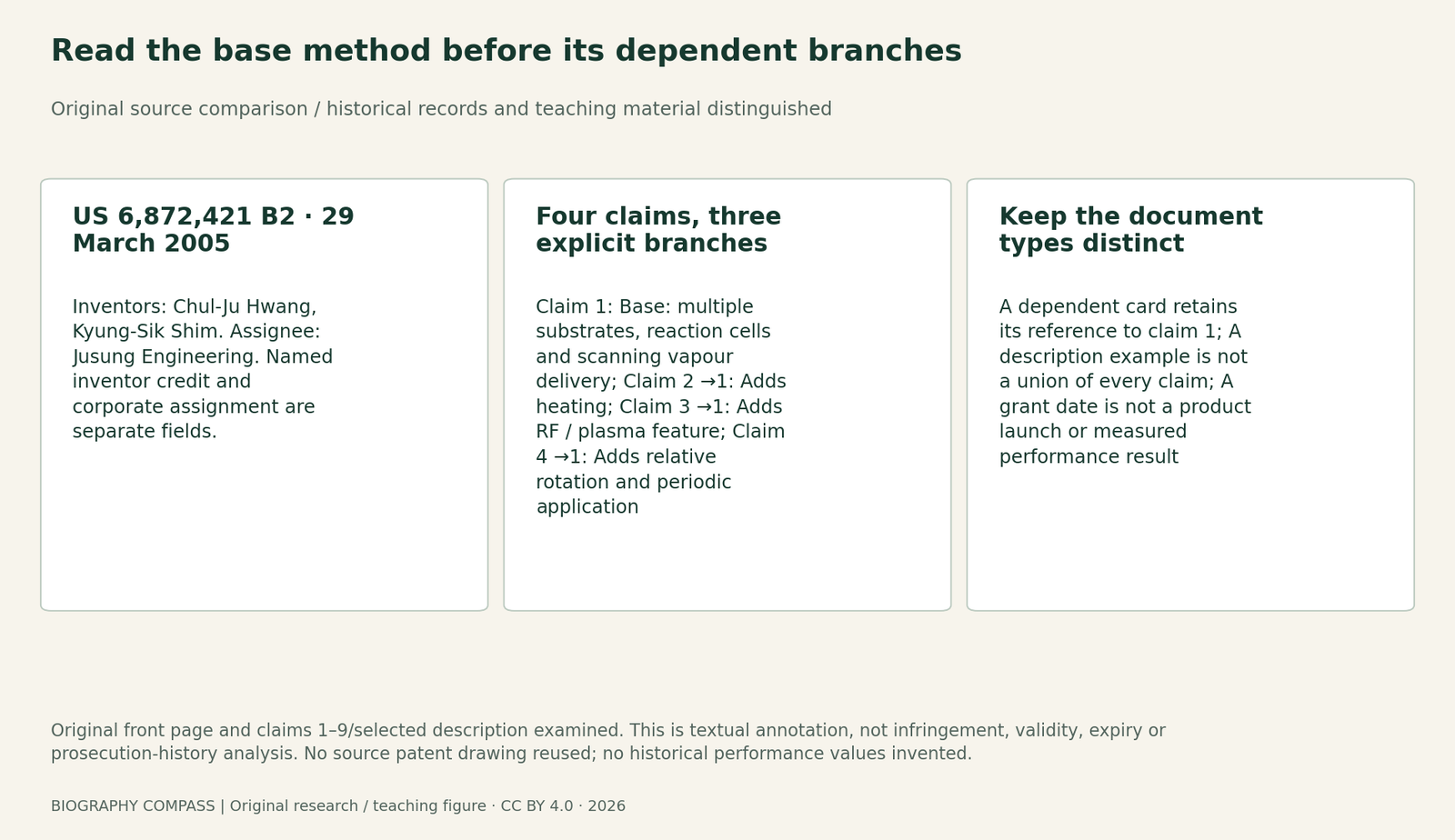
US Patent 6,872,421 B2 is titled Atomic Layer Deposition Method. Its original front page names Chul-Ju Hwang and Kyung-Sik Shim as inventors and Jusung Engineering as assignee. It also separates a Korean priority claim, a US filing, a published application and the 2005 grant. These fields locate the document. They do not establish that the inventor first conceived every part of atomic layer deposition on the priority date, or that a commercial machine launched on the grant date. The more distinctive research task begins inside the claims: how does one numbered statement explicitly build on another?
Sources for this section: [1]
Claim 1 states the base method being referenced
Claim 1 describes multiple substrates in multiple reaction cells within a chamber, and repeated application of different vapour substances using injection pipes that scan over the substrates. This is a paraphrase of the selected claim, not a complete engineering design. The document’s later claims refer back to it, so a reader who copies only the added phrase from a dependent claim loses part of the stated method. The recurring reference to claim 1 is therefore useful information in its own right. It tells the annotator where to look before writing a compact technical summary.
Dependent additions should remain on their own branches
Claim 2 references claim 1 and adds substrate heating. Claim 3 also references claim 1 and adds RF power associated with plasma generation. Claim 4 references claim 1 and specifies relative rotation and periodic application. These are separate textual branches, not an instruction to merge every later detail into one universal description. The precise statement is that claim 1 does not expressly recite each of those added features. It would be different to assert that claim 1 forbids them. The exercise follows explicit cross-references; it does not decide infringement, validity or the full legal reach of any implementation.
An example in the description answers a different question
The selected description discusses a rotating arrangement with successive vapour delivery and illustrates a particular implementation. Examples can help a reader understand a technical proposal, but they should not silently replace the numbered claims. Nor should the presence of a diagram be treated as a factory test report. The original grant includes drawings and an account of expected advantages; this guide does not reproduce those illustrations or claim independently measured throughput. The company’s separate history records equipment and research milestones. That supplies business context, while the patent supplies a bounded description of invention work and its stated claims.
Preserve publication stages without adopting machine-status labels
The front page gives 9 August 2000 as the foreign-priority date, 19 August 2003 as this US application’s filing date, 26 February 2004 for the application publication and 29 March 2005 for the grant. It also identifies an earlier parent application, so this is not a single unbroken filing event. Google’s page helps locate the record and transcribes its claims, but warns that status and assignee fields may be assumptions. The guide uses the original front-page facts and selected claim text. It does not repeat an automated expiry label as a current legal opinion or infer a product’s commercial performance from a grant.
Original exercise: make a claim-reference card
Prepare four cards for a technical-reading notebook. Card 1 summarises the base method; cards 2, 3 and 4 identify their explicit reference and added feature. Now audit three notes: “Claim 3 is only an RF statement, without the method in claim 1”; “every claim must contain every feature shown in the rotating example”; and “the 2005 grant proves a 2005 product launch.” Correct each note using the document type and cross-references. Finally, identify a separate record that could help study an actual machine’s operating performance. Do not invent measured speed, yield or a current licensing conclusion from the patent alone.
Reference answer: retain the base before adding a feature
Card 1 should retain the multiple substrates, reaction cells and scanning vapour-delivery method. Cards 2–4 should each point back to 1, then identify heating, RF/plasma and relative rotation respectively. The first note omits the incorporated textual reference; the second substitutes an example and a union of features for distinct claim branches. The third confuses a grant record with a launch record. A dated product announcement could investigate launch, while a defined test report or customer-acceptance record could investigate performance. The method is useful because it preserves what the document actually states while making the next evidence question explicit.
Continue the chronology
Related history guides
Inflectra in 2016: Proposed Uses and Approval
Which statements in a regulatory review describe an applicant’s request, and which establish what the regulator actually licensed?
Read the timeline2019–2021Woowa and Yogiyo: What Did Approval Require?
Why did permission to acquire the operator of Baemin require a sale of Yogiyo, and what do the surviving announcements actually establish?
Read the timelineBiography context
Explore United States through connected lives
Connected biographies
Business lives in context
1959–
Hwang Chul-joo
Semiconductor-equipment entrepreneurHwang Chul-joo developed a semiconductor-equipment business after technical education and experience with electronics and equipment companies.Read biographyQuick answers
Common questions
- Does claim 1 expressly require every later feature?
- The selected text does not recite every addition. Claims 2–4 refer to 1 and state distinct added features.
- Is this an assessment of infringement or patent validity?
- No. It is a source-reading exercise following explicit references in a historical grant. No full prosecution, litigation or current-status file was read.
Primary and institutional sources
How this history was checked
These original comparisons and worked exercises use the stated records. Selected-page reading is explicit; proposed, approved, claimed and independently measured are different descriptions. This article was reviewed on 27 October 2026.