
The short answer
Why was capsaicin a useful probe for finding a heat-sensitive receptor?
Evidence comparison
Capsaicin as a Probe for Heat Sensing
Compare the observations with the narrower conclusions they support.
| Record or observation | What it supports | What remains separate |
|---|---|---|
| A clone confers capsaicin responsiveness | Links a defined molecular candidate with a chemical response | Does not alone establish heat activation |
| Heat activates the cloned channel | Adds temperature sensitivity to the molecular account | Does not explain all pain or every thermal response |
Use a chemical response to find a molecular candidate
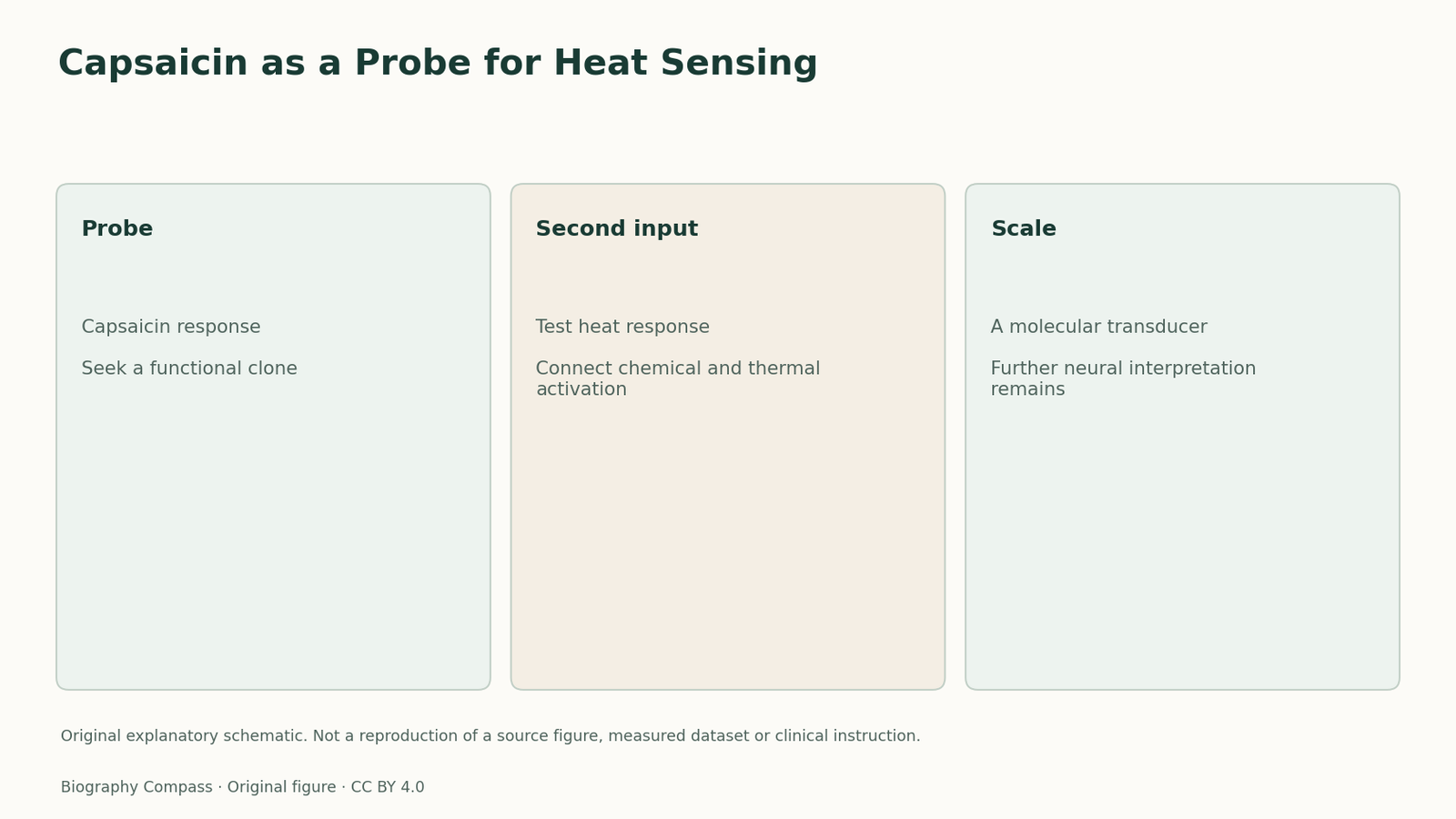
The 1997 capsaicin-receptor paper began with a response that could be sought in an expression-cloning experiment. Introducing candidate genetic material into a test system allowed investigators to identify a functional clone associated with capsaicin sensitivity. The point was not simply that chilli peppers feel hot. The experimental question was whether a defined molecular component could confer a measurable response to the compound.
Test a second kind of input
The cloned receptor was a cation channel, and the paper also reported activation by heat in a noxious range. This second observation connects chemical and thermal stimulation at a molecular level. It differs from finding capsaicin binding alone, which would not establish temperature responsiveness. Conversely, the result does not demonstrate that every heat-sensitive neuron uses only this receptor or that a response in an expression system reproduces a complete pain experience.
A two-input evidence grid
Make an original classroom grid with two columns, capsaicin response and heat response. Label four hypothetical preparations as responding to neither input, only capsaicin, only heat or both. Ask which preparation could support a dual-response hypothesis: the one that responds to both under comparable tests. The answer still requires controls for the host system and the introduced component. This invented grid is a way to organise inference, not a replacement for the paper's recordings or an experiment for readers to perform.
Sources for this section: [4]
Connect the discovery to its proper scale
A receptor identifies one part of sensory transduction. Neural pathways and interpretation occur at further levels. Reading Julius alongside Patapoutian makes the shared question visible while preserving the different chemical, thermal and mechanical evidence used to identify particular sensory mechanisms.
Continue the chronology
Related history guides
Biography context
Explore United States through connected lives
Connected biographies
Researchers and related questions
1955–
David Julius
Physiologist and molecular sensory-system researcherMichael Caterina and colleagues, including Julius, reported an expression-cloning approach to the capsaicin receptor in 1997.Read biography1967–
Ardem Patapoutian
Molecular biologist and mechanosensation researcherIn 2010, Bertrand Coste and colleagues, including Patapoutian, reported evidence involving proteins named Piezo1 and Piezo2.Read biography
1946–
Richard Axel
Molecular biologist and olfactory-system researcherAxel and Linda Buck identified a large odorant-receptor gene family in 1991.Read biographyQuick answers
Common questions
- Why was capsaicin a useful probe for finding a heat-sensitive receptor?
- Links a defined molecular candidate with a chemical response. Does not alone establish heat activation.
- Are the classroom examples historical measurements?
- No. Invented examples are labelled as classroom models; the source-based discussion identifies the historical evidence separately.
Primary and institutional sources
How this history was checked
Official biographical and award records are read alongside the researcher’s technical account. Source scope and hypothetical examples remain distinct. This article was reviewed on 7 November 2026.