
The short answer
A larger money total can buy less. Before deciding whether an aid programme expanded, identify the price basis, the period and whether the number describes a plan, a commitment or an actual payment.
Compare the records
Separate three properties of an aid figure
A number needs its own definition before it can support a conclusion.
| Evidence | What it can establish | What remains to test |
|---|---|---|
| Money total | The stipulated nominal amount. | What its purchasing power was. |
| Price basis | An adjustment under the chosen index. | Every project’s actual input costs. |
| Programme result | Only what delivery records show. | Causation from a budget announcement alone. |
Chronology
A timeline of the turning points
Debate
Price-basis criticism and commitment limits were discussed.
Correspondence
McNamara wrote to Hart about constant-price budgeting.
A letter with a precise scope
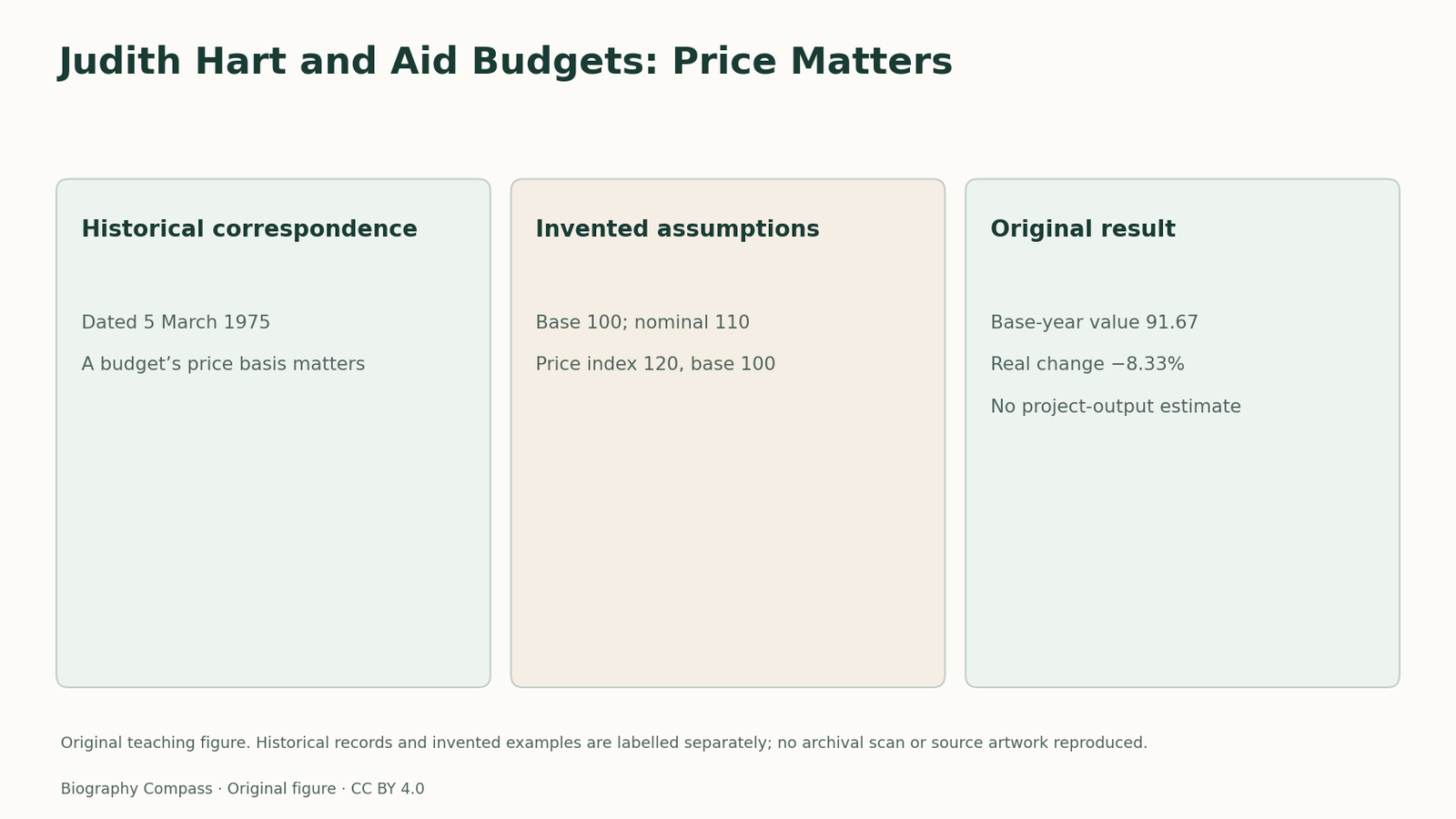
On 5 March 1975, Robert McNamara thanked Hart for comments on Britain’s practice of budgeting aid in constant prices. He contrasted this with current-price budgeting and described adjustments to the Bank’s lending programme as inflation exceeded forecasts.
The letter records his position and acknowledges her contribution. It does not reproduce her earlier letter, establish that every budget was protected, or show how many services a particular project delivered.
Sources for this section: [1]
An earlier argument about the numbers
In the November 1969 debate, Reg Prentice criticised the price basis of aid figures. Hart’s later reply distinguished a forward course towards a target from a guarantee beyond the planning horizon. The two speakers were making related but different arguments.
Price adjustment and commitment therefore need separate annotations. A real-terms estimate is not automatically money already paid, while a firm nominal amount can still leave purchasing power uncertain. Keep the accounting object attached to the number.
Sources for this section: [2]
Original exercise: an invented price index
Let a base-year budget be 100 units and its price index 100. A later nominal budget is 110 units and the stipulated price index is 120. Express the later amount in base-year purchasing-power units using nominal amount × 100/index. Calculate its change from 100. Then repeat with an index of 105, holding the nominal amount at 110.
Reference answer: 110 × 100/120 is about 91.67, a real decrease of about 8.33%, despite the 10% nominal increase. With the index at 105, the result is about 104.76, a real increase of about 4.76%. The price assumption changes the conclusion. These are original supplied inputs, not historical British aid totals.
What the calculation cannot deliver
The exercise holds the index’s coverage and the spending basket fixed. Actual project inputs, exchange rates and timing could require further investigation. The arithmetic alone cannot count completed classrooms, determine a recipient’s welfare or demonstrate that a policy succeeded.
A stronger reading would request the stated price base and basket, identify whether the sum is a budget or payment, and compare the relevant periods. It would then seek evidence of delivery and outcomes. The historical letter motivates those questions; it does not supply the missing observations.
Continue the chronology
Related history guides
Biography context
Explore United Kingdom through connected lives
Connected biographies
A connected working life
1924–1991
Judith Hart
Labour politician and development ministerHart’s political career connected social research, ministerial work and arguments about the purposes of international aid.Read biographyQuick answers
Common questions
- Does a ten-percent nominal increase guarantee a real increase?
- No. In the stipulated case, a price index rising from 100 to 120 more than offsets the money increase from 100 to 110.
Primary and institutional sources
How this history was checked
Dated records are distinguished from retrospective accounts and original teaching cases. This article was reviewed on 31 October 2026.