
The short answer
The words owner and partner can conceal several different arrangements. Ask who holds property, who receives a benefit, who manages the business and who can change the governing rules.
Read the records
Separate the document’s object from the inference
Each comparison identifies what a record can support and what remains to be checked.
| Record | What it establishes | What it does not establish |
|---|---|---|
| First settlement | Profit benefit with retained control | A completed transfer of every right |
| Later settlement | Transfer of remaining shares | Individual direct share certificates |
| Governance report | Trustee and amendment conditions | Current rules or actual participation quality |
Chronology
A timeline of the turning points
First stage
Distinguish benefit from ultimate control.
Further transfer
Remaining shares transferred.
Report snapshot
Read the named authorities and conditions.
The two settlements were not the same event
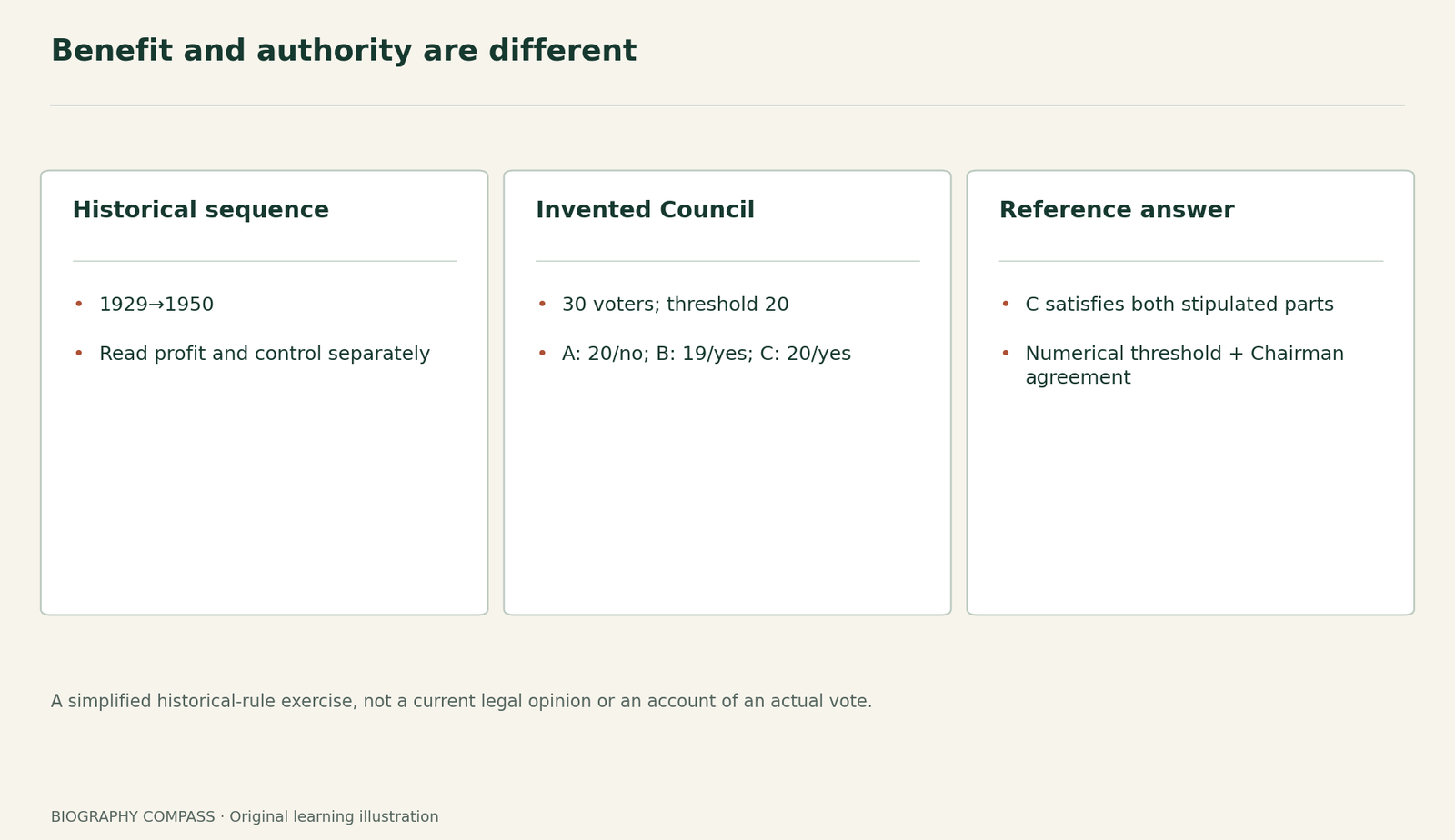
The archive dates the first settlement to 18 April 1929. Trustees held shares for workers’ benefit, while Spedan retained practical control through ordinary shares. It dates the transfer of remaining shares to 26 April 1950.
The sequence prevents an easy but misleading inference: passing benefits to workers did not mean that all controlling rights had already moved at the first step. Nor does beneficial ownership automatically mean an individual transferable share certificate for every worker.
Sources for this section: [1]
A later report identifies the governance structure
The 2019 report names John Lewis Partnership Trust Limited as trustee. It makes the Constitution subordinate to the settlements and divides power between Council, Board and Chairman. Constitutional amendments require agreement between two-thirds of the Council’s voting membership and the Chairman.
This is a dated description, not a claim that the same wording is operative today. Ownership, operational management and rule amendment are separate entries in an institutional map. The map alone does not measure how freely people used their voices.
Sources for this section: [2]
An original amendment file
Assume an invented Council has 30 voting members, with no vacancies or special voting rules. File A records 20 votes in favour and the Chairman’s refusal. File B records 19 in favour and the Chairman’s agreement. File C records 20 in favour and the Chairman’s agreement.
Apply the two-thirds-plus-agreement condition from the selected report. Which file satisfies both parts? State the threshold calculation and explain why a majority alone is insufficient. The votes are invented, not a reconstruction of a Partnership meeting.
Sources for this section: [2]
Reference answer and the historical boundary
Two-thirds of 30 is 20. A meets the numerical threshold but lacks the second agreement. B has agreement but falls one vote short. C meets both stipulated conditions. This conclusion assumes the simplified file is complete and says nothing about other procedural requirements.
The example shows why a governance rule must be read as a combination of conditions. It does not show that one structure guarantees commercial success, fair treatment or a particular contemporary legal result.
Sources for this section: [2]
Continue the chronology
Related history guides
Rowntree Trusts: Reading Intentions
Compare a different historical institution through its records and a bounded original learning task.
Read the timeline1871/1873 records; later provenance enquiriesSaltaire Rules: Who and What Did They Govern?
Compare a different historical institution through its records and a bounded original learning task.
Read the timelineBiography context
Explore United Kingdom through connected lives
Connected biographies
People connected with these records
1885–1963
John Spedan Lewis
Retail reformerReworked profit sharing and control in retail.Read biographyQuick answers
Common questions
- Does employee benefit establish direct personal shareholding?
- No. Read the named holder and the arrangement’s conditions before describing an individual’s rights.
Primary and institutional sources
How this history was checked
The archive narrative and selected 2019 report pages were read. The complete deeds and a current constitution were not inspected. This article was reviewed on 30 October 2026.