
The short answer
A musical idea, a timed passage in a film and a recorded album are different objects. Reading their records together makes it possible to ask a more precise question than whether a soundtrack has one recognisable theme.
Evidence and interpretation
What each record adds
Compare the production task and the authority behind its description.
| Record | Supported finding | Further question |
|---|---|---|
| Musical terminology | A recurring phrase differs from a scene-related cue. | How can one idea cross several timed passages? |
| Recording credits | Film-score and album sessions are distinguished. | Which recorded performance does an edition contain? |
Chronology
A timeline of the turning points
Film-score sessions
The label identifies the film-score recordings.
Album sessions
The label separately identifies album recording.
A recurring idea is not the entire score
The Academy’s education guide defines a leitmotif as a short recurring phrase associated with a character, situation or emotion, and uses the two-note shark theme in Jaws as an example. A cue is a piece attached to a scene or segment; cues together form a score.
Intrada’s anniversary release description stresses the score’s adventurous material as well as the threatening shark theme. A famous musical cell therefore gives a starting point for investigation, rather than a complete description of everything composed for the film.
Recording dates separate performances
The label credits John Williams as composer and conductor. It dates the original film-score sessions to 3, 4 and 10 March 1975, source-music recording to 5 March, and the soundtrack-album sessions to 17–18 April. Its 2025 set separates the film score and original album programme.
These dates establish different recording occasions. They do not, without listening or a score comparison, prove that every track has a particular audible difference. The practical question is which performance and programme a record identifies. A release year alone cannot answer that question.
Original spotting-plan task
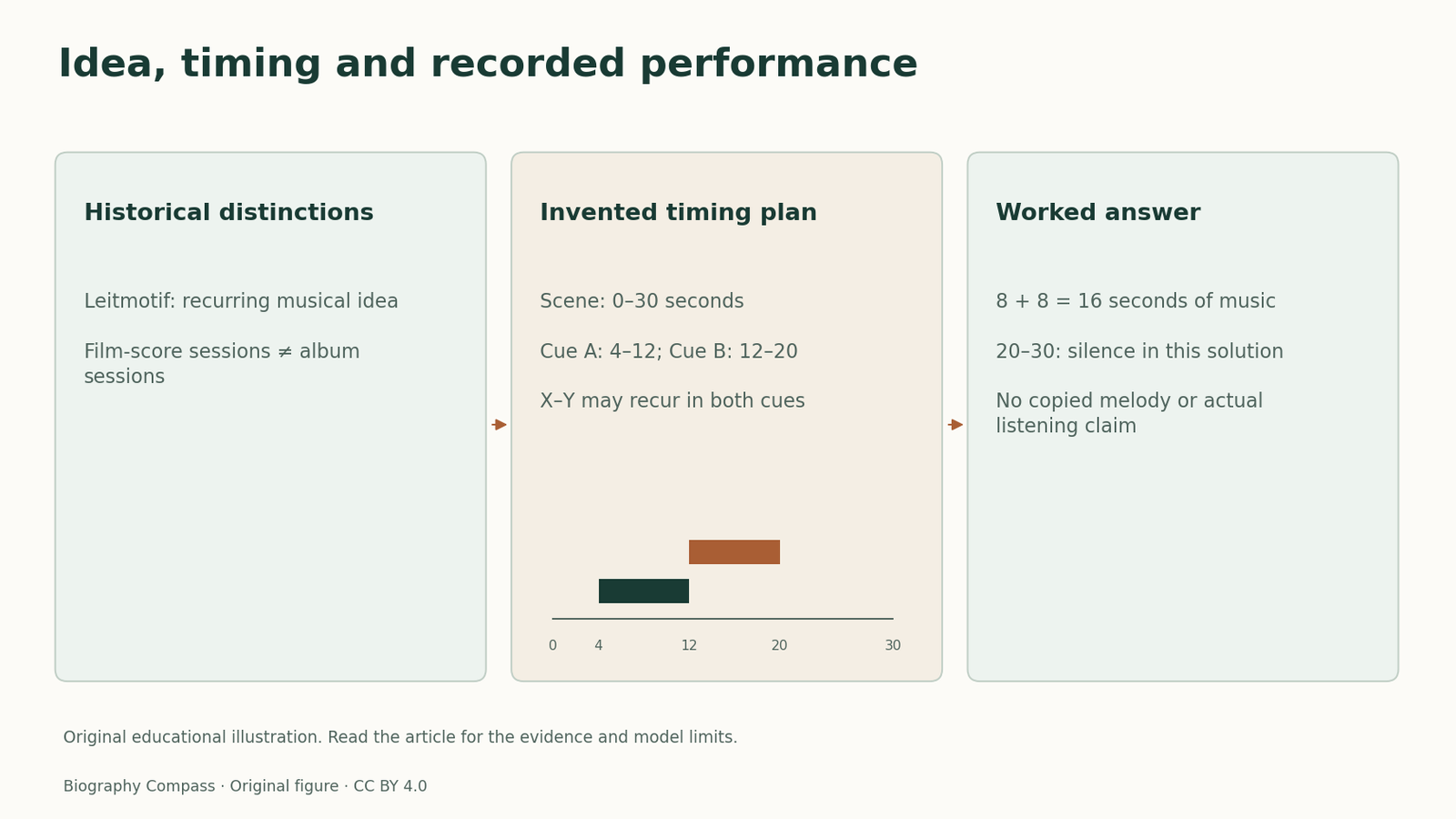
Invent a two-event musical cell, labelled X–Y, without copying any film melody. Supplied scene plan: an empty corridor lasts 12 seconds, a door opens over 8 seconds, and a character sees an ordinary room for 10 seconds. Cue A runs from second 4 to second 12; Cue B runs from second 12 to second 20. Choose where X–Y recurs and whether the final ten seconds contain music. Calculate total cue time and explain one change in what the viewer might expect.
Reference answer: put X–Y softly in Cue A, repeat it faster in Cue B, and leave seconds 20–30 without music. The two non-overlapping cues total (12 − 4) + (20 − 12) = 16 seconds. The recurring cell links expectation across two separate cues; silence after the reveal can weaken the expectation of continuing danger. A different solution could retain the cell at an unchanged speed to suggest unresolved uncertainty. Neither solution describes the actual Jaws score or requires a recording to have been heard.
Continue the chronology
Related history guides
Biography context
Explore United States through connected lives
Connected biographies
Creative lives behind the records
born 8 February 1932
John Williams
Composer, pianist and conductorWilliams wrote for cinema and concert halls while sustaining a conducting career.Read biographyQuick answers
Common questions
- Does the exercise reproduce the shark theme?
- No. X–Y is an invented label, with no supplied pitches or copied score. The exercise concerns recurrence, timing and dramatic expectation.
Primary and institutional sources
How this history was checked
Read the linked credits and participant accounts alongside the original task. Dates identify the stated object or event; the exercise inputs are invented. This article was reviewed on 31 October 2026.