
The short answer
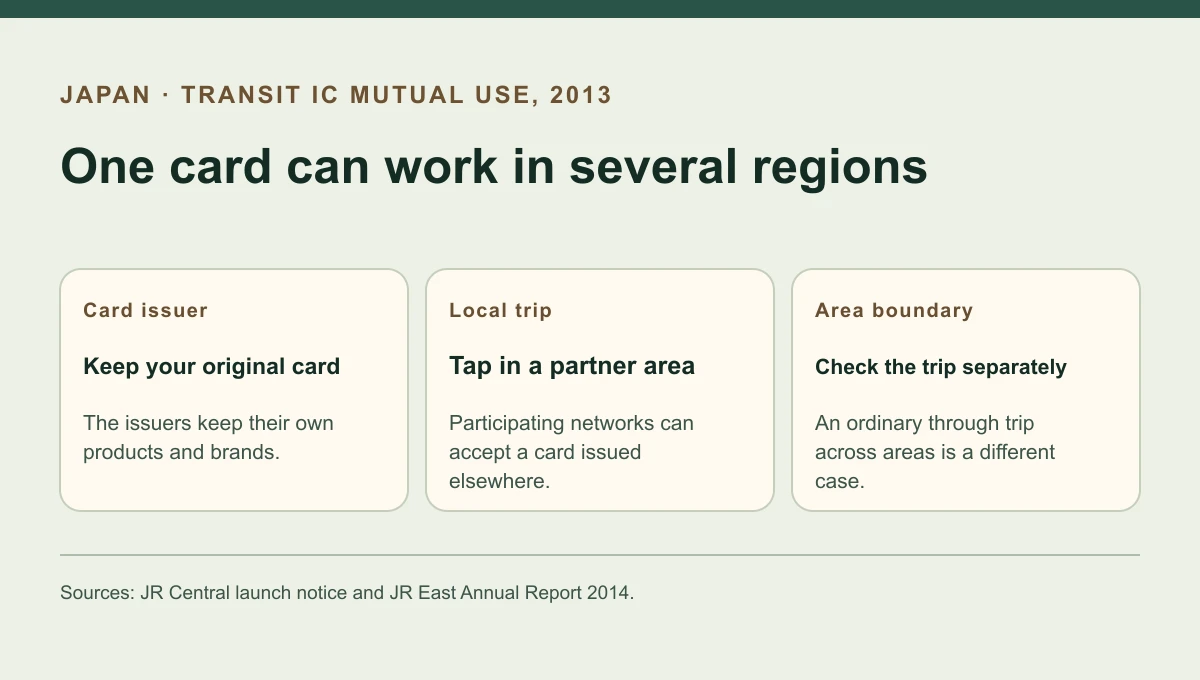
On 23 March 2013, Japan’s ten participating transit IC card schemes began offering broader mutual use. A rider could take a card issued in one area and use it for eligible trips in another participating area. The regional fare boundaries still mattered when somebody tried to make one continuous journey across them.
A shared card network with local boundaries
What mutual use included
Start by distinguishing who issued the card from where an individual trip takes place.
| Case | Rule in the launch-era sources | What a passenger gains |
|---|---|---|
| Within another area | A participating service recognises a partner card. | A visitor can take an eligible local trip without obtaining another card. |
| Across service areas | Ordinary continuous travel across different IC areas generally falls outside the arrangement. | A card accepted on both networks still has to meet the rules for the whole trip. |
| At shops | The agreement handles e-money separately and excludes PiTaPa from mutual shopping use. | Transit acceptance and retail acceptance can have different boundaries. |
Chronology
A timeline of the turning points
Operators begin joint studies
Early announcements identify the targeted card schemes and a spring 2013 start.
The participants announce agreement
The scheme covers eligible transit use along with separate rules for shopping.
Mutual use launches
Participating systems accept cards from partner areas under defined conditions.
Which cards participated
The start announcement lists Kitaca, PASMO, Suica, manaca, TOICA, PiTaPa, ICOCA, Hayakaken, nimoca and SUGOCA. They came from multiple regional and local issuers. The agreement connected the systems while allowing the brands and issuers to continue serving their own markets.
How acceptance differs from trip coverage
A person could use a compatible card for a qualifying local journey in another participating area. The card issuer and the operator carrying the passenger could therefore be different. JR East’s report also explains that ordinary single journeys spanning separate IC areas generally could not be treated as if those areas formed one continuous zone.
That distinction is useful when looking at old route maps. A map of card acceptance tells a visitor where a card can work. The rules for a through trip also depend on how the trip’s starting and ending points are grouped by the railways.
Why payment at shops needed its own rule
The agreement materials distinguish electronic money at participating shops from transport use and give a specific exception for PiTaPa on mutual retail payments. It is evidence that compatibility was defined function by function. The system allowed reuse of a card for agreed purposes while leaving some rules tied to the operator, service area or type of payment.
Continue the chronology
Related history guides
Connected biographies
People connected to this history
Quick answers
Common questions
- When did Japan’s ten-card arrangement start?
- The operators set 23 March 2013 as the launch date.
- Did the same rules apply to all continuous trips and shops?
- The service areas still had boundaries for through trips, and the agreement had a separate PiTaPa exception for mutual use at shops.
Primary and institutional sources
How this history was checked
Dates, legal milestones and historical claims are checked against the official and institutional records below. This article was reviewed on 19 November 2026.