
The short answer
How does Muriuki’s Matatus use blur and still photography to describe Nairobi’s moving transport?
Compare the records
What the sources allow us to say
Read the object record alongside the contextual account.
| Record | Evidence | Reading limit |
|---|---|---|
| Museum object account | Matatus uses motion and blur within still photography. | A blurred image does not supply a traffic measurement. |
| Artist biography | Connects the series with Nairobi and urban experience. | A selected route or view is not a complete city history. |
A transport subject with a social setting
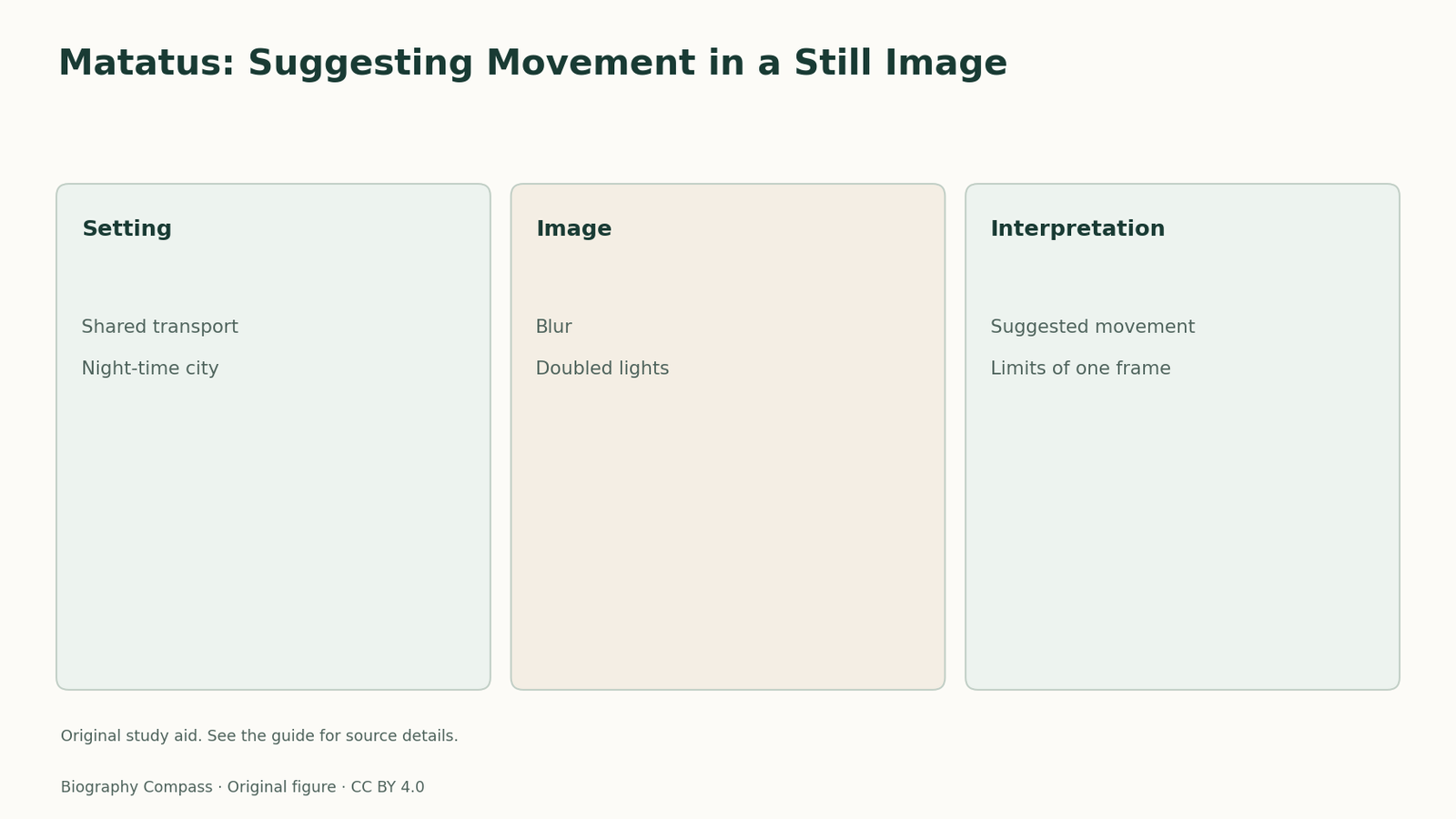
The Walther Collection identifies Matatus as 2005 photographs within Muriuki’s Town series. The vehicles provide shared transport in Nairobi and also carry decoration, music and social associations. This setting explains why the subject can convey more than a route between work and home. The photograph selects one moment within that wider activity. Its visual construction must therefore be examined alongside the transport context, without assuming that every sound, journey or social relationship can be directly recovered from the still image.
Sources for this section: [2]
Blur changes how a moment is perceived
The collection account describes sharp contrasts, blurred forms and doubled lights in night traffic. These effects make motion and density perceptible even though the photograph itself remains still. Ask which features are clearly identified and which are suggested through visual traces. The distinction is useful because a photograph can make movement felt without providing a measurable account of a vehicle’s speed. Its expressive force comes partly from the uncertainty between a passing bus, a crowded street and the viewer’s own position.
Sources for this section: [2]
Compare an object reading with an artist’s inquiry
ICP’s biography situates Muriuki within an investigation of changing societies and the possibilities of lens-based media. Use that wider account to frame a close description of one Matatus image. A supported answer should begin with observable light and blur, then connect them with an interpretation of urban movement. It should leave precise claims about a driver’s intentions or the passengers’ experience open. The photograph contributes a particular visual encounter with Nairobi, while the broader city remains larger and more varied than that encounter can encompass.
Continue the chronology
Related history guides
Biography context
Explore Kenya through connected lives
Connected biographies
Read the artist’s biography
b. 1977
James Muriuki
Photographer and curatorA Kenyan artist whose lens-based practice studies social change, urban movement and the images through which communities know themselves.Read biographyQuick answers
Common questions
- Can the blurred image establish a bus’s exact speed?
- No. It can suggest motion, but a precise speed would require evidence beyond the photograph and its catalogue description.
Primary and institutional sources
How this history was checked
The listed records support the facts. Observation exercises and arguments are Biography Compass editorial interpretations. This article was reviewed on 7 November 2026.