
The short answer
How does If We Dream Too Long place a young clerk’s uncertain future within newly independent Singapore?
Compare the records
Different records answer different questions
The distinctions below follow the identified sources.
| Record | What it establishes | Limit of the conclusion |
|---|---|---|
| NUS Press edition record | Confirms 1972 firstpublication and distinguishes a later edition. | Does not date every drafting stage to 1972. |
| Officialchapter 3 excerpt | Shows routine, nightchoices and a Sabah daydream. | An imagined permit obstacle is not an actual refusal. |
| Jamie Lin’s criticalintroduction | Identifies 1968 composition and an outsider interpretation. | A critical frame is not the only possible reading of the passage. |
Writing and publication belong on different lines
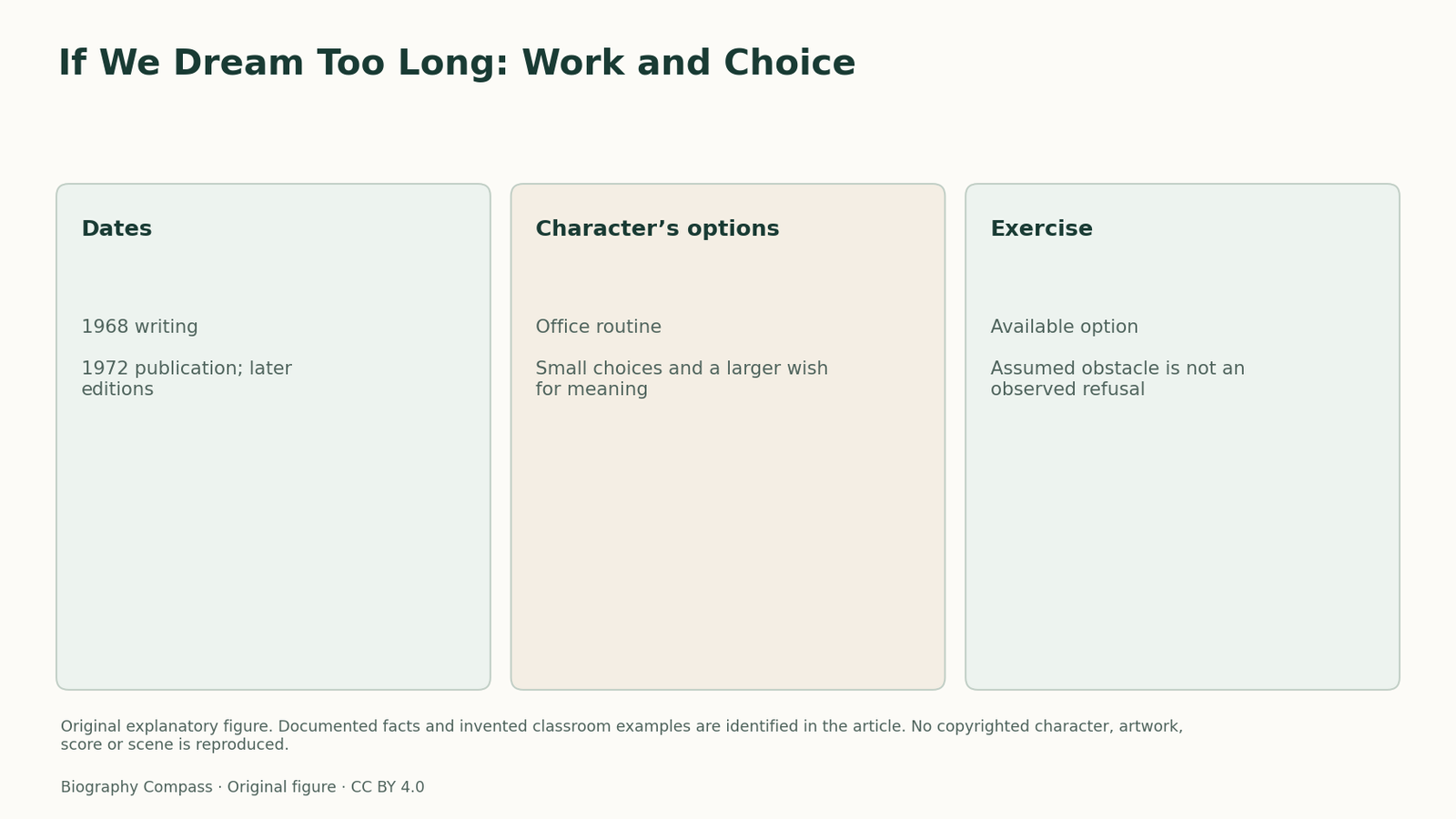
If We Dream Too Long was written in 1968 and first published in 1972. NUS Press confirms the publication date, while Jamie Lin’s critical introduction identifies the earlier period of composition. The distinction prevents an anniversary or biographical summary from dating every stage to the same year. The later publisher’s description also places the work within a changing 1960s Singapore. A novel can therefore portray a period earlier than its appearance in print, and a subsequent restored edition adds another date without replacing either the writing or first-publication history.
Routine is not the same as an absence of decisions
The chapter 3 excerpt on Goh’s official website follows Kwang Meng through office routine and evenings in which he must choose where to go and what to do. The contrast is not simply employment versus freedom. He experiences work as a setting where others have already determined much of his action, yet his available night-time choices also fail to give his life a larger purpose. This is a close reading of the inspected passage: an abundance of small decisions does not necessarily answer a desire for meaningful direction. It should not become a general diagnosis of every young clerk or of the author’s medical career.
Sources for this section: [4]
An imagined escape meets an imagined obstacle
In the same excerpt, Uncle Cheong’s account of opportunities in Sabah prompts Kwang Meng to picture himself as a pioneering descendant of migrants. The fantasy grows until he thinks about the need for a work permit and assumes he lacks the influence to obtain one. The text records that assumption, not an actual rejected application. The distinction is interpretively important: the barrier belongs partly to the way he imagines the future before testing it. Lin’s discussion of the outsider adds one critical frame, but the passage itself preserves the movement from excitement toward paralysis without requiring us to know the entire novel’s conclusion.
Choice chart and answer
Make two columns headed available choice and meaningful action. Place an invented decision about tonight’s entertainment in the first, and a proposed change of occupation in the second. Then add a third label, assumed obstacle, and ask how a character’s untested expectation might prevent movement between them. A supported answer distinguishes having options from believing that an option can sustain a worthwhile life. It also separates a character’s prediction from an event that has actually happened in the fictional world. The chart draws on the inspected office-and-Sabah passage, not on invented claims about later chapters. It gives readers a specific way to assess the relation between hesitation, social expectations and self-understanding.
Continue the chronology
Related history guides
Biography context
Explore Singapore through connected lives
Connected biographies
People and practices to explore
1936–2010
Goh Poh Seng
Novelist, playwright and physicianGoh Poh Seng combined medical work with writing and arts organisation, creating If We Dream Too Long and helping develop spaces for Singapore’s English-language literature.Read biographyb. 1948
Suchen Christine Lim
Novelist and educatorSuchen Christine Lim writes fiction attentive to people left at the margins of public histories, including the teacher-artist at the centre of the prize-winning Fistful of Colours.Read biography1939–2002
Kuo Pao Kun
Playwright and theatre educatorKuo Pao Kun built institutions for theatre across languages.Read biographyQuick answers
Common questions
- Was If We Dream Too Long first published in 1968?
- The checked publisher record gives 1972. The critical introduction identifies 1968 as its composition period; those are different stages.
Primary and institutional sources
How this history was checked
Written catalogues, production records and interviews are distinguished from our own learning exercise. No complete film viewing, song listening or full-novel reading is claimed where only the identified written material was inspected. This article was reviewed on 7 November 2026.