
The short answer
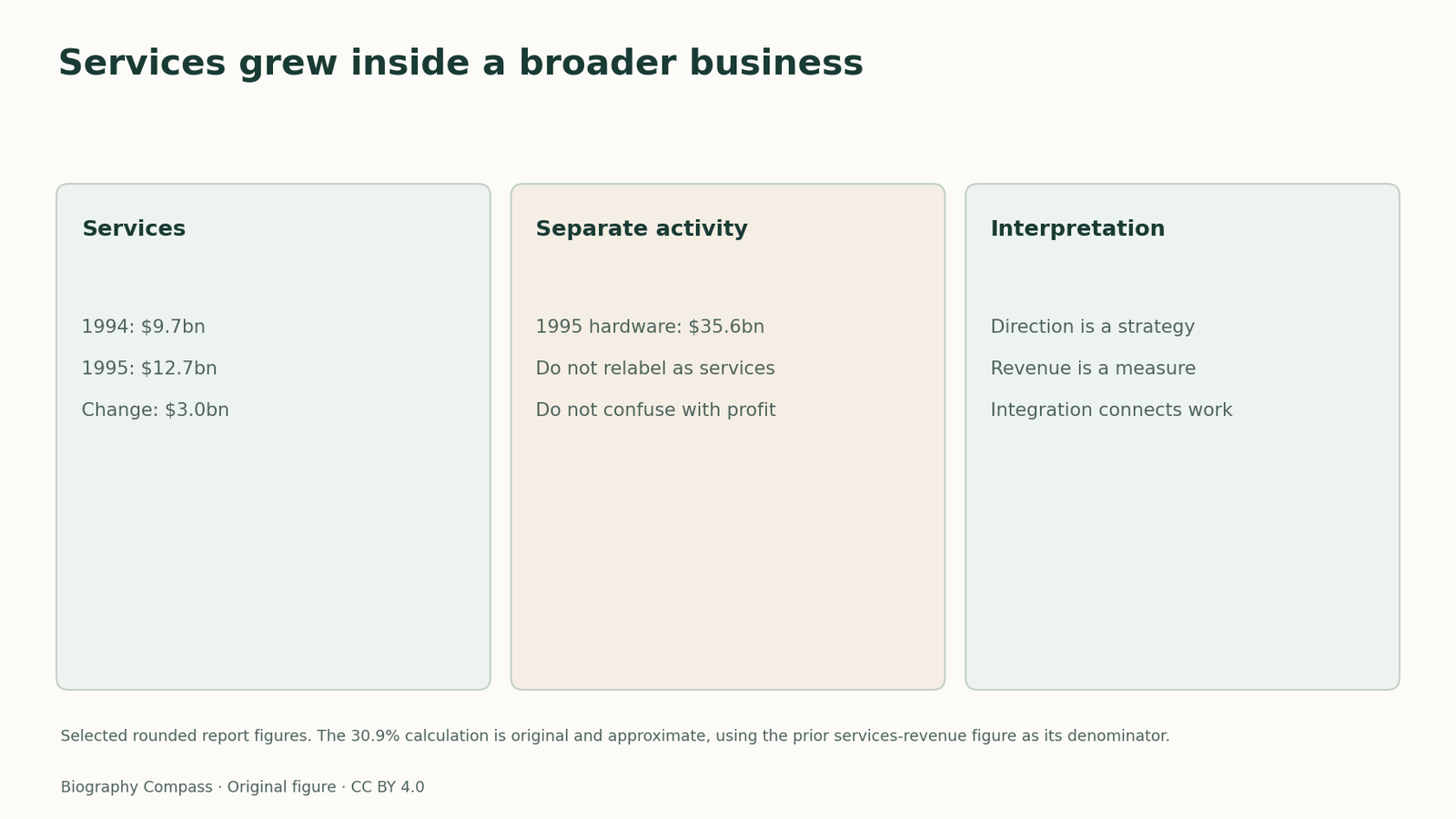
A strategic direction is not the same thing as a revenue category. Reading them together gives a more useful account of a transition than saying IBM simply stopped being a hardware company.
Evidence and interpretation
Direction, size and change
Selected rounded figures are shown in billions of US dollars; each row keeps its measure visible.
| Question | Evidence | Permitted conclusion |
|---|---|---|
| Services, 1994 → 1995 | 9.7 → 12.7. | The selected reported activity grew. |
| Hardware, 1995 | 35.6. | Hardware remained a large reported activity. |
| Original calculation | (12.7−9.7)/9.7 ≈ 30.9%. | Approximate revenue growth, not profit growth. |
| Management explanation | Activities integrated around customer work. | A statement of strategy, not independent causal proof. |
What the contemporary letter actually joins
In the selected chairman’s letter, Gerstner links network-centric computing to products, services and staff. The same pages describe increased investment and expense reduction. The report presents services revenue of $9.7 billion in 1994 and $12.7 billion in 1995, alongside $35.6 billion of 1995 hardware revenue.
The coexistence matters. A growing service activity can help connect products into a customer system without making product sales disappear. Integration describes a relationship among activities; it is not a separate pile of receipts that can automatically be added to each product category.
Sources for this section: [1]
A calculation with an honest denominator
Using the rounded figures supplied above, the increase in services revenue is $3.0 billion. Relative to the 1994 services figure, that is approximately 30.9%. The denominator is 9.7, not 12.7. Because the values are rounded, the result should remain an approximate classroom calculation.
Do not call that the increase in profit, cash receipts or employee productivity. Those questions need different measures. Likewise, a faster-growing smaller activity need not be the largest activity. The table permits a comparison of the reported categories; it does not allocate credit for growth among executives or staff.
The retrospective account asks a different question
The HBS leadership entry stresses the decision to retain one company and the accompanying downsizing. IBM’s later memorial instead foregrounds integration and customer focus.
The memorial is a successor’s tribute, written decades after the turnaround. It is evidence of how the company remembers Gerstner, as well as a source for his later life.
The report tells shareholders how management explained its direction at the time. The later accounts select the decisions that became central to a legacy. Read their difference as a question about viewpoint and purpose rather than assume that either genre is a complete history of the workforce.
Build a better research question
Instead of asking whether “services saved IBM,” ask three narrower questions: which activities grew; what customers received from coordinating them; and how the change affected people doing the work. The selected pages address the first two unevenly and describe management’s priorities. They do not supply an employee-level account of the third.
A useful extension would compare a specific customer contract with its hardware, software and support obligations, then read staff or labour records from the same period. That would test the mechanism of integration more directly. It would also avoid deriving a universal management recipe from one company’s reported recovery.
Continue the chronology
Related history guides
Biography context
Explore United States through connected lives
Connected biographies
The working life

1942–2025
Lou Gerstner
Business executiveGerstner led IBM through a difficult restructuring.Read biographyQuick answers
Common questions
- Did the 1995 report show services replacing hardware?
- Services grew alongside hardware; integration described how the work connected.
Primary and institutional sources
How this history was checked
Selected passages and records support the discussion below. Original reasoning and invented classroom cases are labelled; no whole-archive or product-testing claim is made. This article was reviewed on 4 November 2026.