
The short answer
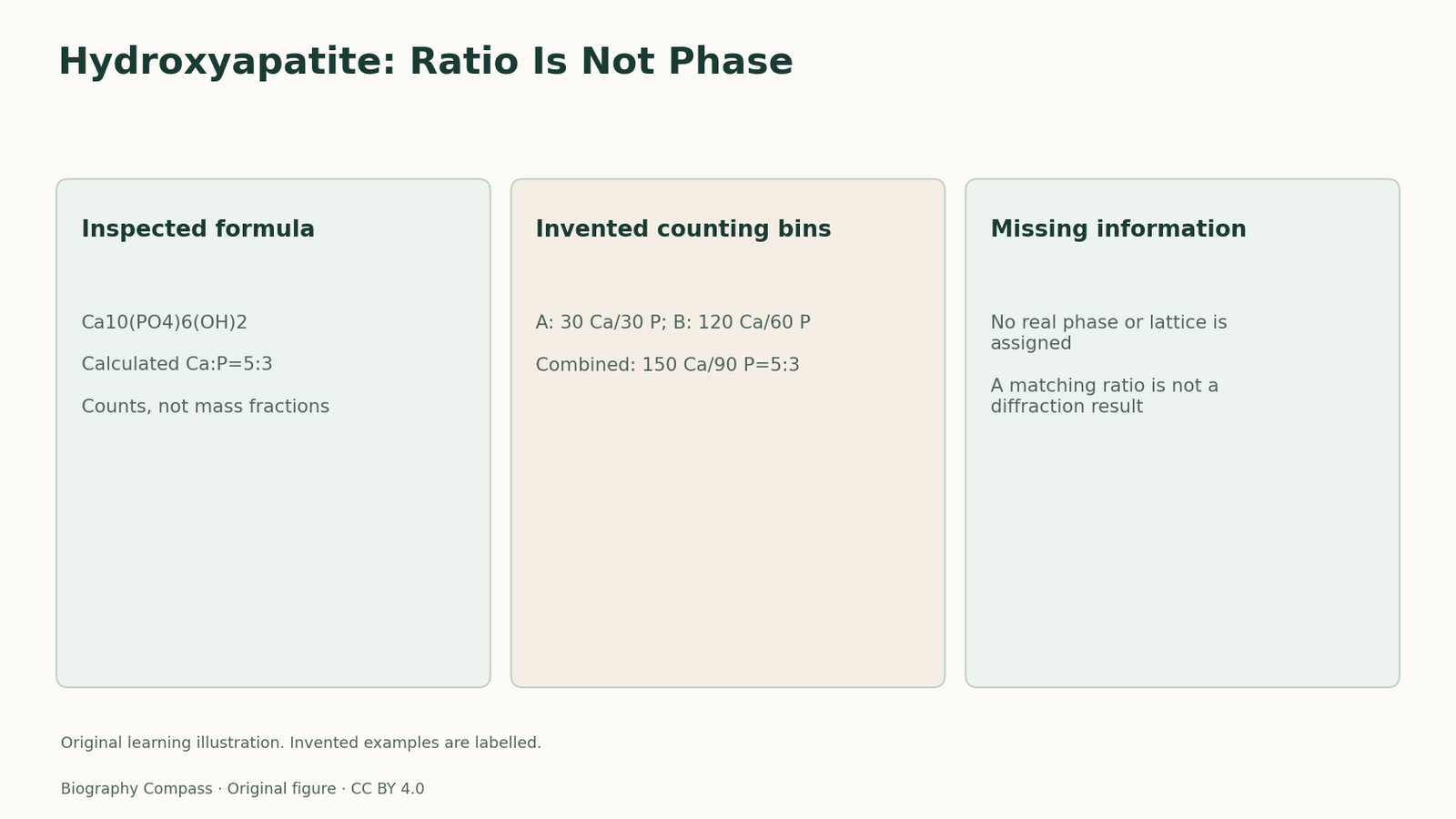
A formula constrains the numbers of elements. It does not place every atom in space. Keep composition, structure and the method used to investigate each one separate.
Original record and worked example
A common ratio does not specify a common structure
The bins are invented counting inputs, not named chemical phases.
| Input | Ca and P counts | Ca:P |
|---|---|---|
| Formula unit | 10 Ca; 6 P | 5:3 |
| Bin A | 30 Ca; 30 P | 1:1 |
| Bin B | 120 Ca; 60 P | 2:1 |
| Combined bins | 150 Ca; 90 P | 5:3 |
Chronology
A timeline of the turning points
Manuscript received
Date printed on the original first page.
Publication
Journal issue shown on the original.
The record uses more than a formula
Nakahira, Kijima and Ying studied hydroxyapatite precursors and heat-treatment effects on crystallinity and particle size. The inspected pages state Ca10(PO4)6(OH)2 and a fixed starting Ca:P ratio of 10:6, while also using diffraction and microscopy.
The record therefore asks about material structure as well as starting composition. This guide does not reproduce the procedures or its micrographs, and it makes no claim about clinical suitability.
Sources for this section: [1]
Count, then construct a limited counterexample
First count Ca and P in the stated formula and reduce their ratio. This is an atom-count or molar ratio, not a mass fraction.
Now invent two counting bins representing hypothetical materials, not identified real phases. Bin A contains one Ca per P; bin B contains two Ca per P. Assign 30 P units to A and 60 P units to B. Calculate total Ca, total P and the combined ratio. What information about real phase identity has this counting model omitted?
Sources for this section: [1]
Reference answer
The formula contains 10 Ca and 6 P, so Ca:P=10:6=5:3, approximately 1.667. The parentheses group six PO4 units; they do not create 24 phosphorus atoms.
A contributes 30 Ca and 30 P. B contributes 120 Ca and 60 P. The totals are 150 Ca and 90 P, again 5:3. A weighted combination can therefore match the target ratio in this stipulated counting model without either bin having that ratio individually.
This is not a claim that the two invented materials are chemically real. The model supplies no oxygen or hydrogen balance, charge state, crystal lattice or diffraction pattern. It demonstrates the information lost by reducing a stipulated composition to one ratio. Real phase identification needs evidence about real materials.
Sources for this section: [1]
Return to what was inspected
The original’s formula and composition statement are explicit, while its characterisation methods investigate additional properties. A correct ratio calculation should not be promoted into a finding about purity, particle morphology or an implant’s performance.
The selected English synopsis, formula and methods were inspected within a predominantly Japanese paper. No full translation or unseen experimental result is claimed. The numerical bins and the reference answer are original.
Sources for this section: [1]
Continue the chronology
Related history guides
Biography context
Explore Japan through connected lives
Connected biographies
A career behind the record
Quick answers
Common questions
- Does the fixture supply a mass or volume fraction?
- No. Atom counts are the stipulated inputs; neither masses nor volumes are supplied for the hypothetical bins.
- Are A and B claimed as actual mineral phases?
- No. They are explicitly hypothetical counting inputs, used to expose what a ratio omits.
Primary and institutional sources
How this history was checked
Selected original records support the historical discussion. Worked examples are original and explicitly bounded; they are not reconstructed experiments. This article was reviewed on 31 October 2026.