
The short answer
Why did penicillin activity depend on bacterial growth conditions rather than the drug label alone?
Read the evidence
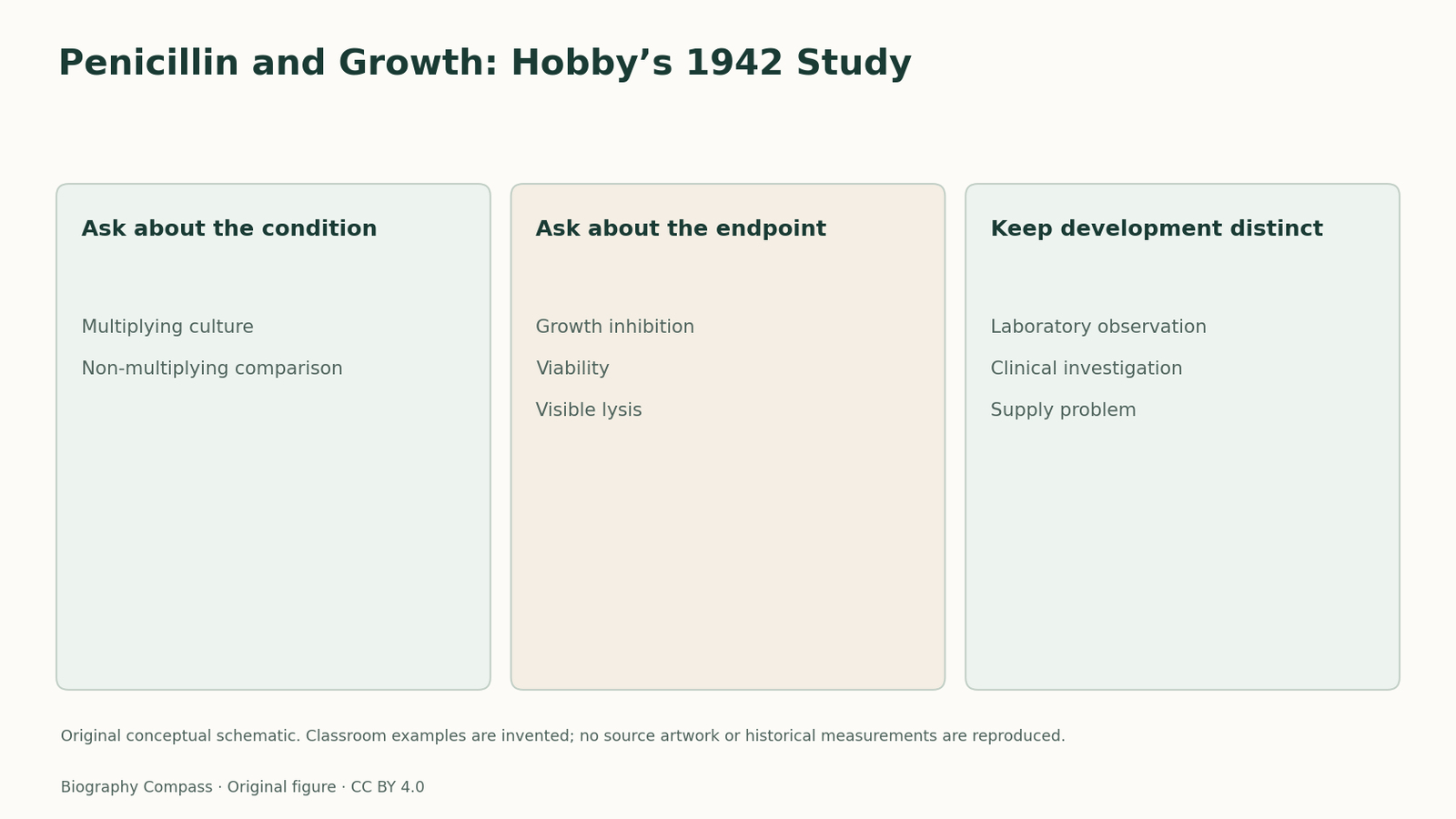
Penicillin and Growth: Hobby’s 1942 Study
Keep growth, viability, visible lysis and medicine supply as separate questions.
| Record or comparison | What the record supports | What remains separate |
|---|---|---|
| 1942 laboratory summary | Penicillin effects depended on organisms and experimental conditions | One observed effect does not establish identical behaviour in every system |
| 1944 clinical-report opening | Limited material constrained the early investigation programme | Supply history is not a measurement of cellular mechanism |
What did the 1942 report compare?
Hobby, Meyer and Chaffee’s 1942 summary describes penicillin as capable of inhibiting growth or killing bacteria depending on the experimental circumstances. It also states that effects varied between organisms. The useful question is therefore not simply whether penicillin was present. It is what organism was studied, whether it was multiplying, and what observation counted as an effect. The report’s historical terminology should be read as an account of those experiments, not expanded into a claim that one drug behaves identically in every bacterial system.
Sources for this section: [2]
Killing and lysis are different observations
The summary notes killing of haemolytic streptococci without accompanying lysis. That distinction prevents a common reading error: disappearance or rupture of cells is not the only way an experiment might register loss of viability. Conversely, reduced growth is not automatically proof that every cell has been killed. The clinical report’s accessible opening addresses another issue altogether, the shortage of material for early investigations. A supply constraint can explain why a programme advanced cautiously, but it does not identify the cellular mechanism of an observed effect.
Design an original comparison
Imagine two invented cultures of the same organism. Culture A is actively multiplying; culture B is temporarily not multiplying. Each has an untreated comparison and a penicillin-exposed comparison. Ask students why a two-culture design without untreated comparisons would be weaker. An answer is that a change might reflect the growth condition itself rather than exposure. Then provide two hypothetical observations: growth stops in A, and B shows no detectable change during the observation window. Ask whether that proves B is permanently resistant. It does not; the observation concerns one condition and one interval. Finally, ask what additional record would distinguish inhibition from killing. A measure of viability after the original observation would address a different endpoint from growth alone. These scenarios are interpretive classroom examples, not a reconstructed historical protocol or dataset.
Sources for this section: [2]
Read development as a sequence of questions
Hobby’s later history of penicillin development, identified by its publisher, places laboratory work within the larger problem of turning a research finding into available medicine. Her career account also documents later tuberculosis research and journal editing. Those records explain why research communication and production deserve attention, while the 1942 summary remains the relevant source for its particular mechanistic observations. A strong answer to the guide’s question therefore names the condition and endpoint before making a claim. The drug’s name alone cannot supply either missing part of the experiment.
Continue the chronology
Related history guides
Biography context
Explore United States through connected lives
Connected biographies
Researchers and related questions
1910–1993
Gladys Hobby
Microbiologist and antibiotic researcherGladys Hobby investigated antibiotic action in a career spanning academic laboratories, pharmaceutical research and public-health work.Read biography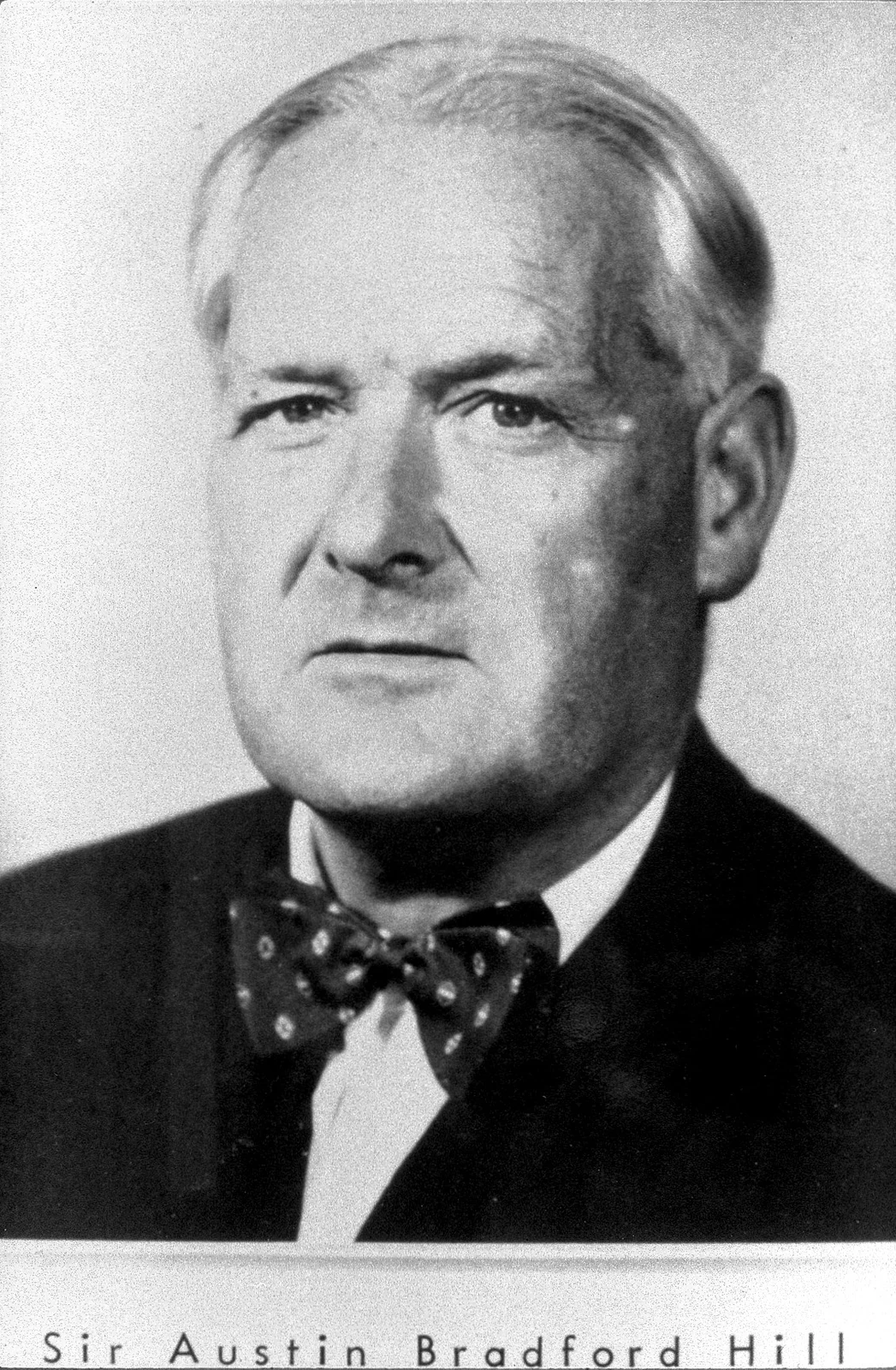
1897–1991
Austin Bradford Hill
Medical statistician and epidemiologistAustin Bradford Hill translated statistical reasoning into practical medical research, helping investigators build fairer comparisons and assess their limits.Read biographyQuick answers
Common questions
- Does killing always imply visible cell lysis?
- No. The 1942 summary specifically reports killing of haemolytic streptococci without accompanying lysis.
- Are the classroom cultures historical data?
- No. They are invented comparisons illustrating why growth conditions and endpoints must be recorded.
Primary and institutional sources
How this history was checked
The 1942 summary is compared with a clinical-report opening, a scoped institutional biography and publisher book metadata; neither full historical paper is represented as fully read. This article was reviewed on 7 November 2026.