
The short answer
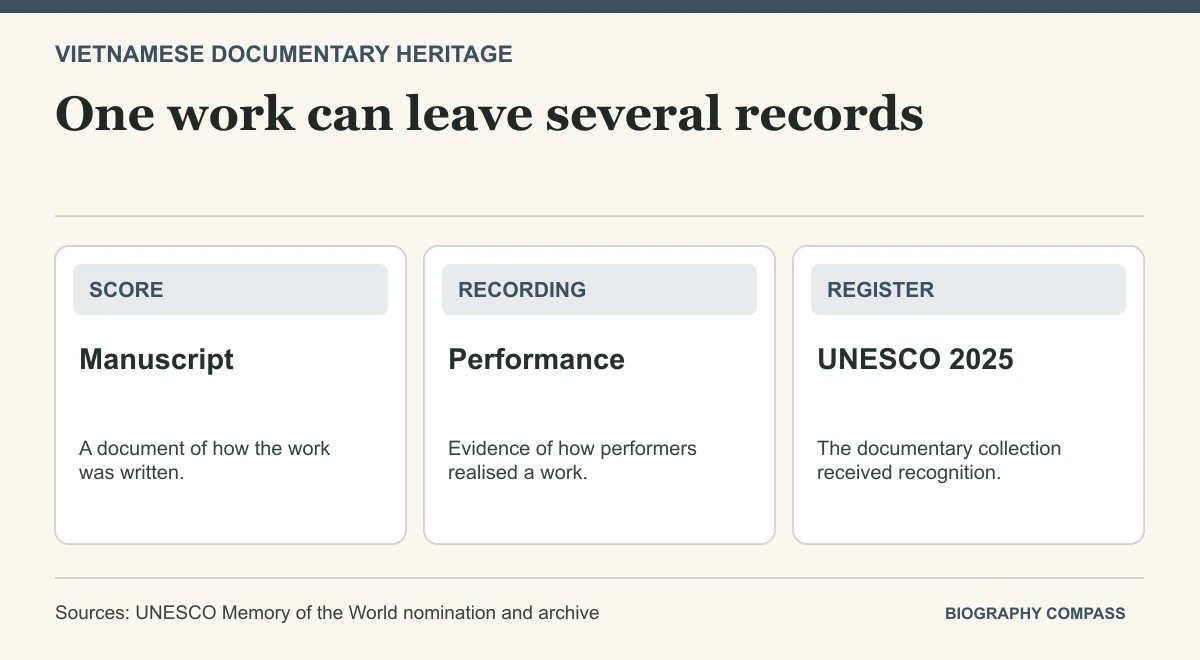
The Hoàng Vân Collection, registered by UNESCO in 2025, contains evidence of Vietnamese composition in several forms. A score gives instructions for a performance. A broadcast recording preserves a particular reading. A reconstructed score can link the two when the composer’s manuscript survives only indirectly.
Vietnamese documentary heritage
One work can leave several records
A recording and a score preserve different details of a work.
| Item | What survives | Use in research |
|---|---|---|
| Handwritten or printed score | Musical text | Check instrumentation or variants |
| Broadcast recording | A realised performance | Check performers and the version that was heard |
| Reconstruction | A new written rendering from sound | Document a work with a lost or incomplete original score |
Chronology
A timeline of the turning points
Works accumulated
Printed materials, manuscripts and recordings document the period.
Manuscripts moved to archives
The nomination identifies the National Archives Centre III in Hanoi.
UNESCO registration
The collection joined the international documentary heritage register.
Count works separately from the surviving records
UNESCO’s overview describes more than 700 musical works. Its nomination discusses handwritten materials, printed editions and sound recordings, many involving broadcasters and performers. Multiple objects can document the same composition. The register’s total describes the scope of that repertoire and does not turn every individual catalogue entry into a separate work.
Use Hồi tưởng to read across media
The nomination says that the original score and parts for Hồi tưởng, also presented as Reminiscence, were lost. It identifies reconstructing missing music from surviving recordings as one part of the work of preservation. The collection catalogue identifies performers and excerpts. A researcher can cite the recording as evidence of a performance and separately document the basis of any reconstructed score.
What registration tells a researcher
The nomination places manuscript material at the National Archives Centre III in Hanoi from 2022 and identifies documents also held or supplied elsewhere. The 2025 date refers to recognition of documentary heritage on the international register. It does not date the music itself. Start with the inventory entry and the material type, then follow the holding institution or catalogue to find the particular version.
Continue the chronology
Related history guides
Connected biographies
People in this history
Quick answers
Common questions
- What did UNESCO register in 2025?
- The documentary collection of composer Hoàng Vân, including records in multiple media.
- Where are original manuscripts held?
- The nomination identifies the National Archives Centre III in Hanoi for manuscript material.
Primary and institutional sources
How this history was checked
Dates, legal milestones and historical claims are checked against the official and institutional records below. This article was reviewed on 19 November 2026.