
The short answer
An asteroid’s reported orbit can change with epoch. A family search asks whether several objects are related after the expected changes are taken into account.
Reading the evidence
What changes when an orbit is compared across time
Read the meaning of the values before judging closeness.
| Stage | Comparison | Question it answers |
|---|---|---|
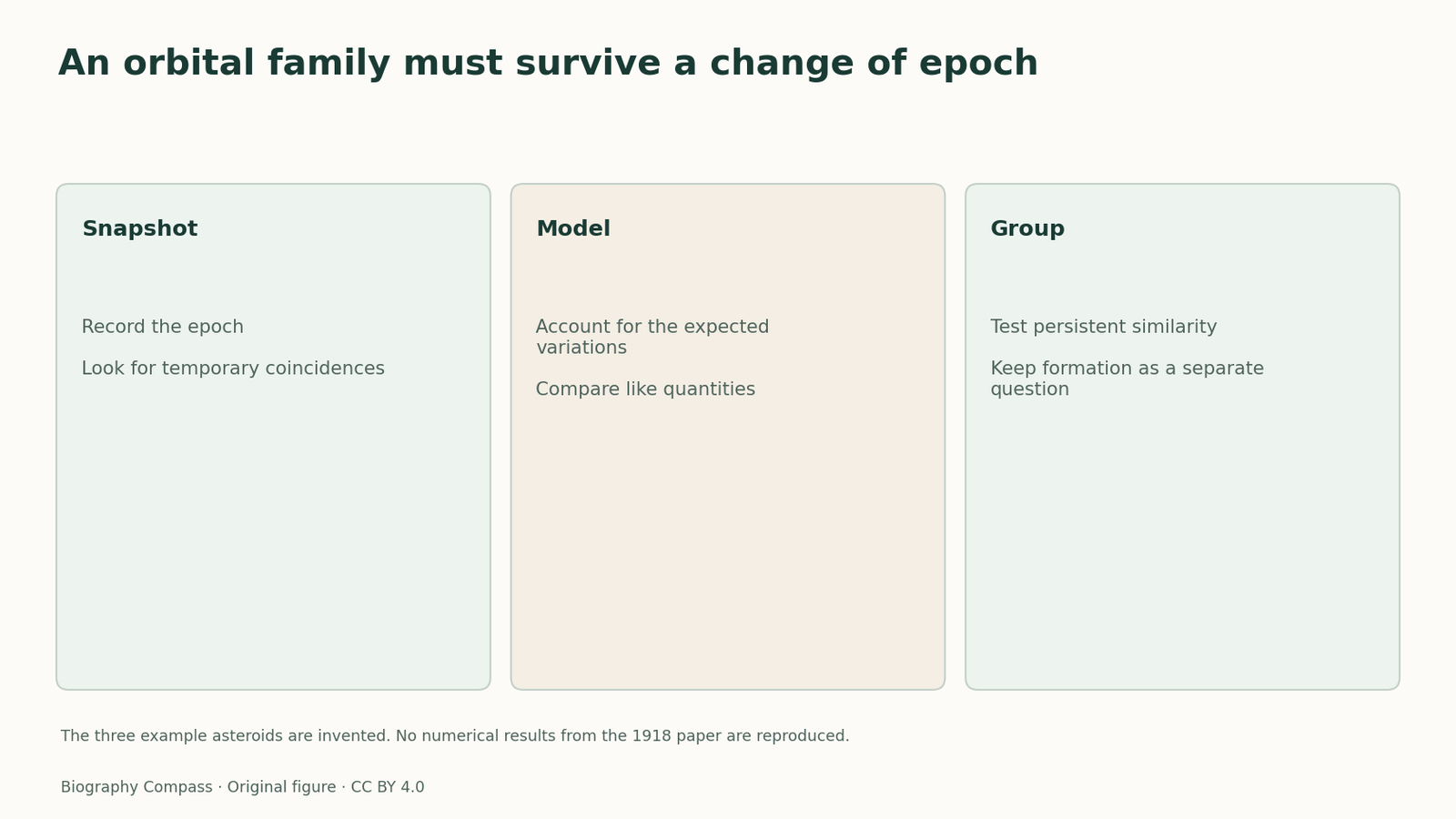
| Snapshot | Values fitted at one time. | How do the reported paths compare at that epoch? |
| Characteristic value | A quantity less affected by the variations being modelled. | Does a grouping persist after accounting for those variations? |
| Origin hypothesis | An interpretation of a persistent group. | What further evidence would distinguish explanations? |
Choose what will be compared
Hirayama’s 1918 paper approaches asteroid grouping through orbital characteristics rather than a picture of where objects happened to be. The Astronomical Society of Japan’s account explains why removing or accounting for the perturbation terms helps reveal groups with similar characteristic values. The comparison concerns the paths and their behaviour over time, not whether the asteroids are presently close in the sky.
When reading an orbital catalogue, ask which values describe a fit at an epoch and which represent a more persistent feature estimated from a model. Using the same units is necessary, but using values with the same meaning is also necessary.
Test a toy grouping
Suppose two invented asteroids each have a characteristic tilt of 6 units, with modelled variations of 1 unit on either side. A snapshot can catch one at 5 and the other at 7. A third asteroid with a characteristic tilt of 8 might be seen at 7. The second and third then look identical in the snapshot even though they have different characteristic values.
The example simplifies the real problem to one quantity. It shows how a time-specific match can hide a persistent difference, and how a time-specific difference can hide a persistent similarity.
Distinguish family evidence from origin
A cluster in several comparable orbital quantities supports an association. It remains a step from that association to a proposed formation history. Ask how many objects are involved, what uncertainties affect the grouping, and what observations beyond the orbital table could test a common origin.
Continue the chronology
Related history guides
Biography context
Explore Japan through connected lives
Connected biographies
People in the records
1874–1943
Kiyotsugu Hirayama
Astronomer and investigator of asteroid orbitsHirayama found that groups of asteroids shared orbital properties after accounting for effects that changed those properties over time.Read biographyQuick answers
Common questions
- Were the groups defined by asteroids being near each other on one night?
- No. The groups came from similarities in orbital properties after accounting for changes, not from proximity on the sky at one time.
Primary and institutional sources
How this history was checked
Dates, legal milestones and historical claims are checked against the official and institutional records below. This article was reviewed on 5 November 2026.