
The short answer
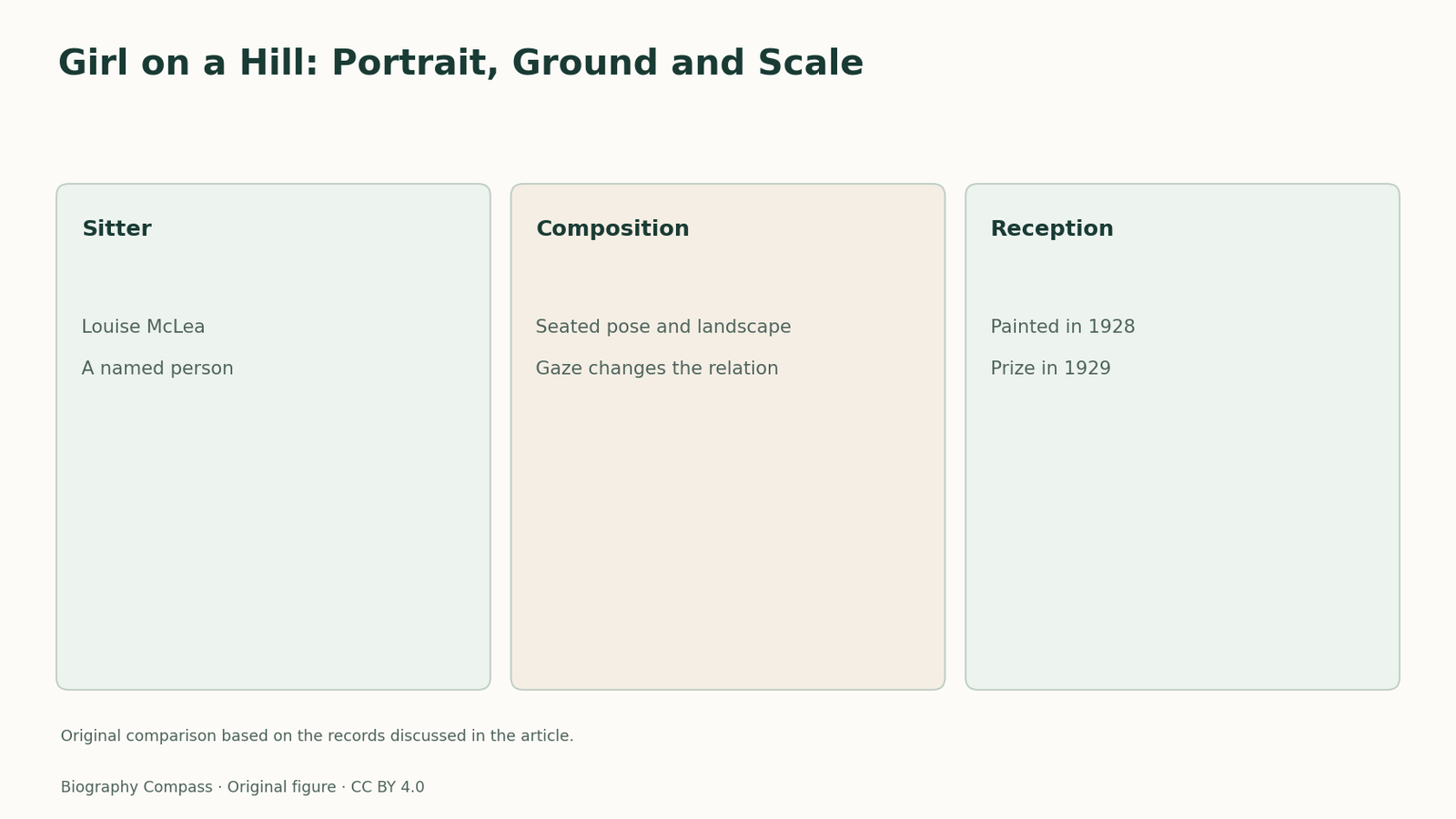
Girl on a Hill identifies a painting with a landscape setting. The work entry identifies its sitter as Montreal dancer Louise McLea. Holding both facts together gives a reader a useful question: how does the surrounding landscape change the sitter’s presence rather than dissolve her into scenery?
Evidence comparison
How a sitter occupies a landscape
Give pose, gaze and public record separate descriptions.
| Detail | Question |
|---|---|
| Seated figure | How does the ground make her position clear? |
| Head and eyes | Which way is her attention directed? |
| Competition record | When did the picture gain documented recognition? |
Begin with the sitter and the landscape together
The work entry identifies Louise McLea as the sitter. Its description gives a reader a way to compare the presence of a particular person with the more general idea suggested by the title. The dancer is seated in a country landscape. A reader can ask how much of the picture is occupied by her body and which parts of the surrounding space are still available to look at. The landscape gives the portrait a ground, but its relation to the seated figure is a visual arrangement that can be examined without making the sitter disappear into a category.
A partly turned head can still address a viewer
The account describes McLea looking toward the viewer while her head is turned only partway. This is a useful distinction between orientation and gaze. A full frontal pose would make facing the viewer a property of the whole body. A turned posture can establish a more particular relation, as though attention has shifted without every other part of the sitter’s position following it. A description can preserve the difference by noting separately where the body is placed and where the eyes seem directed. That approach gives the sitter a position within the landscape and a relation to someone outside it.
Sources for this section: [2]
The date of recognition is a second date
The National Gallery identifies the painting as a 1928 work. The Art Canada Institute entry documents a competition prize in 1929. These dates describe different events, which can help organise a reading of the work’s reception. A prize can establish that an institution singled it out under a particular set of conditions. It cannot tell a reader how every viewer interpreted the expression or why the artist chose the pose. Linking both records keeps the evidence useful. One supplies the date and identity of the object, while the other adds a documented moment when its public visibility changed.
Try an original pose and scale comparison
Place a simple seated form on two imaginary hillsides. In one arrangement allow the surroundings to occupy most of the available space. In the other bring the seated form closer to the foreground and let its head turn toward an observer. The background can remain important while the relation between person and observer changes. This is an exercise in description rather than a reproduction of Heward’s work. It helps a reader articulate the difference between the land as a setting and the use of ground, placement and gaze to give a sitter presence.
Give the person and the work their own labels
Louise McLea is the sitter and Heward is the artist. The competition is a later event. Keeping the labels distinct allows a reader to follow the painting’s reception without losing the separate evidence for the person represented.
Biography context
Explore Canada through connected lives
Connected biographies
People connected to the work
1896–1947
Prudence Heward
PainterPrudence Heward made figure paintings that give a sitter a specific relation to the space around her. Girl on a Hill is an example with a named sitter and a documented exhibition history.Read biography1898–1986
Paraskeva Clark
PainterParaskeva Clark brought experience of Russian art and theatre into a Canadian painting career. Petroushka gives a concrete example of her use of public subjects and figure composition.Read biographyQuick answers
Common questions
- Who is the sitter in Girl on a Hill?
- The work entry identifies the dancer Louise McLea.
- When did the painting receive the Willingdon prize?
- It won first prize in the 1929 competition, a year after the painting’s date.
Primary and institutional sources
How this history was checked
Dates, legal milestones and historical claims are checked against the official and institutional records below. This article was reviewed on 13 November 2026.