
The short answer
How did controlled collisions and angular measurements reveal reaction dynamics beyond bulk reaction rates?
Read the evidence
Records that answer different questions
Compare the research record, the explanatory model and the original learning exercise.
| Record or test | What it establishes | What remains different |
|---|---|---|
| Bulk rate | Summarises the progress of a reacting population. | Averages over many encounters. |
| Selected product and angle | Relates an identified product to its direction. | Needs detection and background controls. |
| Product speed | Adds a translational-motion record. | Does not alone supply a complete molecular trajectory. |
A reaction rate averages over many encounters
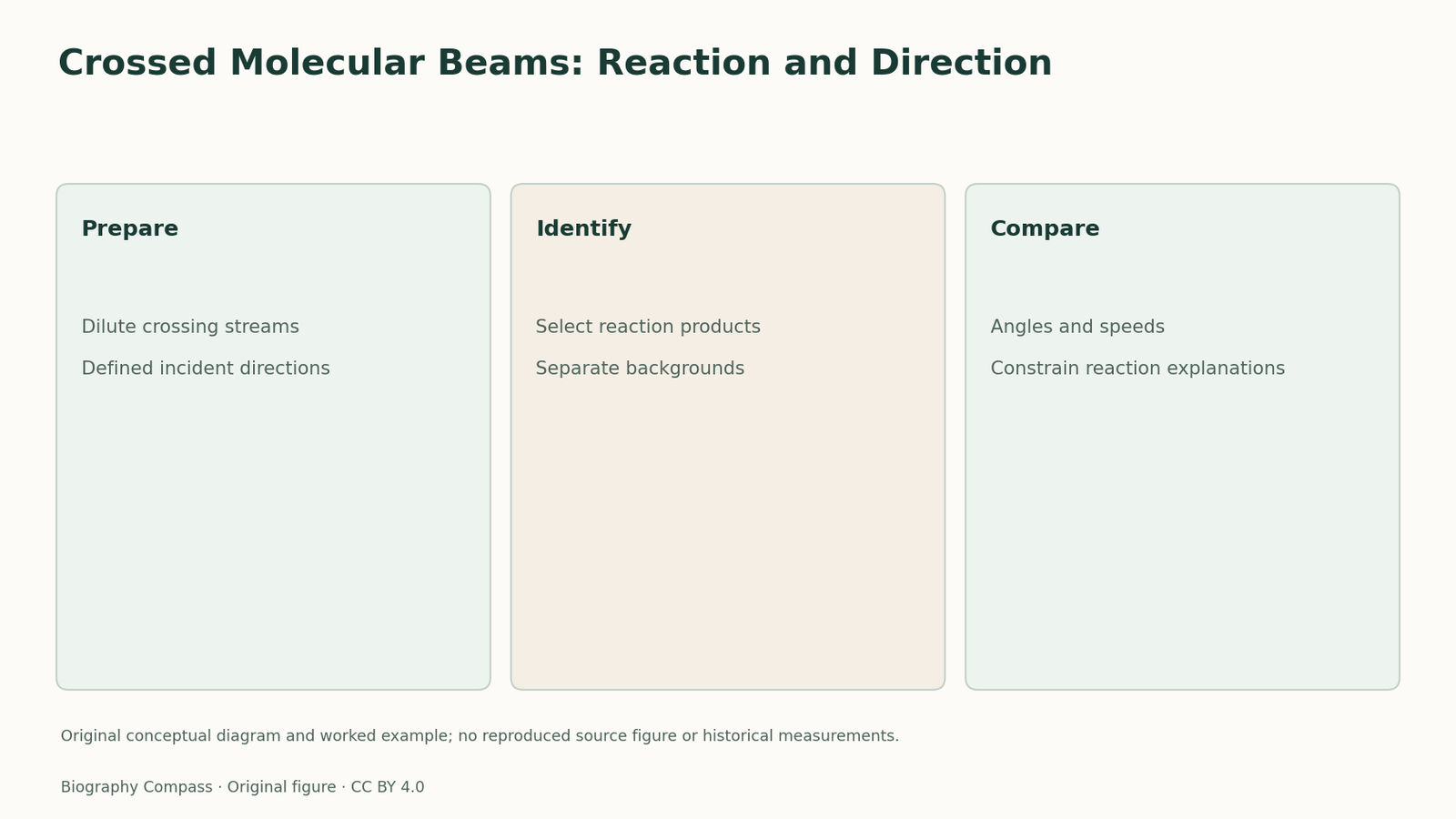
Herschbach’s lecture begins with a limitation of conventional kinetics. Concentration and temperature allow important rate measurements, but many different molecular encounters contribute to the result. A crossed-beam experiment asks a more selective question. Two dilute streams meet in a vacuum, reducing repeated collisions and defining the incident directions. A detector then examines products emerging from the intersection. The advantage is not simply producing a faster reaction; it is connecting a measured outcome with more controlled initial conditions.
Sources for this section: [3]
Direction, energy and identity are different measurements
The lecture identifies product velocities, emission angles and the distribution of energy among translation, rotation and vibration as distinct kinds of information. A signal at an angle first needs a reliable product identification. Its angular pattern can then constrain explanations of how the encounter proceeds. The Nobel facts account likewise connects product movement, mass and energy with the mapping of reactions. These records explain the purpose of the method without making every instrument capable of measuring every property simultaneously.
The career record explains why instruments changed
The early Berkeley experiments and the later instrument associated with Lee belong to successive stages. Herschbach’s retrospective distinguishes relatively simple alkali-reaction apparatus from a machine with substantially stronger pumping and more sensitive mass detection. This practical history explains why a general method can open to additional classes of reaction. The apparatus and the scientific question develop together: wider access to products makes new comparisons possible, while theoretical questions determine which observables matter. The department’s description of single-collision dynamics is therefore a useful overview, not a replacement for a particular experiment’s specification.
Original detector exercise: separate three conclusions
Imagine a teaching apparatus with two crossing streams and a movable detector. In trial A a detector counts all arrivals but does not distinguish substances. In trial B it selects a reaction product and records counts at several angles. In trial C it also resolves the selected product’s speed. Which trial supports a claim about product direction? B and C can, subject to calibration and background checks; A cannot identify which arrivals are reaction products. Which supports a speed distribution? C. None of the three, by itself, proves the exact sequence of atomic motions during an encounter. Now suppose B and C show the same total count but different patterns across angle and speed. A single overall yield would hide that difference. This is an original comparison of information available from hypothetical records, not reconstructed data from Herschbach’s experiments. The useful answer names the measured quantity before proposing a molecular interpretation.
Biography context
Explore United States through connected lives
Connected biographies
Researchers and related approaches
1932–
Dudley Herschbach
Chemical physicist and reaction-dynamics researcherDudley Herschbach connected mathematical training, molecular spectroscopy and beam experiments, helping turn individual chemical collisions into measurable events.Read biography1929–
John Polanyi
Chemist and public advocateJohn Polanyi used infrared emission to investigate how newly formed molecules share energy, building a Toronto research career alongside advocacy on science and nuclear weapons.Read biographyQuick answers
Common questions
- Is a product-angle plot a film of a collision?
- No. It is a measured distribution that constrains, but does not directly photograph, a molecular mechanism.
- Can total yield replace angle and speed measurements?
- No. The same total can conceal different distributions across those variables.
Primary and institutional sources
How this history was checked
Read scopes distinguish original papers, selected lecture passages, institutional biographies and editorial teaching models. This article was reviewed on 8 November 2026.