
The short answer
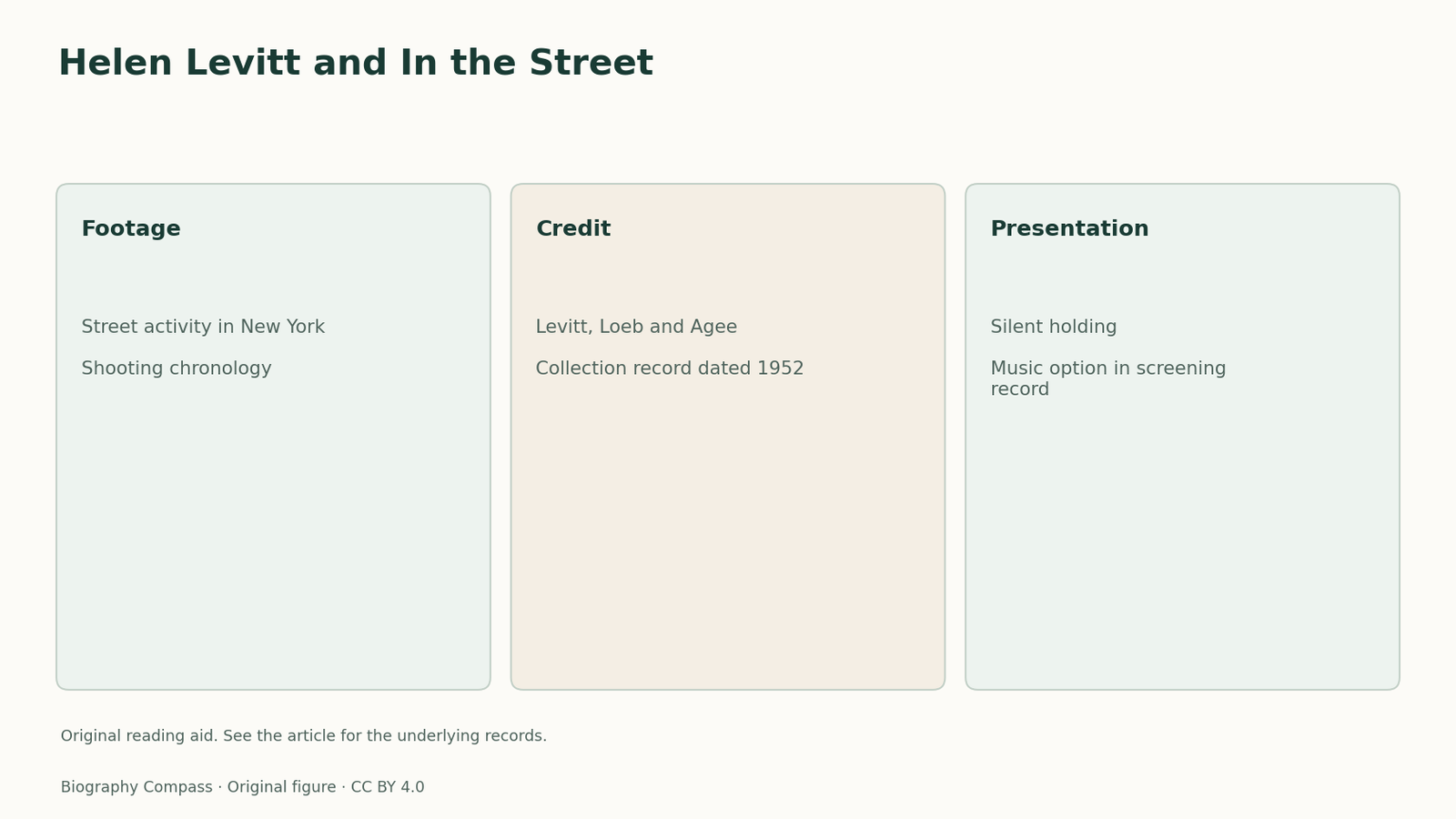
In the Street connects Levitt’s still photography with a film made by three people. The catalog and screening records help distinguish footage, credits and presentation.
Compare the evidence
Read the version evidence
Use a different field for shooting, collection and exhibition information.
| Record or element | Evidence | What it establishes |
|---|---|---|
| Shooting chronology | IDFA dates footage to 1945–46 | When the camera work took place |
| MoMA collection | 1952, 16mm, black-and-white and silent | The object as catalogued |
| MoMA screening | Arthur Kleiner music or silent option | A way the film could be presented |
Use the catalog’s version date
MoMA’s object entry gives 1952 for In the Street. The Jewish Museum refers to the film with an earlier year, and the International Documentary Film Festival Amsterdam uses 1948 in its listing while describing shooting in 1945–46 and release in 1952. These are reasons to label the event attached to a date. Production, release and the cataloguing of a version can produce different dates in accounts of the same film. When citing MoMA’s holding, preserve the date printed in that entry. When discussing when footage was made, identify the source for the shooting chronology and keep its narrower claim visible.
Give the filmmakers distinct credit
The MoMA collection names Helen Levitt, Janice Loeb and James Agee, and a screening record credits the three with direction and photography. The film’s survival in a museum with the named collaborators gives a more reliable starting point for citation than an abbreviated artist label. It does not describe who made every exposure. A collaboration can include shared decisions about where to film, which views are useful and what happens when the shots are ordered. A reader comparing the film with Levitt’s photographs can start from the visual interests they share while keeping the authorship of the film attached to all three names.
Separate the silent holding from the screening option
MoMA describes its collection object as black-and-white silent 16mm. A program for a screening names music by Arthur Kleiner and says that clients could choose to show the film silently. Those records answer different questions about presentation. A description of a museum holding identifies the material it catalogs. A program can describe the experience offered at a showing. If a viewer hears music, the program can help explain why that experience differs from what the collection label appears to promise. Use the stated version when making a comparison. The evidence about sound is part of the history of the object and its exhibition.
From a photograph to a moving sequence
Take the idea of an everyday street gesture and describe what a still photograph makes available. It can place a figure and surroundings into one relation and give the reader time to examine the details. A film can show the action changing and relate it to a later shot. The comparison is a way to approach a film described as a collage of street activity without claiming a particular shot is present when it has not been checked. Write one observation about the format, one about the contributors and one about the experience that the screening record describes. This makes the comparison concrete and leaves the full film available for a subsequent reading.
Continue the chronology
Related history guides
DeCarava and Hughes’s Sweet Flypaper
Read The Sweet Flypaper of Life through Roy DeCarava’s Harlem photographs, Langston Hughes’s narrative voice and the evidence for their collaboration.
Read the timeline1951Ruth Orkin’s American Girl in Italy
Examine Ruth Orkin’s 1951 Florence photograph alongside her travel series with Jinx Allen, with separate evidence for collaboration, scene and print.
Read the timelineBiography context
Explore United States through connected lives
Connected biographies
Photographers and related work
1913–2009
Helen Levitt
Street photographer and filmmakerHelen Levitt photographed New York’s streets for decades and worked with collaborators on a film about neighborhood life.Read biography1919–2009
Roy DeCarava
Photographer and gallery founderRoy DeCarava developed an independent photographic practice in Harlem, where he made prints, helped create books and presented work in a gallery.Read biography1903–1975
Walker Evans
Photographer, editor and teacherA photographer and editor who found lasting visual complexity in ordinary places, objects and public encounters.Read biographyQuick answers
Common questions
- Who made In the Street?
- MoMA credits Helen Levitt, Janice Loeb and James Agee.
- Why is it described as silent when some records name music?
- MoMA’s collection identifies a silent holding, while a screening record also describes a later music option.
Primary and institutional sources
How this history was checked
Dates, legal milestones and historical claims are checked against the official and institutional records below. This article was reviewed on 13 November 2026.
- The Jewish MuseumHelen Levitt
- Museum of Modern ArtPhotography and Creative Documentation
- Museum of Modern ArtThe Long Run exhibition texts
- Museum of Modern Art1943 exhibition press release
- National Gallery of ArtNew York, 1940
- Museum of Modern ArtIn the Street, collection object
- Museum of Modern ArtFilms from the 1955 20th Anniversary Program
- International Documentary Film Festival AmsterdamIn the Street
- National Gallery of ArtNew York, 1971