
The short answer
A visible product can make a promise persuasive without demonstrating every part of that promise. Put a brand’s historical explanation beside the actual statute and ask what each kind of evidence can establish.
The records answer different questions
Match the claim to the evidence
A visible package, a printed claim and a test record support different conclusions.
| Record or measure | What it establishes | What it does not establish |
|---|---|---|
| Visible package | Appearance available to sight | Full composition or provenance |
| Printed statement | A claim to investigate | Proof that the claim is true |
| Test record | A result with a method and sample | Every historical production batch |
Chronology
A timeline of the turning points
Brand origin account
Clear bottles in the brand narrative.
Statute
Adulteration and misbranding provisions.
A sales signal with a limit
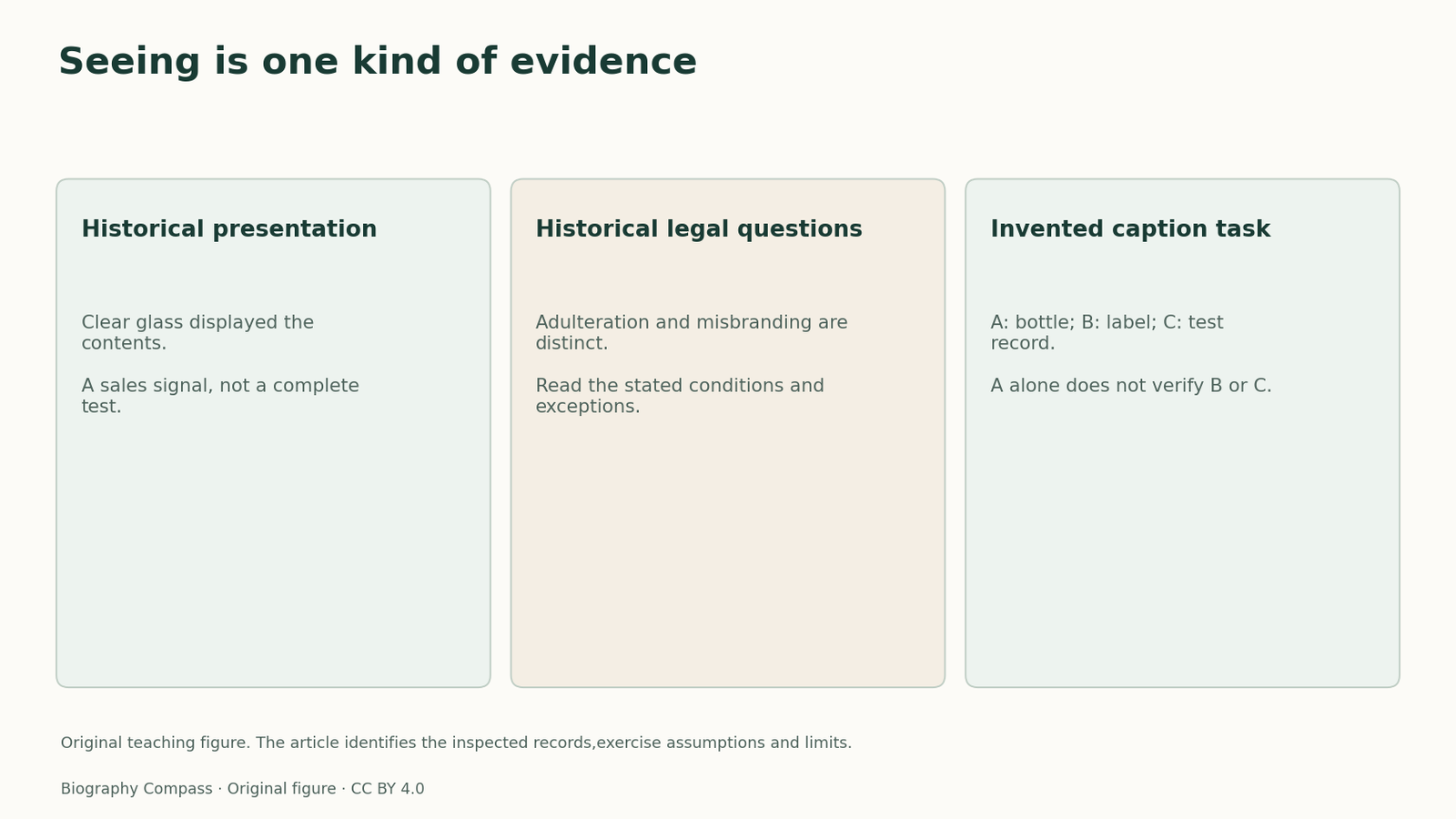
Heinz’s brand history describes clear horseradish bottles as displaying purity and quality.
The finding aid places packaging alongside sales training and factory tours.
Transparency made the contents available to sight. That is different from a chemical analysis, a production record or an independently verified statement of ingredients. A persuasive signal can be useful without answering all of those questions.
What the historical Act actually addresses
The 1906 Act separately addresses adulteration and misbranding. Its food provisions include concealed damage or inferiority and false or misleading package statements. Section 8 also preserves qualified treatment of proprietary formulas; it is not a simple command to disclose every recipe.
The comparison is historical. The original Act’s jurisdiction, exceptions and subsequent amendments prevent this selection from serving as current compliance instructions. Nor does a photograph of a bottle establish whether every relevant condition was satisfied.
Sources for this section: [3]
An original evidence-allocation task
Consider three invented exhibit cards: A shows a clear bottle; B shows its printed origin claim; C records a laboratory finding about its contents. The draft caption says that A alone verifies both B and C. Repair the caption in two sentences, and identify what additional evidence the historian would need.
Reference answer: “The bottle lets a viewer inspect visible appearance. It does not by itself verify the origin claim or the laboratory finding.” Compare B with provenance or production records, and C with the actual sample, test method and result. Do not infer those missing documents merely because the display is attractive.
An argument stronger than a slogan
The records support a more precise history of commercial trust: explain how the product was presented, then ask whether the evidence supports the particular claim being made. The exercise does not find that an actual historical bottle violated a statute. It improves the connection between a caption and its evidence.
Continue the chronology
Related history guides
Biography context
Explore United States through connected lives
Connected biographies
The connected careers
1844–1919
Henry J. Heinz
Food manufacturerHeinz combined food manufacturing with merchandising.Read biographyQuick answers
Common questions
- Is this a ruling about an actual Heinz bottle?
- No. It is a historical-source comparison and an invented caption exercise.
Primary and institutional sources
How this history was checked
Read these dated records together; the original task states its own assumptions and separates them from reported facts. This article was reviewed on 31 October 2026.