
The short answer
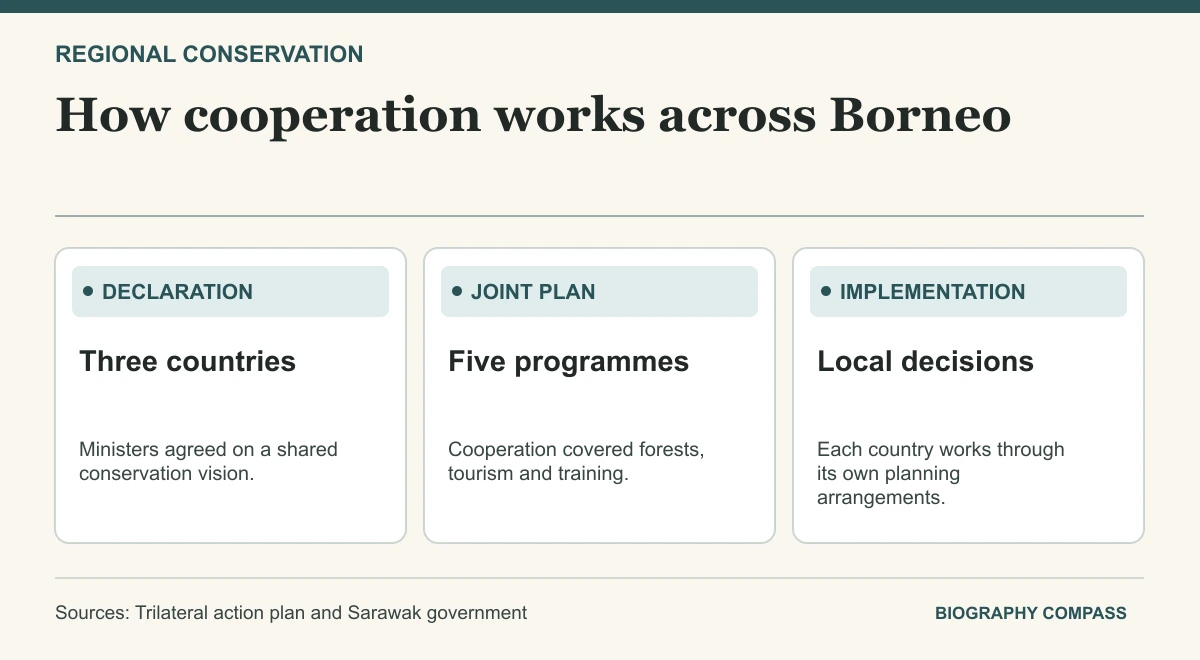
A forest catchment can cross an international border even when responsibility for the land changes at the frontier. The Heart of Borneo Declaration addressed that problem in 2007. Brunei, Indonesia and Malaysia agreed on cooperation across inland Borneo, including protected areas and forests where people continued to work.
Compare the records
From shared intent to work on the ground
The declaration, joint plan and participating governments’ programmes address different levels of responsibility.
| Record | Subject | Example |
|---|---|---|
| Bali Declaration | Shared commitment across national boundaries. | Manage a network of protected areas and productive forests. |
| Joint plan | Five fields of cooperation. | Cross-border management and training are separate work programmes. |
| Sarawak’s implementation | Priorities within one participating state. | Community livelihoods sit alongside land use and conservation. |
Chronology
A timeline of the turning points
Preparatory workshop
A workshop in Bandar Seri Begawan brought the three countries together.
Bali Declaration
The ministers issued their joint declaration in Indonesia.
First trilateral meeting
Brunei hosted discussion of how to carry out the initiative.
Second trilateral meeting
Delegates met in Pontianak, Indonesia.
Who signed, and where?
The officials who signed in Bali represented three national governments. Malaysia’s interests on the island included Sabah and Sarawak, while Indonesia’s part lay in Kalimantan. Brunei had already hosted a preparatory workshop and later hosted the first trilateral implementation meeting. Those locations help distinguish the place where a declaration was signed from the places where officials developed the work before and after it.
A network that includes working forests
The joint plan envisaged protected areas linked across a wider landscape, alongside productive forests and sustainable land uses. Its five programmes covered cross-border management, management of protected areas, natural resources, ecotourism and training. A park boundary answers a question about one defined area. The plan posed a question at a larger scale: how could the different land uses on either side of a boundary remain compatible with forest connectivity?
Where to look for implementation
Sarawak organised its own activities around priorities that included conservation, forestry, ecotourism, agriculture and rural welfare. The ten-year review also identifies successive trilateral meetings, including the second in Pontianak in 2008. A meeting is evidence of coordination, and a work programme identifies agreed tasks. Establishing whether a particular watershed or forest corridor improved would require evidence from the land involved, measured over time.
Continue the chronology
Related history guides
Tasek Merimbun: Brunei’s Black Lake and Heritage Park
Read a site-level record for a named heritage park within Brunei.
Read the timeline1935–2000How Brunei’s Forest Herbarium Became the BRUN Collection
See how botanists document the individual plants behind regional accounts of forest diversity.
Read the timelineConnected biographies
People connected to this history
Quick answers
Common questions
- Did the declaration create a single international national park?
- It established voluntary cooperation across a landscape containing protected areas, productive forests and other land uses.
- Where did the ministers sign the declaration?
- They signed in Bali, Indonesia, on 12 February 2007.
Primary and institutional sources
How this history was checked
Dates, legal milestones and historical claims are checked against the official and institutional records below. This article was reviewed on 19 November 2026.