
The short answer
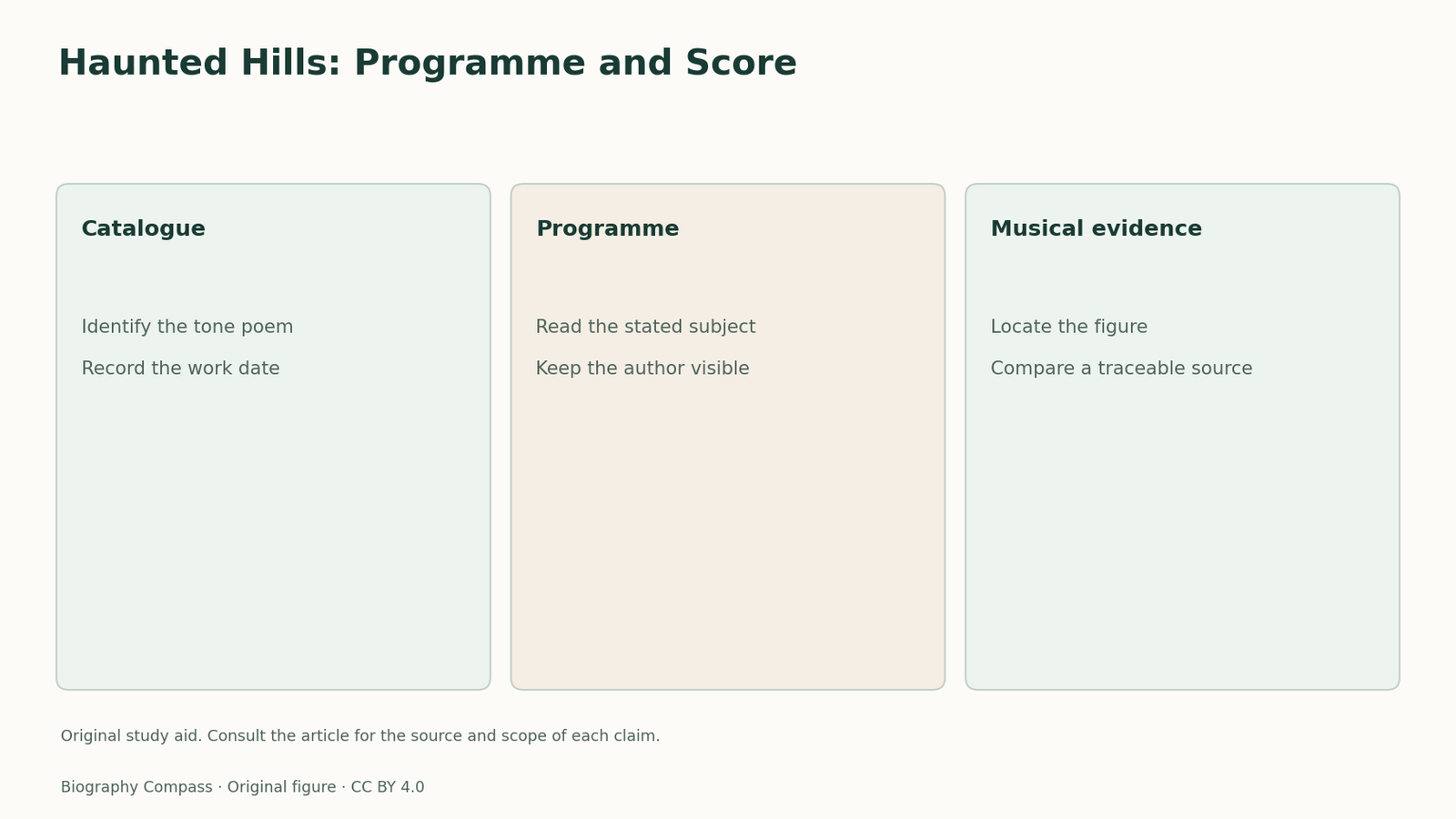
A tone poem can suggest a setting through its title and programme. In Haunted Hills, those materials help a reader approach the work and frame questions about what an orchestral score can establish.
Reading the evidence
What each record establishes
Read across the rows to keep the claims and evidence attached to the right record.
| Record | What it establishes | What needs separate evidence |
|---|---|---|
| Work record | A dated orchestral composition. | Exact sources of individual musical figures. |
| Composer’s programme | A subject and a frame for hearing it. | Community testimony or permissions. |
| Score and source comparison | A way to test a particular musical claim. | Everything a listener could associate with the work. |
Find the work and its accompanying text
The Australian Dictionary of Biography places Haunted Hills among Sutherland’s orchestral works and dates it to 1950. David Symons cites the Australian Music Centre score and discusses a programme that Sutherland put with the music. The programme connects the landscape with the history of its Aboriginal inhabitants and their displacement.
This is evidence of a composer’s framing. It is also historical evidence of one way settler composers addressed Indigenous subjects in concert music. A programme is neither a collection of community testimony nor a record that names all the musical material inside a piece.
A claim about musical borrowing takes more evidence
Symons distinguishes works with an Aboriginal subject from works for which researchers can identify particular musical sources. That distinction helps with Haunted Hills. A listener may associate an effect with the subject named in a programme. A claim about a borrowed melody would require a traceable source and a persuasive match in the musical material.
The scope of this guide is the argument supported by Symons’s discussion and the published work record. It does not transcribe the score. A practical next step for further study would be to mark an exact score location before searching for a proposed source.
Sources for this section: [2]
Test the distinction with a caption
Suppose a concert booklet says a tone poem reflects events in a coastal village. A programme can support that statement about subject. If a caption then claims that an instrument plays a traditional village melody, it has made a second claim. Keep the first sentence attached to the booklet. Give the second its own line for a musical citation. The exercise makes the gap visible while preserving the useful evidence already in hand.
Continue the chronology
Related history guides
Biography context
Explore Australia through connected lives
Connected biographies
Explore the people behind the records
died 1984
Margaret Sutherland
Composer and pianistAn Australian composer, pianist and advocate who developed a wide repertory alongside work for public arts facilities.Read biographyQuick answers
Common questions
- Does the title Haunted Hills identify the origin of its musical figures?
- The title and programme establish a subject. A claim about a specific musical borrowing needs separate musical evidence.
Primary and institutional sources
How this history was checked
Selected written and catalogue records. The article distinguishes documented production details from its editorial examples. This article was reviewed on 5 November 2026.