
The short answer
A very wide frame need not be reserved for distant scenery. The Hateful Eight’s production combined an older optical process with intimate interiors; its camera, print and screen dimensions describe different decisions.
A practical comparison
Keep the different decisions visible
A useful comparison preserves what changes and what remains an assumption.
| Aspect | What to examine | What the example cannot establish |
|---|---|---|
| Gauge | Physical film width. | A complete projection specification. |
| Aspect ratio | Width relative to height. | The camera negative’s width. |
| Invented rectangle | An explicit geometric calculation. | A reconstruction of a particular cinema. |
Chronology
A timeline of the turning points
Production case
The equipment record identifies the camera and lens systems.
A photographic choice in a confined setting
American Cinematographer’s production report describes Robert Richardson and Quentin Tarantino using Ultra Panavision 70 for landscapes and close-ups, including much of the action inside a stagecoach stop.
A wide frame is a compositional opportunity, not a command to fill every shot with scenery. In a confined setting it can accommodate the relationships between people and spaces. The report documents the collaborators’ intentions and methods; it does not replace a close viewing of their results.
Sources for this section: [2]
Camera gauge, print gauge and picture shape
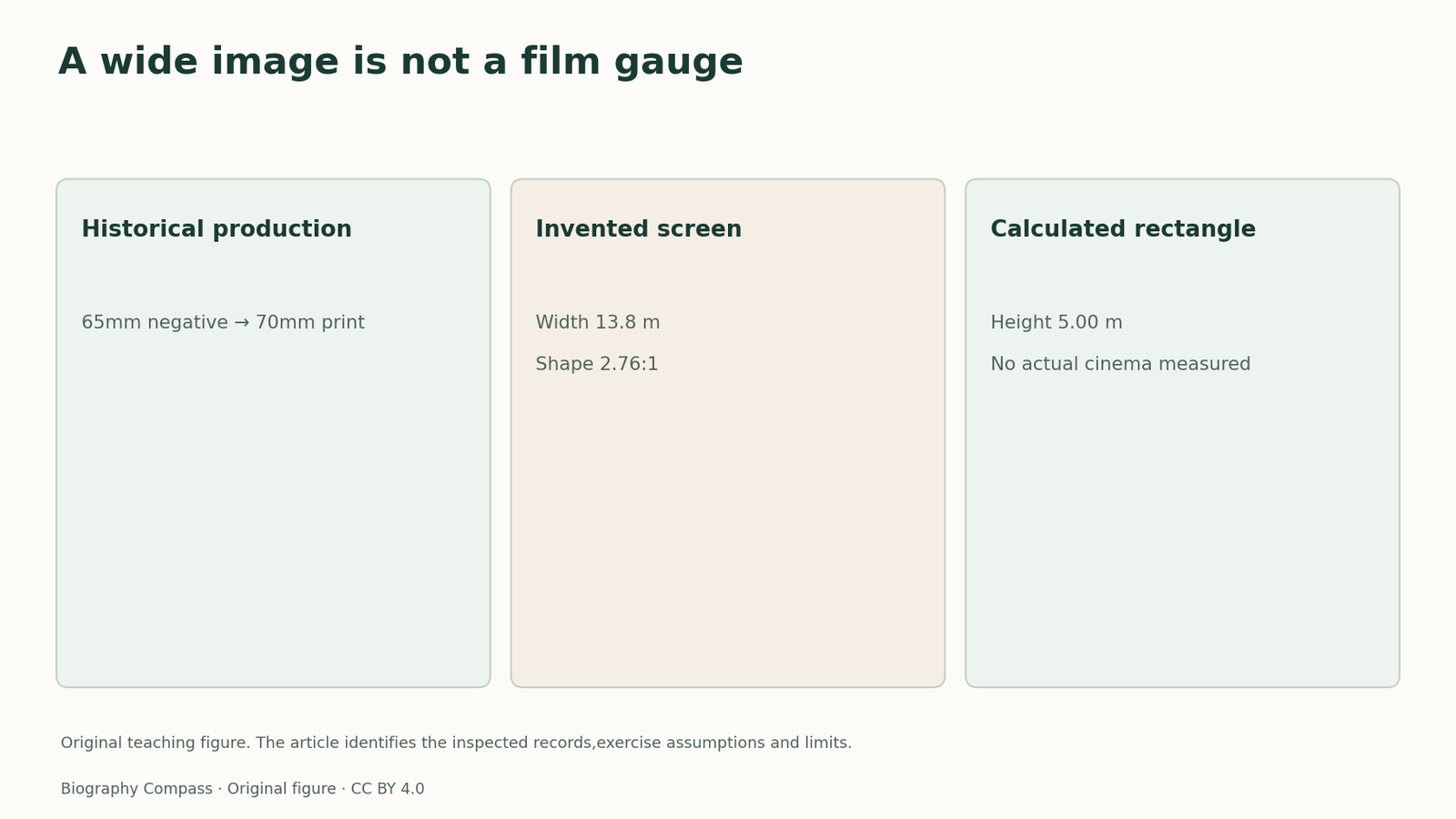
The film used 65mm camera negative and 70mm projection prints, with an anamorphic process producing the reported 2.76:1 picture. Panavision’s equipment record separately identifies its System 65 camera and Ultra Panavision 70 lenses.
Gauge names the physical width of the film material. An aspect ratio describes width relative to height. The two quantities cannot be substituted for one another: a number describing an image’s shape is not a measurement of the material carrying it.
The report gives a squeeze factor and a picture ratio; those labelled specifications do not supply a calibration for every camera aperture or projected image.
Exercise: fit an invented screen
Assume a rectangular screen is 13.8 metres wide. Use the reported 2.76:1 shape for one calculation and an explicitly assumed 2.20:1 shape for a comparison. Keep width constant and find the height in each case. Do not assume either rectangle describes a particular cinema.
Reference answer: height is width divided by the width-to-height ratio. The first rectangle is 5.00 metres high; the second is approximately 6.27 metres high. The difference is about 1.27 metres. These are geometric results under the stated assumptions, not measured screen or film dimensions.
Now list what a projection plan would still need: the usable aperture, masking, lens and throw conditions, brightness and sound arrangements. The rectangle calculation cannot establish those requirements or tell us how well the film was presented.
Sources for this section: [2]
From format preference to practical work
The production required refurbished lenses, customised film magazines and substantial preparation of projection equipment for its roadshow presentation.
That history gives the calculation a purpose. A creative preference becomes an experience through photographic, engineering and exhibition work. The simple diagram preserves only the relationship between width and height; it does not reproduce a film frame, simulate a lens or judge the finished film’s visual quality.
Sources for this section: [2]
Continue the chronology
Related history guides
Biography context
Explore United States through connected lives
Connected biographies
The wider creative career
Born 1963
Quentin Tarantino
Filmmaker and writerQuentin Tarantino developed a career across genre filmmaking and published criticism, with scripts, collaborators and production choices central to his work.Read biographyQuick answers
Common questions
- Does a wider rectangle prove a larger negative?
- No. Image proportions and the physical width of film are different quantities.
- Is the example an inspection of a cinema?
- No. Its width is invented, and the calculation assumes ideal rectangles.
Primary and institutional sources
How this history was checked
The bibliography and access notes identify the selected records. Original examples are labelled separately from historical production facts. This article was reviewed on 31 October 2026.