
The short answer
What did changing neighbouring illumination reveal about the signal from one Limulus visual unit?
Read the evidence
Different records within the same investigation
The following comparison distinguishes the specific questions answered by the inspected records.
| Record or test | What it establishes | What remains different |
|---|---|---|
| Direct input held steady | A neighbour comparison becomes interpretable | Other changed conditions can still matter |
| Connections interrupted | An interaction depends on the stated pathway | Its full molecular mechanism is not identified |
A receptor does not respond in isolation
Hartline, Wagner and Ratliff’s 1956 paper investigated how illumination elsewhere in the lateral eye of Limulus changed the discharge of a selected receptor unit. The key question was relational: what happened when neighbouring units were stimulated while the test unit was observed? This differs from merely asking whether light can evoke a response. Their record described mutual inhibitory influences within the eye. A receptor’s output could therefore change even when an explanation based only on its own direct light input would be incomplete. That makes the choice of comparison central to understanding the result.
Sources for this section: [1]
What the original observations supported
The paper’s abstract reports that cutting lateral nervous connections abolished inhibition on the affected unit, supporting a role for those interconnections. It also explicitly leaves the nature of the mediated influence and its mechanism unresolved. This pairing is valuable: an experiment may constrain where an interaction depends on a connection without yet identifying every molecular event. The authors also related inhibition to illumination intensity and the area illuminated nearby. The claim should retain its organism and experimental setting rather than becoming an unqualified statement about every retina or every experience of contrast.
Sources for this section: [1]
A later explanation organised the relationships
Hartline’s lecture describes several influences separately. More intense illumination of neighbours produced stronger slowing, larger illuminated neighbourhoods increased the effect, and nearby receptors were generally more effective than distant ones. These distinctions matter because brightness, number and distance are different variables. If two comparisons change several together, a difference in output cannot identify the contribution of each. The lecture also discusses recovery after neighbour illumination stopped. A changing response therefore has a temporal context: a single count at one moment is less informative than a comparison that identifies when the surrounding input changed.
Sources for this section: [2]
Exercise: identify the controlled comparison
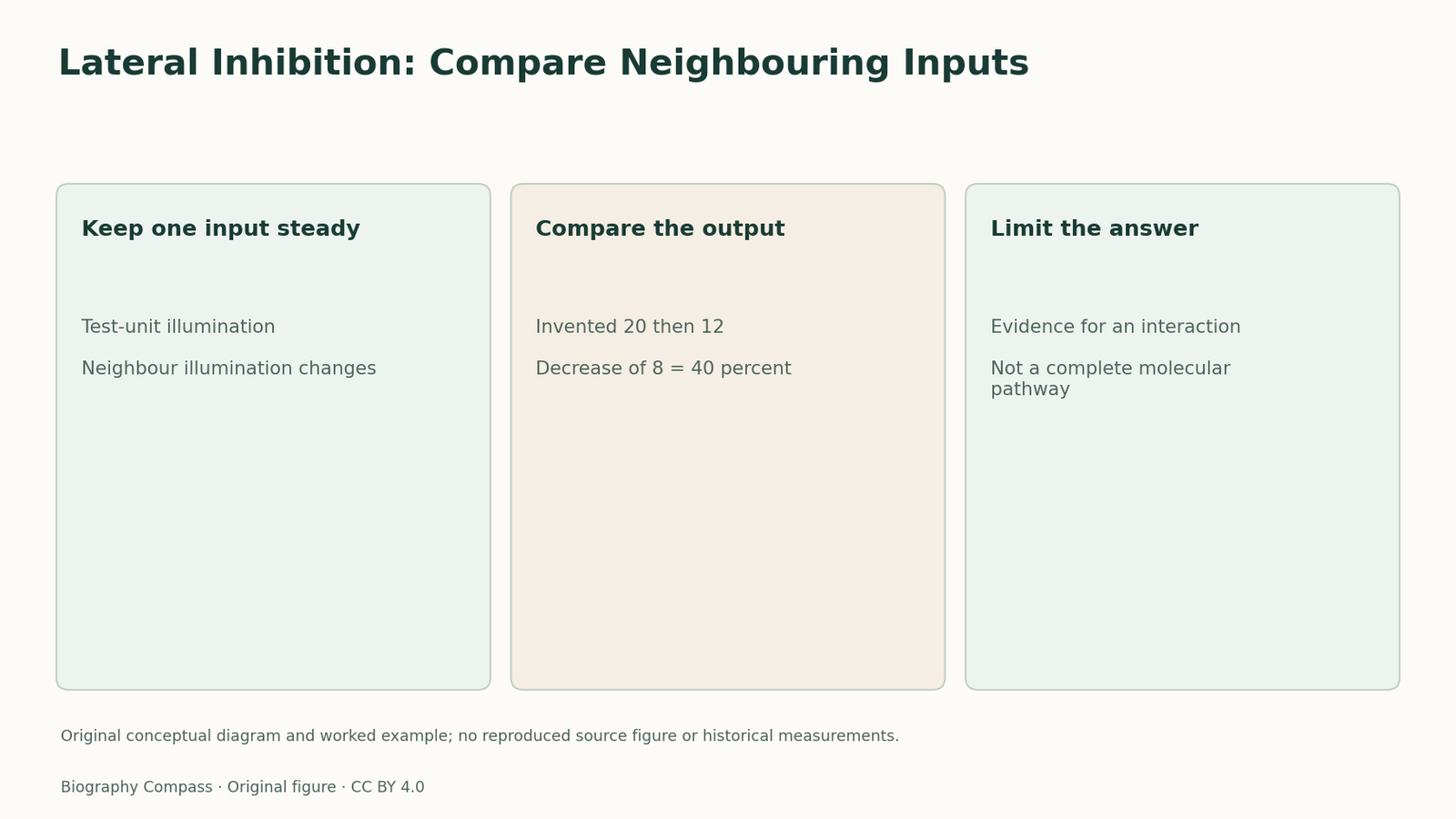
Consider invented records for one test unit. Its direct illumination is unchanged. With neighbouring units dark, its discharge is twenty counts per chosen interval; with neighbours lit, it is twelve. The decrease is eight counts, or forty percent of the first value. What supports a neighbour effect? The unchanged direct input makes the surrounding illumination the relevant contrast in this simplified record. The figures are not historical measurements. If direct illumination also changed between observations, the same arithmetic would remain correct but the explanation would be less specific, because two inputs had changed together.
What the arithmetic cannot establish
The fictional forty-percent difference does not identify a transmitter, prove a molecular pathway or show that all visual systems use the same arrangement. Nor does it imply that less discharge always means less perceived brightness in a human observer. Its value is to connect a response difference with a clearly stated input difference. Read the related Wald topic for a complementary question: visual pigment chemistry concerns molecular changes associated with light, whereas Hartline’s experiment concerns interactions among responding units. They belong to visual science together, but an explanation of one should not be offered as proof of the other.
Continue the chronology
Related history guides
Biography context
Explore United States through connected lives
Connected biographies
Researchers and related approaches
1903–1983
H. Keffer Hartline
Visual physiologist and biophysicistExplore Haldan Keffer Hartline’s training, single-fibre visual research and work with Wagner and Ratliff on inhibition in the horseshoe-crab eye.Read biography
1926–2013
David H. Hubel
Neurophysiologist and visual-cortex researcherDavid H. Hubel was a Canadian-born neurophysiologist whose collaboration with Torsten Wiesel changed the study of visual processing. Their experiments asked how particular cells respond to the position, shape and orientation of a visual stimulus.Read biographyQuick answers
Common questions
- Are the twenty and twelve counts historical results?
- No. They are an original arithmetic example.
- Did the 1956 paper identify the complete inhibitory mechanism?
- No. Its abstract explicitly separated the observed interaction from an unresolved mechanism.
Primary and institutional sources
How this history was checked
The references below distinguish the original study from later explanations. The worked exercise and comparison are newly written for this article. This article was reviewed on 8 November 2026.